
Lê Hồng Phong (1902–1942), born Lê Huy Doãn, was a leading figure in the Indochinese Communist Party during the struggle for national independence. Having carried out revolutionary work in China, the Soviet Union and Vietnam, he served as General Secretary from March 1935 to July 1936. In his final years, the French colonial authorities deported him to Côn Đảo, where he endured a harsh prison regime and died on 6 September 1942, his 40th birthday.
Today, General Secretary Lê Hồng Phong’s grave in Section A of Hàng Dương Cemetery is one of Côn Đảo’s important memorial sites. His life was closely linked to major changes in the Vietnamese revolutionary movement during the first half of the 20th century, and left accounts of steadfastness and an unyielding spirit within the Côn Đảo prison system.
Who was Lê Hồng Phong?
Lê Hồng Phong’s birth name was Lê Huy Doãn. He was born on 6 September 1902 in Đông Thôn village, Thông Lãng canton, Hưng Nguyên prefecture, Nghệ An province, in what is now the Hưng Nguyên area.
He was born into a poor farming family in a rural area with a tradition of valuing education and patriotism.
As a child, Lê Huy Doãn learned classical Chinese characters and the Vietnamese quốc ngữ script. After completing elementary schooling, difficult family circumstances forced him to leave his home village at an early age to find work and help support his family.
He went to the city of Vinh, worked at manufacturing establishments, and later became a worker at the Bến Thủy Match Factory.
In the early 20th century, Vinh and Bến Thủy formed one of central Vietnam’s important industrial centers. Large numbers of workers were employed in factories, workshops, the port and businesses managed by the French or private employers.
This working environment brought Lê Hồng Phong into direct contact with workers’ difficult lives and the injustices of colonial society.
While working at the Bến Thủy Match Factory, he helped mobilize workers to demand better working conditions.
These activities led to his dismissal by the employers, but also marked an important transition from a young worker to an active participant in the patriotic movement.
From this point, Lê Hồng Phong began seeking a path to revolutionary work abroad.
From Nghệ An to China: The first steps on a revolutionary path
In late 1923 and early 1924, Lê Hồng Phong, Phạm Hồng Thái and several other patriotic young people secretly left Vietnam for Siam, present-day Thailand, before continuing to Guangzhou, China.
At the time, Guangzhou was an important base of activity for many Vietnamese revolutionaries.
There, Lê Hồng Phong joined Tâm Tâm Xã, an organization established by patriotic young Vietnamese people to oppose colonial rule and seek a path to national liberation.
Tâm Tâm Xã brought together patriots willing to sacrifice their personal interests to take part in political activities.
Although still limited in its political direction and organizational methods, Tâm Tâm Xã helped shape a generation of young revolutionaries with a strong determination to struggle.
While working in Guangzhou, Lê Hồng Phong had the opportunity to meet Nguyễn Ái Quốc and receive guidance in revolutionary theory and methods.
This was a turning point that profoundly influenced his political thinking and subsequent activities.
Beginning with patriotic convictions, Lê Hồng Phong gradually became acquainted with Marxism-Leninism and joined revolutionary organizations with more clearly defined directions and objectives.
Years of military and political study in China and the Soviet Union
Lê Hồng Phong was among the early Vietnamese revolutionary cadres to receive a relatively comprehensive education in military affairs, politics and theory.
Between 1924 and 1926, he studied at the Whampoa Military Academy in Guangzhou.
This was a renowned Chinese military training institution of the period, where many patriotic young Vietnamese people studied.
In 1926, Lê Hồng Phong continued on to the Soviet Union.
There, he attended military and political training programs, including a military school in Leningrad and an aviation school in Borisoglebsk.
His training in military aviation is a distinctive feature of Lê Hồng Phong’s biography.
Official accounts record that he joined the Soviet Red Army and describe him as one of the first Vietnamese people trained for and serving in its air force.
In late 1928, he continued his studies at the Communist University of the Toilers of the East in Moscow, an institution of the Communist International that trained revolutionary cadres from around the world.
In the Soviet Union, Lê Hồng Phong used various aliases for his studies and clandestine activities.
His education enabled him to build knowledge of theory, organizational methods and political mobilization.
These also provided important foundations for the leadership role he would play in rebuilding the Indochinese Communist Party’s organization in the following years.
Lê Hồng Phong’s role in rebuilding the Party organization
After the revolutionary upsurge of 1930–1931, particularly the Nghệ-Tĩnh Soviet movement, the French colonial authorities launched a severe crackdown on revolutionary organizations in Vietnam.
Many leaders and Party members were arrested, operational bases were dismantled, and communications between organizations inside and outside the country faced considerable difficulties.
In these circumstances, rebuilding the Party organization became particularly urgent.
In late 1931, Lê Hồng Phong returned to China to carry out revolutionary work.
He sought to establish contact with revolutionary bases in Vietnam, bring forces together and restore the organizational network.
In 1934, the Overseas Leadership Committee of the Indochinese Communist Party was established in Macau, with Lê Hồng Phong in a leading role.
The Overseas Leadership Committee was tasked with reestablishing contacts, strengthening the organization and preparing the conditions needed to convene the Party’s First National Congress.
Lê Hồng Phong’s work during this period made an important contribution to restoring the leadership system and rebuilding organizations after the period of repression.
This was one of his most notable contributions to the history of the Indochinese Communist Party.
Lê Hồng Phong elected General Secretary in 1935
From 27 to 31 March 1935, the First National Congress of the Indochinese Communist Party was held in Macau, China.
The Congress took place clandestinely, while many cadres and organizations in Vietnam remained subject to surveillance and repression by the colonial authorities.
At the Congress, Lê Hồng Phong was elected General Secretary of the Indochinese Communist Party.
He held this position from March 1935 to July 1936.
His election to the highest leadership position reflected the standing he had gained through building and restoring the Party organization.
During this period, he continued promoting efforts to strengthen the organizational network and expand contacts between bases inside Vietnam and the overseas organization.
These activities took place as the Vietnamese revolutionary movement had to adapt to numerous changes in the international situation and colonial policies.
Attending the Seventh Congress of the Communist International
In July 1935, Lê Hồng Phong led the Indochinese Communist Party delegation to the Seventh Congress of the Communist International in Moscow.
The delegation included several Vietnamese revolutionary cadres, among them Nguyễn Thị Minh Khai and Hoàng Văn Nọn.
The Seventh Congress was a major political event for the international communist movement in the 1930s.
At the Congress, Lê Hồng Phong was elected a member of the Executive Committee of the Communist International.
This recognized his role and activities in the communist movement in Indochina.
After the Congress, Lê Hồng Phong continued to undertake important political responsibilities, helping direct organizational work and maintain contact with the revolutionary movement in Vietnam.
Returning to Saigon and continuing revolutionary work
In November 1937, Lê Hồng Phong secretly returned to Vietnam, working in Saigon and other parts of Cochinchina under the alias La Anh.
This was a period when the democratic movement in Indochina developed through open, semi-open and clandestine forms of struggle.
Lê Hồng Phong undertook organizational, ideological and journalistic work, helping mobilize the population and strengthen the movement’s forces.
He wrote many political commentaries, helped explain the Party’s line and policies, and challenged views that the organization considered unsuited to the revolutionary situation.
During these years, the press became an important means of spreading ideas and mobilizing society.
Through his journalism, Lê Hồng Phong helped bring political issues, workers’ interests and demands for democracy to a broad public.
In March 1938, he attended the Central Committee Conference in Hóc Môn, Gia Định.
His activities in Cochinchina continued to demonstrate his role not only in organization but also in theoretical work and political mobilization.
Lê Hồng Phong and Nguyễn Thị Minh Khai
Lê Hồng Phong’s life was also closely connected with the revolutionary Nguyễn Thị Minh Khai.
Both spent time working and studying abroad, participated in the international revolutionary movement, and later continued their activities in Vietnam.
Nguyễn Thị Minh Khai was a leading woman in the Vietnamese revolutionary movement before 1945.
They had a daughter, Lê Nguyễn Hồng Minh.
Clandestine work and repeated arrests caused many separations in their family life.
In 1941, Nguyễn Thị Minh Khai was executed by the French colonial authorities in Hóc Môn, while Lê Hồng Phong was imprisoned on Côn Đảo.
Only a year later, Lê Hồng Phong also died in prison.
The family story of these two revolutionaries reflects the personal losses experienced by many political activists during the struggle against colonial rule.
Two arrests and the sentence that sent Lê Hồng Phong to Côn Đảo
On 22 June 1939, Lê Hồng Phong was arrested by the French colonial authorities in the Saigon–Chợ Lớn area.
He was sentenced to six months in prison and three years of restricted residence under surveillance.
After serving his prison term, he was sent back to Nghệ An for restricted residence under the supervision of the colonial authorities.
Despite restrictions on his movement and communications, he continued seeking ways to remain active, write for the press and stay in contact with like-minded people.
In January 1940, Lê Hồng Phong was arrested for a second time and detained at Saigon Central Prison.
During his imprisonment, he continued to undergo interrogation and investigation and faced repressive measures from the authorities.
On 22 October 1940, he was sentenced to five years of hard labor.
In late 1940, the French colonial authorities sent Lê Hồng Phong to Côn Đảo.
From this point, his life entered its final phase in one of the harshest prison systems in Indochina.
Lê Hồng Phong in Côn Đảo Prison
By the time Lê Hồng Phong was exiled to the island, Côn Đảo had become a place of imprisonment for many patriots, communist Party members and participants in movements against colonial rule.
The prison system was divided into numerous detention areas, including communal cells, isolated compounds, solitary cells and forced-labor facilities.
The prison regime was especially harsh toward people considered politically influential or capable of organizing resistance.
As a senior leader of the Indochinese Communist Party, Lê Hồng Phong attracted the authorities’ attention and was subjected to particularly strict detention measures.
Historical accounts record that he was held in solitary confinement, frequently beaten, subjected to restrictions on daily activities, and made to endure inadequate food and sanitation.
Even in these circumstances, however, Lê Hồng Phong remained concerned for his fellow prisoners.
He helped encourage prisoners’ morale, opposed harsh treatment and maintained his political convictions.
Banh II and Solitary Cell No. 5
One site particularly associated with Lê Hồng Phong’s final years is Banh II, also called Lao II, now part of the Phú Sơn Prison heritage site.
This was an important part of the Côn Đảo prison system under French colonial rule.
Banh II contained cell blocks and solitary cells used to control prisoners considered dangerous or in need of isolation.
According to historical accounts, Lê Hồng Phong was placed in Solitary Cell No. 5 in the special detention area.
The cramped isolation cell, lack of light, limited ventilation and harsh daily regime seriously damaged prisoners’ health.
Prolonged imprisonment, beatings and a lack of medical care gradually depleted Lê Hồng Phong’s physical strength.
Solitary Cell No. 5 became a particularly significant place in accounts of his life on Côn Đảo.
The story of the “bowl of rice soaked in blood” and a communist’s fortitude
One of the stories recounted in many historical works about Lê Hồng Phong on Côn Đảo is the episode commonly known as the “bowl of rice soaked in blood”.
According to accounts of the Côn Đảo prison regime, on one occasion guards beat Lê Hồng Phong while he was eating, causing blood from his head and face to drip into his rice bowl.
Despite his pain, he tried to remain calm and continued eating.
Fellow prisoners remembered this scene as an expression of his refusal to yield to abuse.
Memorial accounts also quote fellow prisoners’ observation that swords and spears could cut through iron and steel but had to bend before a communist’s courage.
The story shows how fellow prisoners regarded Lê Hồng Phong’s character under exceptionally harsh circumstances.
It does not deny the physical pain he suffered, but describes an effort to protect his dignity and maintain his spirit in captivity.
Historical studies and memoirs about Côn Đảo have preserved this story as part of the memory of political prisoners.
Lê Hồng Phong’s final days on Côn Đảo
After prolonged torture and imprisonment in deprived conditions, Lê Hồng Phong’s health deteriorated severely.
He contracted dysentery, a particularly dangerous disease where sanitation and medical care are inadequate.
Accounts record that he did not receive sufficient treatment, while prisoners trying to obtain medicine for him also encountered many obstacles.
Prolonged illness and injuries inflicted by the prison regime left him increasingly exhausted.
At noon on 6 September 1942, General Secretary Lê Hồng Phong died in Solitary Cell No. 5, Banh II, Côn Đảo Prison.
The day of his death was also his 40th birthday.
The coincidence of his birth and death dates became a distinctive milestone in accounts of his life.
His message before his death
Historical accounts and commemorative articles record Lê Hồng Phong’s final message as an affirmation of his belief in the revolution’s victory.
He asked his comrades to convey to the Party organization that, until his final moment, he remained confident in the revolution’s glorious victory.
That message reflects Lê Hồng Phong’s steadfast political ideals, from his years of work in China and the Soviet Union to his return to Vietnam and his final days on Côn Đảo.
He died while the country remained under colonial rule, without witnessing the victory of the August Revolution in 1945.
However, his contributions to organization, building forces and leading the movement became an important part of the course of Vietnam’s revolutionary history.
Where is General Secretary Lê Hồng Phong’s grave on Côn Đảo?
General Secretary Lê Hồng Phong’s grave is in Section A of Hàng Dương Cemetery, Côn Đảo.
Hàng Dương Cemetery is the resting place of thousands of patriots, revolutionary fighters and prisoners who died during different periods of the prison’s history.
According to Hàng Dương Cemetery’s official visitor information, Section A mainly contains the graves of people who died before 1945.
This area also contains the graves of patriot Nguyễn An Ninh and People’s Armed Forces Hero Vũ Văn Hiếu.
Lê Hồng Phong’s grave has been constructed, preserved and maintained within the cemetery’s solemn setting.
Commemorative activities usually include laying flowers, offering incense and recalling his life and revolutionary career.
For visitors to Côn Đảo, Lê Hồng Phong’s grave is an important stop in learning about the history of political prisoners’ struggles.
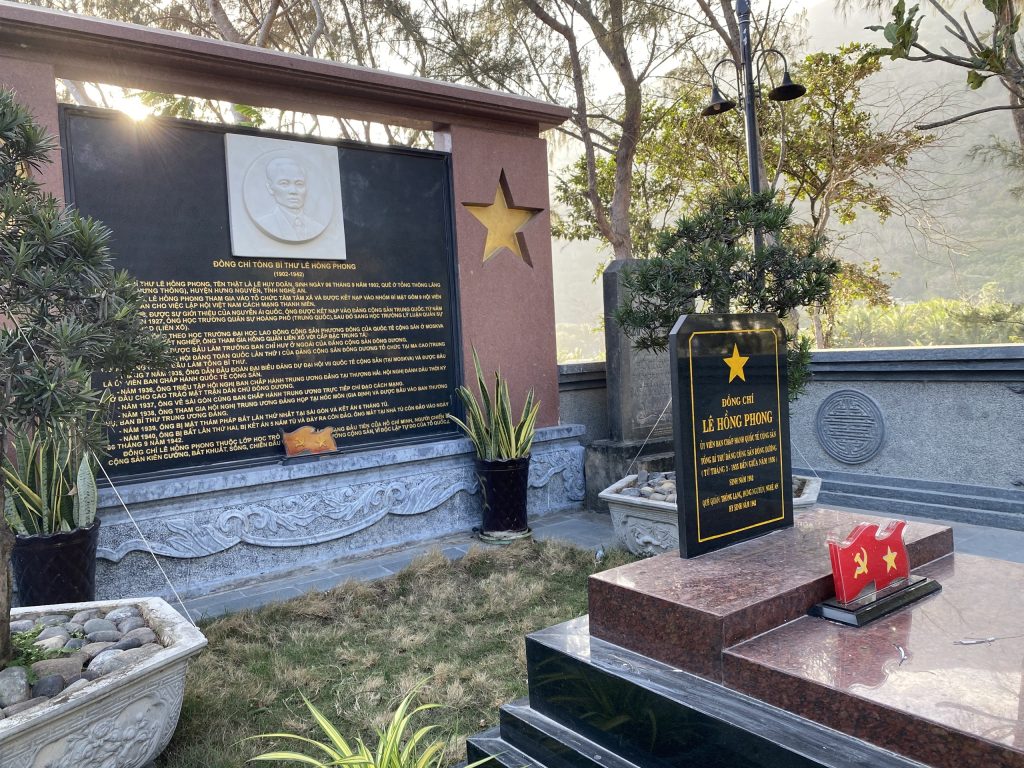
The significance of the grave at Hàng Dương
Lê Hồng Phong’s grave is more than the resting place of a senior leader.
It is also a direct trace of a period when Côn Đảo was used to imprison and suppress opponents of colonial rule.
Alongside the prison compounds, solitary cells, tiger cages and forced-labor sites, Hàng Dương Cemetery helps visitors better understand the living conditions and losses experienced by generations of prisoners.
Every grave here is associated with an individual fate and story.
Lê Hồng Phong’s case is distinctive because his life took him to many centers of international revolutionary activity, but ended in solitary confinement in Côn Đảo Prison.
From a young worker in Bến Thủy, he became a revolutionary activist and Party leader, then died on an island far from the mainland.
His journey reflects the profound upheavals in the lives of a generation of Vietnamese political activists in the first half of the 20th century.
Commemorating General Secretary Lê Hồng Phong
Each year, 6 September on the Gregorian calendar marks both the anniversary of General Secretary Lê Hồng Phong’s birth and the commemoration of his death.
This is an occasion for agencies, organizations and the public to recall his life, career and contributions to the Vietnamese revolutionary movement.
On Côn Đảo, commemorations are usually held at Hàng Dương Cemetery and related historical sites.
On 6 September 2026, Côn Đảo’s authorities and residents held a ceremony marking the 124th anniversary of Lê Hồng Phong’s birth and the 84th anniversary of his death.
As part of the program, delegates offered incense and flowers at his grave in Section A of Hàng Dương Cemetery, and commemorative activities were also held at Côn Đảo Memorial Temple.
This is one of the activities that help pass on historical traditions and preserve local historical memory.
The schedule of commemorative ceremonies may vary each year according to the plans of the managing agencies and Côn Đảo’s authorities.
Visitors wishing to attend should check official information before their trip.
A guide to visiting Lê Hồng Phong’s grave and the historical sites
When visiting Côn Đảo, travelers can combine paying their respects at General Secretary Lê Hồng Phong’s grave with a tour of historical sites.
1. Hàng Dương Cemetery
Lê Hồng Phong’s grave is located in Section A of this cemetery.
Visitors can explore the cemetery grounds, its different sections and the historical figures laid to rest here.
When visiting, follow the managing authority’s instructions, maintain quiet and show respect for the deceased.
2. Phú Sơn Prison
Phú Sơn Prison is associated with Banh II, one of the long-established detention facilities in the Côn Đảo prison system.
This site helps visitors learn more about Lê Hồng Phong’s final years, particularly detention conditions and solitary confinement under French colonial rule.
3. Phú Hải Prison and other prison heritage sites
Phú Hải Prison, together with Phú Sơn Prison and other detention facilities, illustrates the establishment, expansion and operation of the Côn Đảo prison system.
Visiting these sites gives those interested in history a fuller understanding of the circumstances in which political prisoners were held.
4. Côn Đảo Memorial Temple
Côn Đảo Memorial Temple is a place of remembrance for patriots and revolutionary fighters who lost their lives during the prison’s history.
Visitors can combine a visit to the temple with Hàng Dương Cemetery, depending on their time and itinerary.
Visitor guidance
Hàng Dương Cemetery and Côn Đảo’s historical sites have their own rules for visits, incense offerings and organized groups.
Visitors should dress respectfully, keep the grounds clean, avoid making noise, refrain from placing offerings in unauthorized locations, and follow the instructions of heritage-site staff.
Groups wishing to explore the history of Côn Đảo Prison in greater depth can enrich their visit by using the sites’ interpretation services.
Lê Hồng Phong’s contributions to Vietnamese history
Although Lê Hồng Phong lived only 40 years, his life was connected with many important milestones in Vietnam’s revolutionary history.
First, he belonged to a generation of patriotic young people who sought opportunities for activity abroad at an early stage, encountering new revolutionary ideas and organizational methods.
His studies in China and the Soviet Union enabled him to acquire military, political and theoretical knowledge that laid the foundations for his leadership work.
Lê Hồng Phong’s most notable contribution was his role in restoring the Indochinese Communist Party’s organizational network after the severe repression of the early 1930s.
He helped establish the Overseas Leadership Committee, prepare the First National Congress, and served as General Secretary in 1935–1936.
Alongside his organizational work, he made many contributions in journalism, ideological work and mass mobilization.
After returning to Vietnam, Lê Hồng Phong continued participating in the democratic movement in Cochinchina, helping expand its forces and strengthen political activity.
His final years of imprisonment on Côn Đảo became an important part of his historical image.
Research and commemorative works hold Lê Hồng Phong’s steadfastness in the face of exceptionally harsh prison conditions in high regard.
Today, many schools, streets and public facilities throughout Vietnam bear his name.
These are ways of remembering the contributions of a figure who played an important role in the Vietnamese revolutionary movement before 1945.
Lê Hồng Phong and Côn Đảo’s historical memory
Côn Đảo is now known for its beaches, primary forests, natural scenery and marine and island tourism routes.
However, the history of its prison system remains an important part of what gives this destination its distinctive significance.
When exploring Côn Đảo, Lê Hồng Phong’s life helps visitors connect events across Vietnam with the historical traces still present on the island.
A man who had worked in Guangzhou, Moscow, Saigon and many other places ultimately spent his final years in a solitary cell on Côn Đảo.
His story shows the broad reach of the Vietnamese revolutionary movement before 1945, while also reflecting the fate of those imprisoned by the colonial authorities for political activity.
In Hàng Dương Cemetery, Lê Hồng Phong’s grave stands within a memorial landscape for thousands of people who died.
Alongside figures whose names are recorded in history are many graves whose occupants remain unidentified.
Visiting these sites is not only a way to learn about prominent individuals, but also to gain a fuller understanding of a historical period marked by great sacrifice and loss.
On 6 September 1942, Lê Hồng Phong died at the age of 40 in Côn Đảo Prison. More than eight decades later, his grave in Hàng Dương Cemetery remains a place preserving the memory of a revolutionary leader and years of struggle behind prison walls.
References
Books
- The Seven Late General Secretaries of the Communist Party of Vietnam Live Forever with Us!, Thời Đại Publishing House, 2010, pp. 89–129.
- A History of the Struggles of Patriotic and Revolutionary Fighters in Côn Đảo Prison (1862–1975), National Political Publishing House, 2010, p. 198.
- Côn Đảo: Chronicles and Documents, Political Prisoners’ Liaison Committee, Department of Culture and Information, Trẻ Publishing House, Ho Chi Minh City, 1996, pp. 186–187.
Additional cross-reference sources
- Vietnam National Museum of History: Temptation Could Not Buy Off the Communist Fighter Lê Hồng Phong.
- Nhân Dân newspaper: An Outstanding and Steadfast Leader of the Party.
- Party Documents Archive: Chronology of the First National Congress.
- Hàng Dương Cemetery: Historical Information and Grave Sections.
- Ho Chi Minh City Party Committee Information Portal: Côn Đảo Special Zone Commemorates the 84th Anniversary of General Secretary Lê Hồng Phong’s Death.