
In the history of the revolutionary struggle at Côn Đảo, 23 January 1952 is associated with the death of the heroine Võ Thị Sáu. On that same day, the French colonial authorities also executed a young revolutionary from Vĩnh Long: Hồ Văn Năm, known by the alias Năm Đen.
Over the decades, Hồ Văn Năm’s story has been preserved in historical studies and the memories of former Côn Đảo prisoners. He is remembered not only for dying on the same day as Võ Thị Sáu, but also for his revolutionary work, his fortitude during interrogations and his composure in the face of a death sentence.
Today, the grave of the fallen hero Hồ Văn Năm lies at Hàng Dương Cemetery, near that of Hero Võ Thị Sáu, and is a place to commemorate those who died in the nation’s struggle for independence.
Who was the fallen hero Hồ Văn Năm?
Hồ Văn Năm was a revolutionary from Vĩnh Long Province, active during the resistance against French colonial rule. Different documents also refer to him as Năm Đen, Năm Em or Thu Đen.
According to cited material from Historical Figures of Vĩnh Long Province, published in 2017, he was born in 1930 in Long Châu village, Châu Thành district, Vĩnh Long Province. His father was Hồ Văn Giỏi and his mother was Huỳnh Thị Búp. He came from a poor working family.
Other sources on Côn Đảo’s history, including Legends of Côn Đảo and materials from the Côn Đảo National Relics Conservation Centre, record his birth year as 1934 and his hometown as Trà Ôn district, Vĩnh Long Province.
Although the sources differ on his birth year and precise birthplace, they all identify Hồ Văn Năm as a young revolutionary from Vĩnh Long who was sentenced to death by the French colonial authorities and executed by firing squad at Côn Đảo on 23 January 1952.
From Vĩnh Long’s revolutionary movement to the resistance forces
Born and raised while the country was under French colonial domination, Hồ Văn Năm encountered the patriotic movement in his home region at an early age.
According to Vĩnh Long historical records, in 1945, as the August Revolution spread, he joined the Youth for National Salvation organization and demonstrations to seize power in the provincial capital of Vĩnh Long.
After French colonial forces returned to occupy Vĩnh Long, he continued participating in the resistance militia.
His knowledge of the local terrain led to assignments in enemy-controlled areas. He later worked with the volunteer commando unit of the 109–111 Inter-Regimental Operations Committee.
This was a period of fierce resistance in southern Vietnam, involving numerous armed forces and local revolutionary networks.
In these activities, Hồ Văn Năm is described as a resourceful, courageous fighter who repeatedly joined his comrades in propaganda work, building support networks and confronting opposing forces.
The assistance and protection of local residents were important factors enabling him to continue working while being pursued.
Arrest in 1950 and a death sentence
In October 1950, Hồ Văn Năm was arrested by the French colonial authorities while on an assignment.
According to accounts of his life, during his detention the colonial authorities repeatedly interrogated him, offered inducements and tortured him to obtain information about the revolutionary organization.
However, Hồ Văn Năm is recorded as having remained resolute, withholding the information demanded by his opponents and accepting responsibility for his own activities.
Following the investigation, he was tried before a criminal court and sentenced to death.
He was held at Saigon’s Central Prison while awaiting execution, then transferred to Côn Đảo Prison.
In the imprisonment records cited in historical sources, Hồ Văn Năm’s prisoner number was G248.
For prisoners sentenced to death, transfer to Côn Đảo meant spending their final days in the colonial regime’s notoriously harsh prison system.
Sources and the recollections of his contemporaries continue to describe his calm and unyielding spirit there.
The ship that brought Hồ Văn Năm to Côn Đảo on 21 January 1952
On 21 January 1952, the French colonial authorities arranged a ship to transport prisoners from the mainland to Côn Đảo.
According to the cited historical documents, the ship carried 40 prisoners, including two under sentence of death: Hồ Văn Năm and Võ Thị Sáu.
Both were very young when brought to Côn Đảo, where tens of thousands of patriots and revolutionaries were imprisoned throughout the colonial period.
Just two days after the voyage, they were taken to the execution ground.
The events of 23 January 1952 became a remembered milestone in the history of Côn Đảo Prison, associated with two young revolutionaries who died on the same day.
23 January 1952: Hồ Văn Năm dies at Côn Đảo
On the morning of 23 January 1952, corresponding to the 27th day of the twelfth lunar month in the Tân Mão year, the French colonial authorities took Hồ Văn Năm to the execution ground at Côn Đảo.
On the same day, the female revolutionary Võ Thị Sáu was also executed by firing squad.
Accounts of Hồ Văn Năm’s final moments state that he remained composed as he walked to the place of execution.
According to accounts preserved in historical sources, before his death he bade farewell to his comrades and compatriots and expressed his belief in a peaceful, unified Vietnam.
Sources recount his last words with some variations in wording, but all convey the young revolutionary’s resilience and conviction.
Hồ Văn Năm’s death at such a young age left a deeply moving memory among those who lived through the period of struggle at Côn Đảo.
He is remembered alongside Võ Thị Sáu not only because they died on the same day, but also for their shared fighting spirit and resolve in the face of a death sentence.
The story of his final hours in prison
Alongside information about his revolutionary activities and death, some recollections of former Côn Đảo prisoners preserve a very personal story about Hồ Văn Năm.
In journalist Nguyễn Văn Minh’s article “Hồ Văn Năm: The Man Who Went to the Execution Ground with Võ Thị Sáu,” published in the weekend edition of the People’s Army newspaper in 2008 and subsequently featured in Legends of Côn Đảo, his final hours are recounted in moving detail.
According to former prisoners, on the night before his execution, Hồ Văn Năm tried to finish a small portrait on a piece of mother-of-pearl, intended for a young woman close to him during his activities in his home region.
The story has been passed down as a memory of the young revolutionary’s emotional life.
Amid imprisonment and approaching death, he still devoted his final thoughts to loved ones, comrades and the memories of his life.
This detail comes from witness recollections and historical articles. It should be understood as a story handed down, rather than an event fully corroborated by archival records.
Even so, it helps portray Hồ Văn Năm not only through his courage, but also through the feelings and everyday hopes of a young man in wartime.
Where is Hero Hồ Văn Năm’s grave on Côn Đảo?
Today, the grave of the fallen hero Hồ Văn Năm is in Section B of Hàng Dương Cemetery, Côn Đảo, near the grave of Hero Võ Thị Sáu.
Hàng Dương Cemetery is one of the island’s most important historical sites and places of remembrance, the resting place of many revolutionaries, patriots and people imprisoned in the Côn Đảo Prison system.
Among its well-known graves are those of Võ Thị Sáu, Lê Hồng Phong, Nguyễn An Ninh, Hồ Văn Năm and many other historical figures.
For visitors to Hàng Dương Cemetery learning about Võ Thị Sáu, Hồ Văn Năm’s grave is also worth taking time to visit and honour.
The two nearby graves recall the events of 23 January 1952 and the lives that ended in the history of the colonial prison.
Visitors should remain quiet, dress appropriately and respect the cemetery’s commemorative setting.
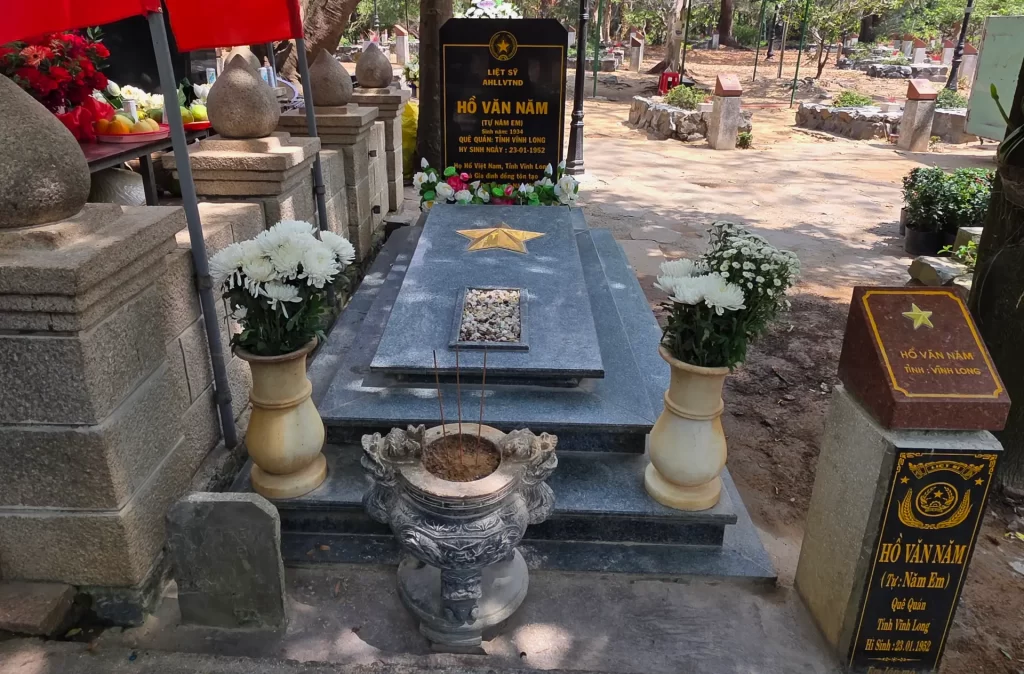
Hồ Văn Năm is posthumously awarded the title of Hero of the People’s Armed Forces
On 21 October 2014, the President posthumously awarded Hồ Văn Năm the title of Hero of the People’s Armed Forces.
This recognized his contributions and fighting spirit in the resistance against French colonial rule.
The posthumous award also helped bring Hồ Văn Năm’s story closer to the public, particularly younger generations learning about Côn Đảo’s history.
During commemorations at Hàng Dương Cemetery, Hồ Văn Năm’s name is often mentioned alongside Võ Thị Sáu and other revolutionaries who died during the struggle against French colonial rule.
In 2017, during a working visit and incense-offering ceremony at Hàng Dương Cemetery, Vice President Đặng Thị Ngọc Thịnh also visited the graves of the two Heroes of the People’s Armed Forces, Võ Thị Sáu and Hồ Văn Năm.
These commemorative activities express respect for the people who helped shape the nation’s history of struggle.
Remembering Hồ Văn Năm while exploring Côn Đảo’s history
When Côn Đảo Prison is mentioned, many people immediately think of well-known sites such as Phú Hải Prison, Phú Sơn Prison, the Tiger Cages or Hàng Dương Cemetery.
Behind each site, however, are stories of people with lives, families, dreams and choices made during a turbulent historical period.
Hồ Văn Năm was one of those people.
From a young man in Vĩnh Long who joined the revolutionary movement, he went through years of resistance activity, arrest and a death sentence, ultimately dying at Côn Đảo on 23 January 1952.
His life is preserved in research, the memories of his contemporaries and his grave at Hàng Dương Cemetery.
Today, alongside visiting the historical sites and learning about Võ Thị Sáu, visitors to Côn Đảo can spend additional time discovering the story of the fallen hero Hồ Văn Năm.
This is also a way to understand more deeply the history of a place once known for imprisoning patriots, while honouring those who gave their lives for Vietnam’s independence.
References
- Historical Figures of Vĩnh Long Province, Vĩnh Long Provincial Party Executive Committee, National Political Publishing House – Truth, Hanoi, 2017, pp. 206–207.
- Thiên Vũ and Võ Huy Quang, Portraits of Death-Row Prisoners in the History of the Struggle to Defend the Country, 1858–1975, volume 1, Văn Nghệ Publishing House, 2001, p. 147.
- Legends of Côn Đảo, Thông Tấn Publishing House, 2013, article on the martyr Hồ Văn Năm.
- Côn Đảo National Relics Conservation Centre, materials commemorating the deaths of Hero Võ Thị Sáu and Hero Hồ Văn Năm.
- Vietnam News Agency, report on the incense-offering ceremony at Hàng Dương Cemetery on 13 July 2017.