
Hero of the People’s Armed Forces Vũ Văn Hiếu (1907–1942) was the first secretary of the special-zone Party committee of the Quảng Ninh mining region and a prominent revolutionary twice exiled to Côn Đảo by the French colonial authorities. He died at Côn Đảo Prison on 26 April 1942, aged just 35. The story of his giving his shirt to his comrade Lê Duẩn in his final days has become a powerful symbol of comradeship and revolutionary sacrifice.
Who was Vũ Văn Hiếu?
Vũ Văn Hiếu, born Vũ Đình Hiếu, was born on 20 March 1907 in Quần Phương Thượng commune, Hải Hậu district, Nam Định Province, now part of Hải Anh commune, Ninh Bình Province.
Born into a farming family, he showed a love of learning and determination from childhood. At 14, he completed the Franco-Vietnamese primary curriculum, then went to Hải Phòng to continue studying, work and seek opportunities to develop himself.
In 1925–1926, the patriotic movement and revolutionary organizations grew strongly, notably with the establishment of the Vietnamese Revolutionary Youth League. Through exposure to progressive ideas, Vũ Văn Hiếu gradually developed revolutionary awareness and chose the path of struggle for national liberation.
In 1928, he went to work in the Hà Tu and Hòn Gai mining area. The miners’ hard labour and the injustice they endured brought him closer to the labour movement and revolutionary activity.
The first special-zone Party secretary of the Quảng Ninh mining region
In November 1929, Vũ Văn Hiếu joined the Indochinese Communist Party (Đông Dương Cộng sản Đảng), adopting the alias Sơn. He was tasked with building and expanding revolutionary networks in Hà Tu, Núi Béo and neighbouring areas.
Through his approachable manner, perseverance and organizing ability, he and his comrades encouraged workers to resist harsh exploitation and demand higher wages, shorter working hours and better conditions.
In April 1930, Vũ Văn Hiếu became secretary of the Hòn Gai–Cẩm Phả mining Party committee. Under the Party organization’s leadership, the labour movement in the mining region continued to grow.
In particular, for International Workers’ Day on 1 May 1930, numerous propaganda activities, leaflet distributions, flag displays and mobilization efforts were organized in Hòn Gai, Cẩm Phả, Hà Tu and other coal-mining areas.
In late October 1930, the Party organization of the Đông Triều–Hòn Gai–Cẩm Phả mining special zone was established. Vũ Văn Hiếu was appointed its secretary, becoming the first secretary of the special-zone Party committee of the Quảng Ninh mining region.
He was only 23, yet had taken on the responsibility of leading the revolutionary movement in one of Vietnam’s important industrial centres.
His first arrest and exile to Côn Đảo Prison
On 9 February 1931, Vũ Văn Hiếu was arrested by the French colonial authorities at the Party committee office in the Cẩm Phả–Cửa Ông area.
During detention, he endured repeated interrogation and torture intended to force him to reveal information about the revolutionary organization. However, he remained determined to protect his comrades and their networks.
On 13 May 1931, the colonial authorities tried him before the Hanoi Criminal Commission alongside other cadres and Party members. He was sentenced to 20 years’ imprisonment and later exiled to Côn Đảo.
At Côn Đảo Prison, Vũ Văn Hiếu was held in Banh II, which contained many political prisoners, including Nguyễn Văn Cừ and Hoàng Quốc Việt.
Despite harsh detention conditions, he continued participating in struggles to improve prison life while helping maintain study and political discussion among the prisoners.
His knowledge of French and clear handwriting led to his being entrusted with preserving documents, copying them and translating some works of political theory from French into Vietnamese for prison study.
With paper, pens and books scarce and surveillance constant, these materials were particularly important to the political prisoners’ intellectual life.
For Vũ Văn Hiếu, prison was not only a test of endurance, but also a place where he and his comrades could continue studying, exchanging ideas and maintaining faith in their chosen path.
Release and renewed revolutionary activity
In November 1936, amid the growth of the democratic movement and political changes in France, Vũ Văn Hiếu was released with many other political prisoners.
Returning to the mainland after more than five years in prison, he quickly re-established contact with the organization and resumed activities in Hanoi and other localities in northern and central Vietnam.
He was later transferred to the South and helped direct Đông Phương tạp chí, a publication associated with the democratic movement and revolutionary organizations’ propaganda work.
In November 1939, he was put in charge of the Party Central Committee Office, operating clandestinely in Saigon.
This was a difficult period for the revolutionary movement as the colonial authorities intensified repression and arrests of leading cadres.
During the night of 17 January and early morning of 18 January 1940, the French secret police unexpectedly surrounded the Party Central Committee office on Nguyễn Tấn Nghiêm Street in Saigon. Vũ Văn Hiếu was arrested with Nguyễn Văn Cừ, Lê Duẩn and several other cadres.
When arrested, he volunteered to take responsibility for the documents seized by the secret police, seeking to reduce the danger to the leaders detained with him.
Once again, he endured prolonged interrogation and torture. Injuries from earlier imprisonment, combined with harsh detention conditions, caused his health to deteriorate further.
His second exile to Côn Đảo
In early 1941, the French colonial authorities exiled Vũ Văn Hiếu to Côn Đảo for a second time.
He was again held in Banh II alongside many political prisoners, including Lê Duẩn and Nguyễn Văn Cúc, later known as Nguyễn Văn Linh.
After years of clandestine activity, repeated arrests and torture, Vũ Văn Hiếu’s health was exhausted. Tuberculosis returned in a prison lacking medicine, adequate nutrition and necessary care.
In his final days, he could barely take part in everyday activities. Even as his illness became severe, however, he remained concerned for the comrades continuing their struggle.
It was in these circumstances that the story of Vũ Văn Hiếu’s shirt arose.
The story of Vũ Văn Hiếu giving his shirt to Lê Duẩn
Among memories of imprisonment on Côn Đảo, Vũ Văn Hiếu’s gift of his shirt to Lê Duẩn is one of the most moving details.
As his health declined and he understood that he was unlikely to survive, Vũ Văn Hiếu thought of one final act that could help his comrades.
In Côn Đảo Prison, a shirt was a precious possession. It helped prisoners withstand the cold and protect bodies already weakened by hunger, illness and harsh living conditions.
According to accounts of the incident, Vũ Văn Hiếu took off the shirt he was wearing and offered it to Lê Duẩn, hoping it would help his comrade preserve his health and continue revolutionary work.
He said:
“I have thought it through. This is the only thing I can still contribute to the Party.”
Lê Duẩn could not bear to accept the shirt when he saw his fellow prisoner gravely ill, emaciated and suffering from the cold.
But Vũ Văn Hiếu insisted. For him, when he no longer had the strength to work, the most meaningful act was to give a surviving comrade a better chance to continue his duties.
It was not a materially lavish gift. Yet among prisoners who had almost nothing, the shirt carried extraordinary affection.
Later generations have retold the story as a symbol of comradeship, care for one another and sacrifice under the harshest conditions.
The poet Tố Hữu also evoked this gesture in Thirty Years of Our Lives with the Party through the line:
“Even in death, they give one another their shirts.”
Only a shirt, yet the story travelled beyond the prison walls to become part of the historical memory of revolutionaries on Côn Đảo.
Vũ Văn Hiếu dies on 26 April 1942
On 26 April 1942, Vũ Văn Hiếu drew his last breath at Côn Đảo Prison, aged just 35.
From a patriotic youth to a leader of the mining labour movement, then a political prisoner twice exiled to Côn Đảo, his life was bound to challenging periods of Vietnam’s revolutionary movement.
He died young, but his contributions to organization, leadership of the labour movement and solidarity with his comrades remain remembered.
On 10 August 2015, the President signed a decision posthumously awarding him the title of Hero of the People’s Armed Forces.
On 24 December 2015, Quảng Ninh Province held a ceremony accepting the award, recognizing the contributions and sacrifice of the mining region’s first special-zone Party secretary.
Where is Hero Vũ Văn Hiếu’s grave on Côn Đảo?
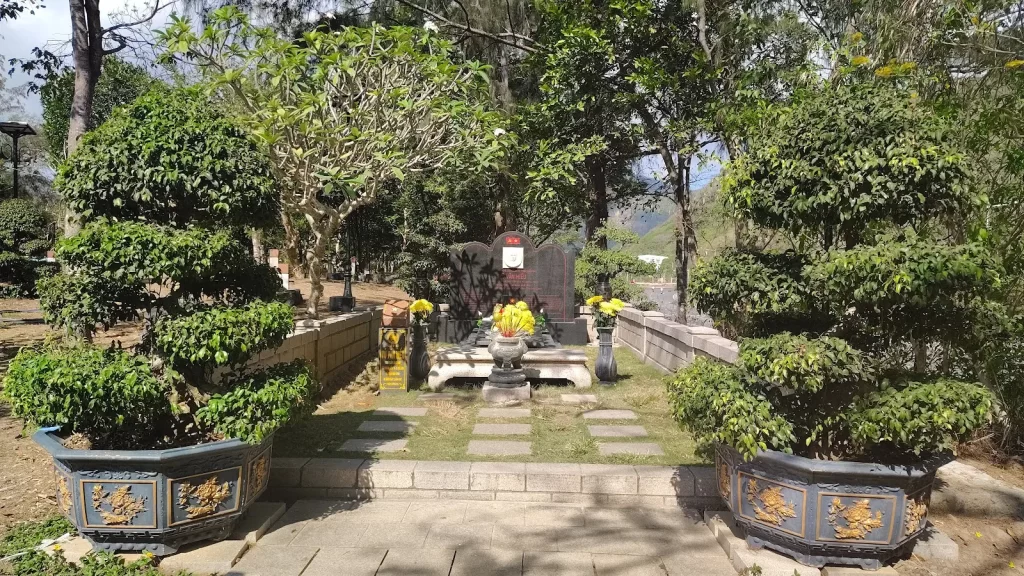
The grave of Hero of the People’s Armed Forces Vũ Văn Hiếu is now in Section A of Hàng Dương Cemetery, Côn Đảo.
This is the resting place of many revolutionaries and patriots who died before 1945. Section A also contains the graves of General Secretary Lê Hồng Phong and patriot Nguyễn An Ninh.
Today, Hàng Dương Cemetery is one of Côn Đảo’s important historical sites, where delegations, relatives of martyrs and visitors offer incense in remembrance.
Visitors wishing to pay respects at Vũ Văn Hiếu’s grave can go to Section A and follow the signs or ask cemetery staff for assistance.
When visiting, dress respectfully, keep quiet, protect the surroundings and follow the heritage site’s rules.
The Shirt-Giving Statue at Hàng Dương Cemetery
In addition to Vũ Văn Hiếu’s grave, the story of his giving his shirt to Lê Duẩn is preserved in the sculpture The Fidelity Statue, also known as the Shirt-Giving Statue, within the Hàng Dương Cemetery complex.
The work was inspired by Vũ Văn Hiếu’s gesture in his final days at Côn Đảo Prison.
The image of handing over a shirt recalls not only one particular story but also the bonds among political prisoners who shared imprisonment, deprivation and loss.
For many visitors to Côn Đảo, learning the story before seeing the statue and visiting Vũ Văn Hiếu’s grave adds meaning to their journey.
From a simple act in prison, the shirt became a symbol of comradeship and devotion to revolutionary ideals.
Remembering a steadfast revolutionary on Côn Đảo
More than eight decades have passed since Vũ Văn Hiếu’s death, but his life and story are still recalled in educational activities about national traditions in Quảng Ninh, his home district of Hải Hậu and Côn Đảo.
Each 26 April marks the anniversary of his death. On Côn Đảo, incense offerings and commemorations honour the revolutionary’s contributions and sacrifice.
For visitors to Hàng Dương Cemetery, Vũ Văn Hiếu’s grave and the Shirt-Giving Statue offer opportunities to learn about political prisoners’ lives in the history of Côn Đảo Prison.
He is remembered not only through his positions and revolutionary milestones but also through a profoundly simple gesture: giving his shirt to a comrade so that the survivor might continue to live and work.
This is one of the stories that gives depth to Côn Đảo’s history, preserving the memory of people who devoted their lives to the nation’s independence and freedom.
Sources
- Lives That Endure: Writings about Côn Đảo Prisoners, Quảng Ninh Literature and Arts Association, 1996, pp. 57–67.
- History of the Struggle of Patriots and Revolutionaries at Côn Đảo Prison (1862–1975), National Political Publishing House, 2010, p. 196.
- Côn Đảo: Chronicles and Documents, Political Prisoners Liaison Committee, Department of Culture and Information, Trẻ Publishing House, Ho Chi Minh City, 1996, p. 173.
- Quảng Ninh newspaper: Comrade Vũ Văn Hiếu, the First Secretary of the Quảng Ninh Mining Special-Zone Party Committee.
- Côn Đảo National Relics Conservation Centre: Ceremony Marking the 84th Anniversary of the Death of Hero of the People’s Armed Forces Vũ Văn Hiếu.
- Hàng Dương Cemetery information portal.