
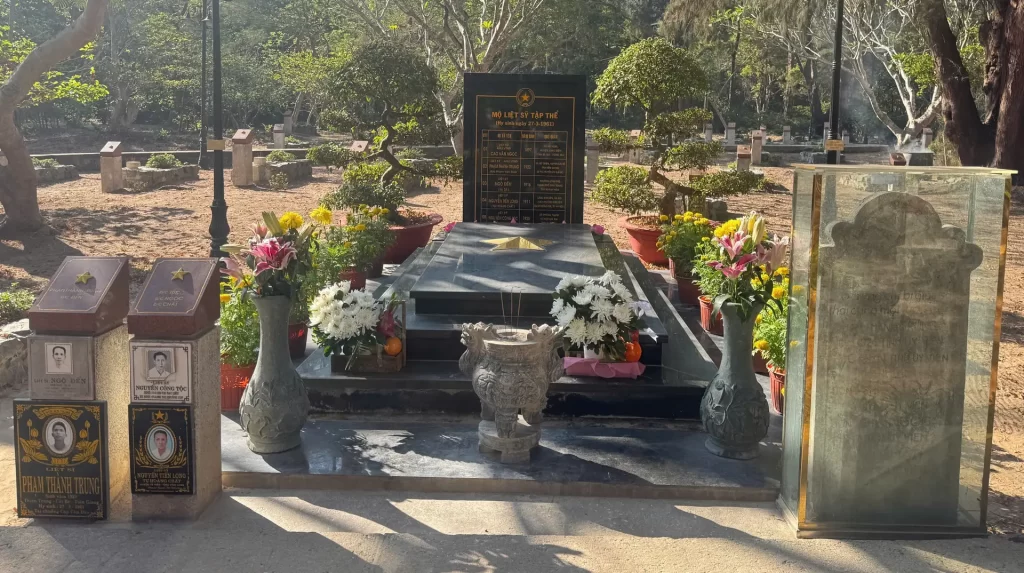
In Section B2 of Hàng Dương Cemetery, Côn Đảo, a distinctive collective grave holds five revolutionaries who died on the night of 27 March 1961: Cao Văn Ngọc, Phạm Thành Trung, Ngô Đến, Hoàng Chất and Nguyễn Công Tộc. These political prisoners firmly resisted attempts to force them to renounce the Party during their imprisonment in the Côn Đảo Tiger Cages. Their deaths became a landmark in the history of political prisoners’ resistance on the island.
The collective grave of five revolutionaries who died on 27 March 1961
27 March 1961 is one of the tragic milestones in the struggle against forced renunciation of the Party at Côn Đảo Prison.
That night, five political prisoners died after torture in the Tiger Cages. The prison authorities buried their bodies together in Hàng Dương Cemetery.
The five were:
- Cao Văn Ngọc (1897–1961): Hero of the People’s Armed Forces, from Bà Rịa.
- Phạm Thành Trung (1922–1961): Hero of the People’s Armed Forces, from Tiền Giang.
- Ngô Đến (1916–1961): Hero of the People’s Armed Forces, from Khánh Hòa.
- Hoàng Chất: a martyr, one of the five who died that night.
- Nguyễn Công Tộc: a martyr who also endured repression in the Tiger Cages.
Today, all five rest in collective grave number 211b2.24, Section B2, Hàng Dương Cemetery, Côn Đảo.
Among them, Cao Văn Ngọc, Phạm Thành Trung and Ngô Đến were posthumously awarded the title Hero of the People’s Armed Forces by the State.
The story of this grave concerns not only the deaths of five individuals, but also a period of particularly intense resistance by Côn Đảo’s political prisoners.
Resistance to forced renunciation of the Party in the Tiger Cages
Between 1957 and 1961, the Côn Đảo prison authorities used various measures to force political prisoners to declare that they had abandoned the Communist Party and accept the political demands of the Saigon government.
Prisoners were required to sign pledges of renunciation, participate in anti-communist denunciation activities or perform compulsory rituals.
Those who refused could face solitary confinement, reduced food rations, restricted drinking water and various forms of torture.
Prison I held many political prisoners determined to resist renunciation. Many were subsequently transferred from there to the Tiger Cages, where conditions were even harsher.
The prolonged struggle left many physically exhausted. Nevertheless, those who remained maintained their solidarity, protected one another and firmly rejected coercion.
Cao Văn Ngọc, Phạm Thành Trung and Ngô Đến were prominent figures in this movement.
Phạm Thành Trung (1922–1961): A revolutionary cadre from Tiền Giang
Phạm Thành Trung, also known as Ba Trung and by the courtesy name Đua, was born in 1922 in Mỹ Thiện village, Cái Bè district, Mỹ Tho province, now in the Cái Bè area of Đồng Tháp province.
He joined revolutionary activities before the August Revolution of 1945 and was admitted to the Party in 1946.
During the resistance against French colonial rule, Phạm Thành Trung held several important local responsibilities.
Between 1947 and 1952, his posts included commune militia commander and chairman of Mỹ Thiện Commune’s Resistance Administrative Committee.
In mid-1952, he was appointed political officer of the district military unit, and was subsequently elected to the Executive Committee of the Cái Bè District Party Committee.
In 1955, he became secretary of the Cái Bè District Party Committee. In May 1958, he was additionally elected to the Provincial Party Committee, continuing to lead the local revolutionary movement.
On 29 July 1958, Phạm Thành Trung was arrested while travelling on assignment. He was held successively at Mỹ Tho Prison, the Saigon General Police Directorate and Phú Lợi Prison before being exiled to Côn Đảo in 1959.
Remaining steadfast in the Tiger Cages
At Côn Đảo, Phạm Thành Trung was sent to Prison I, which held many political prisoners resisting forced renunciation of the Party.
Amid harsh imprisonment, his comrades trusted him for his solidarity, calmness and resolve.
He regularly encouraged other prisoners to withstand waves of repression and sustain their collective resistance.
When the prison authorities demanded written statements of political allegiance, Phạm Thành Trung declared:
“I cannot renounce Uncle Hồ and the Party.”
This statement expressed his political convictions even as he faced the threat of further torture and ill-treatment.
On the night of 27 March 1961, Phạm Thành Trung died alongside four other prisoners in the Côn Đảo Tiger Cages.
On 9 October 2014, the State posthumously awarded him the title Hero of the People’s Armed Forces.
Cao Văn Ngọc (1897–1961): The man known as the “Old Man of the Tiger Cages”
Cao Văn Ngọc was born in 1897 in An Ngãi village, Long Điền district, Bà Rịa province, now part of Ho Chi Minh City.
Born into a working family, he earned local people’s trust and served in the village administration as Hương quản, a village security official, in An Ngãi.
In 1945, Cao Văn Ngọc joined the revolution. In the years that followed, he actively supported and maintained contact with local revolutionary networks.
In 1955, after he was found keeping documents related to revolutionary activities, the Saigon authorities arrested him.
By 1959, Cao Văn Ngọc had been exiled to Côn Đảo Prison.
An elderly prisoner who would not submit
At Côn Đảo, Cao Văn Ngọc joined protests against compulsory flag salutes, anti-communist denunciation sessions and harsh prison conditions.
Despite his advanced age, he remained firm through repeated torture.
On 3 April 1960, he was transferred to the Tiger Cages.
Given the deprivation in prison, many urged him to accept some of the authorities’ demands to preserve his health and life.
Cao Văn Ngọc, however, refused.
According to records of his comrades’ recollections, he once said:
“I am old now. I have known both happiness and hardship in full; the only thing left is to die for the revolution.”
In early 1961, when forced to write a statement of his political position, he again declared that he would not renounce his allegiance.
Cao Văn Ngọc signed his statement in Chinese characters, affirming the resolute decision of a prisoner who had reached 64.
On 27 March 1961, he died during a crackdown in the Tiger Cages.
Generations of Côn Đảo political prisoners remembered Cao Văn Ngọc by affectionate names such as the “Old Man of Bà Rịa” and the “Old Man of the Tiger Cages”.
These names reflected not only his age but also his comrades’ affection and respect.
On 22 August 1998, President Trần Đức Lương signed the decision posthumously awarding Cao Văn Ngọc the title Hero of the People’s Armed Forces.
Today, a primary school on Côn Đảo bears Cao Văn Ngọc’s name, helping preserve his story and introduce it to generations of pupils.
Ngô Đến (1916–1961): A steadfast cadre from Khánh Hòa
Ngô Đến, whose courtesy name was Dã, was born in 1916 in Bóng hamlet, Cù Lao village, Vĩnh Xương district, now in the Vĩnh Thọ area of Nha Trang, Khánh Hòa province.
He joined the revolution in 1945 and was admitted to the Party in 1946.
During his activities, Ngô Đến served as secretary of the Vĩnh Xương District Party Committee and head of Khánh Hòa province’s Communications and Postal Service.
After the 1954 Geneva Accords, the organization assigned him to remain in the South and continue his activities, joining movements calling for consultations, general elections and national reunification.
In early 1957, Ngô Đến was arrested in Ninh Hòa.
After months of interrogation, he was transferred to Nha Trang Prison. On the night of 30 April 1957, he was sent to Côn Đảo Prison.
His role in the movement against forced renunciation
At Côn Đảo, Ngô Đến was appointed secretary of the Party cell in Cell Block 6, Prison I.
Throughout 1957–1961, he helped sustain the organization and fighting spirit of political prisoners determined to resist forced renunciation of the Party.
Drawing on his local leadership experience, Ngô Đến actively encouraged his comrades to remain resolute and preserve their collective unity.
When the prison authorities demanded a written statement of his political position, he clearly set out his views.
Historical records state that Ngô Đến refused to renounce his allegiance because he believed doing so would contradict his chosen struggle for peace, independence and national reunification.
In late March 1961, the repression of political prisoners in the Tiger Cages continued with great intensity.
On the night of 27 March 1961, Ngô Đến died alongside Cao Văn Ngọc, Phạm Thành Trung, Hoàng Chất and Nguyễn Công Tộc.
On 26 April 2018, the State posthumously awarded him the title Hero of the People’s Armed Forces.
The two martyrs Hoàng Chất and Nguyễn Công Tộc
Alongside the three Heroes of the People’s Armed Forces, the collective grave of 27 March 1961 is also the resting place of the two martyrs Hoàng Chất and Nguyễn Công Tộc.
Historical records note that both joined the resistance to forced renunciation and died during the night of repression in the Tiger Cages.
However, individual biographical information about them remains limited compared with the records for Cao Văn Ngọc, Phạm Thành Trung and Ngô Đến.
According to Hàng Dương Cemetery’s grave records, Hoàng Chất came from Kim Liên village, Hanoi, and Nguyễn Công Tộc from Vĩnh Lợi commune in the former Ba Xuyên province.
Both are recognized as martyrs in the collective memorial records of the five who died on 27 March 1961.
Remembering this collective grave therefore requires naming all five, not only the three posthumously awarded the title Hero of the People’s Armed Forces.
The night of 27 March 1961 and the meaning of the struggle
The five prisoners who died on the night of 27 March 1961 came from different backgrounds and hometowns and followed different revolutionary paths.
Cao Văn Ngọc was the oldest and had served as a village official in his native Bà Rịa.
Phạm Thành Trung was a leader of the revolutionary movement in Cái Bè, Tiền Giang.
Ngô Đến had held several important responsibilities in Khánh Hòa’s revolutionary movement.
Hoàng Chất and Nguyễn Công Tộc were also prisoners who chose to continue resisting under harsh confinement.
Despite their differences in age and origin, they met in Côn Đảo Prison and joined the struggle to defend their political convictions.
The deaths of all five deeply affected the prisoners who continued resisting in the Tiger Cages.
Stories of their lives and steadfastness became a source of encouragement for later generations of political prisoners.
Thus, 27 March 1961 marks not only the deaths of five prisoners, but also an important milestone in the history of resistance to forced renunciation at Côn Đảo.
Where is the collective grave of 27 March 1961 in Hàng Dương Cemetery?
The collective grave of the five revolutionaries is in Section B2, Hàng Dương Cemetery, Côn Đảo, with reference number 211b2.24 in the grave lookup system.
It is a shared memorial to all five who died on the night of 27 March 1961.
Visitors to Hàng Dương Cemetery can follow the signs to the grave or ask cemetery staff for assistance.
When paying respects, dress appropriately, speak quietly, burn incense only in designated places and respect the memorial setting.
Before or after visiting the grave, visitors can also tour the French Tiger Cages heritage site to learn about prison conditions and political prisoners’ struggles at Côn Đảo.
The annual 27 March memorial ceremony at Côn Đảo
27 March each year, according to the Gregorian calendar, commemorates the five revolutionaries who died in the Côn Đảo Tiger Cages in 1961.
For many years, commemorations have taken place at Hàng Dương Cemetery and Côn Đảo Temple to remember the three Heroes of the People’s Armed Forces, Cao Văn Ngọc, Phạm Thành Trung and Ngô Đến, and the two martyrs Hoàng Chất and Nguyễn Công Tộc.
On 27 March 2026, the Côn Đảo National Heritage Conservation Centre organized a ceremony marking the 65th anniversary of their deaths.
These commemorations honor those who died and pass on revolutionary traditions to later generations.
Visitors wishing to attend a particular year’s programme should check the heritage management authority’s announcements for the precise time, location and ceremonies.
One grave, five lives remembered by history
Among the thousands of graves at Hàng Dương Cemetery, the collective grave of 27 March 1961 preserves a distinctive story of Côn Đảo’s political prisoners.
The five came from different regions and had different lives and revolutionary duties, yet endured imprisonment together and died on the same night.
Today, pausing before the shared grave of Cao Văn Ngọc, Phạm Thành Trung, Ngô Đến, Hoàng Chất and Nguyễn Công Tộc offers an opportunity to remember people who suffered great losses in the struggle for independence and national reunification.
The grave marks not only 27 March 1961, but also preserves memories of the comradeship, solidarity and determination of prisoners in Côn Đảo’s history.
Sources
- History of the Struggle of Patriotic and Revolutionary Prisoners at Côn Đảo Prison (1862–1975), National Political Publishing House, 2010, pp. 343–363.
- Stories of the Struggle of Tiền Giang Cadres, Soldiers and People in Enemy Prisons and Detention Camps (1930–1975), Tiền Giang Provincial Party Committee, National Political Publishing House – Truth, 2018, pp. 213–220.
- Steadfast and Unyielding, Liaison Committee of Former Political Prisoners of Bà Rịa–Vũng Tàu Province, 2009, pp. 76–91.
- List of Khánh Hòa province’s cadres, soldiers and civilians arrested and exiled to Côn Đảo, Khánh Hòa Provincial Liaison Committee of Côn Đảo Political Prisoners.
- Côn Đảo National Heritage Conservation Centre, Ceremony Marking the 65th Anniversary of the Deaths of Heroes of the Vietnamese People’s Armed Forces Cao Văn Ngọc, Phạm Thành Trung, Ngô Đến and Martyrs Hoàng Chất and Nguyễn Công Tộc, 27 March 2026.
- Records of the collective grave of five revolutionaries at Hàng Dương Cemetery.