
In the history of the revolutionary movement in southwestern Vietnam before the August Revolution of 1945, Trần Văn Bảy, commonly known as Bảy Xệ, was one of the leaders who held important responsibilities in the provinces of Rạch Giá, Cần Thơ and Vĩnh Long.
Born into a poor farming family, he joined the patriotic movement early and became a Party leader while still young. During his years of activism, Trần Văn Bảy helped build revolutionary organizations and actively spread ideas and mobilized farmers to oppose heavy levies, excessive taxes and injustices in colonial society.
As the revolutionary movement in southern Vietnam entered preparations for an uprising, French colonial authorities arrested him, sentenced him to life imprisonment and exiled him to Côn Đảo.
According to records of the Côn Đảo heritage management authority, Trần Văn Bảy died at Côn Đảo Prison on 18 October 1942. He was posthumously awarded the title Hero of the People’s Armed Forces in 2014.
Today, his grave is in Section D of Hàng Dương Cemetery, in the same area as the resting place of Hero Trần Văn Thời.
Who was Hero Trần Văn Bảy (Bảy Xệ)?
Born in 1911 and commonly known as Bảy Xệ, Trần Văn Bảy was a revolutionary activist closely associated with Mỹ Quới and the revolutionary movement in southwestern Vietnam.
According to the book “Historical Figures of Vĩnh Long Province”, his family originated in Tam Bình District, Vĩnh Long Province. After the family lost its farmland, his parents had to move to Mỹ Quới Commune, then in Thạnh Trị District, Sóc Trăng Province, to earn a living.
Meanwhile, records of the Côn Đảo National Heritage Conservation Center state that he was born in 1911 in Mỹ Quới Commune, Ngã Năm District, Sóc Trăng Province, a locality now within Cần Thơ City.
Despite the differences in the recorded birthplace, Mỹ Quới remained particularly significant in Trần Văn Bảy’s life: it was where he grew up and began his earliest revolutionary activities.
His family lived in difficult circumstances and had to work to support themselves. These conditions gave him an early understanding of farmers’ poverty and the injustices of contemporary society.
Through exposure to progressive books and newspapers and patriotic ideas, Trần Văn Bảy gradually became involved in mobilizing young people, spreading ideas and organizing the local movement.
Early involvement in the revolutionary movement in Mỹ Quới
From the late 1920s, Trần Văn Bảy participated in patriotic activities in the Mỹ Quới area.
According to local historical records, in 1927, when he was only about 16, he began meeting revolutionary activists and learning about progressive ideas.
In 1928, he helped mobilize support for establishing a branch of the Vietnamese Revolutionary Youth League in Mỹ Quới.
This was a period of important changes in Vietnam’s revolutionary movement, as patriotic youth organizations developed toward the formation of communist organizations.
In rural southwestern Vietnam, mass mobilization was often closely tied to people’s everyday lives, especially land, taxation and workers’ rights.
Trần Văn Bảy actively spread ideas, brought young people together and helped establish the first local bases of the revolutionary movement.
In 1930, when a Party organization was established in Mỹ Quới Commune, he became one of its core cadres and subsequently served as Party cell secretary.
From then on, Trần Văn Bảy’s activities became increasingly connected with building organizations and developing the movement in localities across southwestern Vietnam.
From Mỹ Quới Party cell secretary to Phước Long District Party Committee secretary
In the early 1930s, the revolutionary movement in the western provinces faced many difficulties because of arrests and repression by the colonial authorities.
Under these circumstances, Trần Văn Bảy continued his activities in Mỹ Quới, helping build local bases and mobilize the population.
According to local documents, he served as secretary of the Mỹ Quới Party cell for many years, helping increase Party membership and extend activities into neighboring areas.
By the mid-1930s, he had been assigned responsibilities in the Phước Long District Party Committee.
This was an important stage in Trần Văn Bảy’s development as an activist. From working in a single commune, he moved on to help lead the movement across a wider area.
The main tasks during this period were to consolidate the organization, develop local Party bases and mobilize the public to campaign for livelihood and democratic rights.
With his understanding of farmers’ lives, he focused on practical issues such as taxation, land, workers’ living conditions and the hardships of poor families.
Journalism during the Democratic Front period
Another notable aspect of Trần Văn Bảy’s life was his involvement in revolutionary journalism.
During the Indochinese Democratic Front period, legally published newspapers became important vehicles for spreading progressive ideas and reflecting people’s lives.
According to “Historical Figures of Vĩnh Long Province”, Trần Văn Bảy contributed to Dân Chúng and Lao Động, newspapers published in Saigon during this period.
Through journalism, he described economic difficulties, unemployment, poverty and the injustices faced by working people.
He paid particular attention to farmers’ concerns, including levies and taxes, land and living conditions.
Newspapers not only conveyed information but also helped connect urban struggles with rural areas.
This work shows that Trần Văn Bảy was involved not only in organizing but also in raising public awareness through communication and education.
Trần Văn Bảy and the revolutionary movement in Rạch Giá and Cần Thơ
In the late 1930s, Trần Văn Bảy continued to receive important assignments in the revolutionary movement in southwestern Vietnam.
According to “Historical Figures of Vĩnh Long Province”, in 1938 he was appointed secretary of the Rạch Giá Provincial Party Committee, focusing on building and strengthening Party organizations.
In 1939, he was transferred to leadership work in Cần Thơ and the Hậu Giang Interprovincial Party Committee.
During this period, the political situation in Indochina changed considerably. After the Popular Front lost power in France, the colonial authorities intensified measures to control and suppress the revolutionary movement.
Many bases were searched, cadres were pursued and public activities faced increasing restrictions.
In response, revolutionary organizations had to change their approach, strengthen protection of their bases and prepare for more intense struggles.
Trần Văn Bảy was one of the cadres involved in this transition in localities across southwestern Vietnam.
Helping prepare the Southern Uprising in Vĩnh Long
In 1940, the revolutionary movement in southern Vietnam entered preparations for the Southern Uprising.
In this context, Trần Văn Bảy was assigned to lead the movement in Vĩnh Long Province.
As provincial Party committee secretary, he helped consolidate the organization, build its forces and implement policies for preparing the uprising.
Places such as Cầu Lầu, Gò Ân and Nước Xoáy were associated with the activities of revolutionary organizations in Vĩnh Long at this time.
In early 1940, the provincial Party committee held meetings to discuss changing its approach, building its forces and preparing the necessary conditions.
In the process, Trần Văn Bảy and local cadres frequently had to change contact locations, hold secret meetings and guard against surveillance by the French secret police.
However, the provincial Party committee’s activities were discovered before the uprising began.
Arrest at the provincial Party committee base in Cầu Lầu in 1940
According to historical documents of the Vĩnh Long Provincial Party organization and information from Vĩnh Long Newspaper, on 26 September 1940 the French colonial authorities searched the provincial Party committee’s base in Cầu Lầu and arrested Trần Văn Bảy and several revolutionary cadres.
During this crackdown, many organizational documents were also confiscated, seriously affecting local preparations for the uprising.
After his arrest, Trần Văn Bảy was successively held and interrogated in several prisons in southern Vietnam.
According to accounts of his life, these included prisons in Vĩnh Long, Cần Thơ and Saigon, as well as other colonial facilities.
During interrogation, he endured various forms of torture intended to extract information about the revolutionary organization and his fellow activists.
Historical accounts nevertheless record that he held firm and did not provide information that could endanger his comrades or organizational bases.
Trần Văn Bảy was eventually sentenced to life imprisonment and exiled to Côn Đảo.
The sentence ended his years of direct activism in southwestern Vietnam and began the final period of imprisonment in his life.
Years of detention at Côn Đảo Prison
Under French colonial rule, Côn Đảo Prison held generations of patriots and revolutionary fighters.
Prisoners lived in deprivation under strict control and regularly faced disease, forced labor and punishments.
Trần Văn Bảy was sent to Côn Đảo after his health had already been affected by interrogations and his previous detention.
According to biographical accounts, however, he maintained his resolve and continued to participate in struggles within the prison.
Besides protecting political prisoners’ status, he helped bring people together, organize collective activities and assist fellow prisoners.
Solidarity among prisoners was especially important in captivity. Those in better health tried to support the sick; those with knowledge shared their experience and encouraged other prisoners.
Trần Văn Bảy is remembered as an active participant in these efforts, particularly attentive to prisoners whose health had deteriorated.
Helping organize the Prisoners’ Association and support his comrades
According to “Historical Figures of Vĩnh Long Province”, while imprisoned on Côn Đảo, Trần Văn Bảy helped organize the Prisoners’ Association, bringing together like-minded people and sustaining activities of resistance.
These activities were intended not only to oppose the prison regime but also to maintain prisoners’ solidarity and organizational discipline.
Alongside political activities, Trần Văn Bảy also cared for and encouraged those who were ill or weakened by prison conditions.
He also participated in debates about political views, ideals and approaches to struggle with groups of prisoners holding different positions.
These activities show that prison life involved not only labor and confinement, but also intellectual exchange, learning and collective organization.
For Trần Văn Bảy, maintaining solidarity, protecting his comrades and holding to his views were important parts of his final years.
18 October 1942: Trần Văn Bảy dies at Côn Đảo Prison
According to the Côn Đảo National Heritage Conservation Center, Hero Trần Văn Bảy died at Côn Đảo Prison on 18 October 1942.
He died at about 31, after years of participation in the revolutionary movement and detention in the colonial prison system.
Deprived living conditions, a harsh prison regime and injuries from torture severely affected the health of many prisoners, including Trần Văn Bảy.
His death brought grief to comrades who had worked with him in southwestern Vietnam and to his fellow prisoners on Côn Đảo.
Trần Văn Bảy’s name continues to appear in historical works on the revolutionary movements in Vĩnh Long, Rạch Giá and Cần Thơ and on the Côn Đảo prison system.
Notably, some local historical documents record his date of death as 25 November 1941, differing from 18 October 1942, the date used by the Côn Đảo heritage management authority.
This discrepancy requires further research and comparison with archival records and original sources to clarify when he died.
Trần Văn Bảy is posthumously named a Hero of the People’s Armed Forces
On 1 December 2014, the President of the Socialist Republic of Vietnam posthumously awarded Trần Văn Bảy the title Hero of the People’s Armed Forces.
The honor recognizes his contributions to the revolutionary movement in southwestern Vietnam and his steadfast resistance during imprisonment.
His life of activism was connected with many localities and important stages of the revolutionary movement before 1945.
From a young man who joined the patriotic movement early, he went on to serve in Party cells, district committees and provincial committees, while also participating in journalism, communication and mass mobilization.
Although his life ended while he was still young, Trần Văn Bảy’s contributions remain remembered through historical records and commemorative activities on Côn Đảo.
Where is the grave of Hero Trần Văn Bảy (Bảy Xệ)?
Today, the grave of Hero of the People’s Armed Forces Trần Văn Bảy is in Section D of Hàng Dương Cemetery, Côn Đảo.
Section D was created during the gathering of remains and restoration of Hàng Dương Cemetery, receiving remains from Hàng Keo Cemetery, Hòn Cau and several other locations on the island.
According to the heritage management authority, Section D contains the graves of two Heroes of the People’s Armed Forces: Trần Văn Bảy and Trần Văn Thời.
Hàng Dương Cemetery is one of Côn Đảo’s most important places of remembrance, the resting place of many revolutionary fighters, patriots and people detained in the prison system across different periods.
For those visiting Côn Đảo to learn about its history, Trần Văn Bảy’s grave is a place to pause in remembrance and learn about a revolutionary cadre who made many contributions to the struggle in southwestern Vietnam.
Visitors should dress appropriately, preserve the quiet atmosphere and follow the cemetery management’s rules.
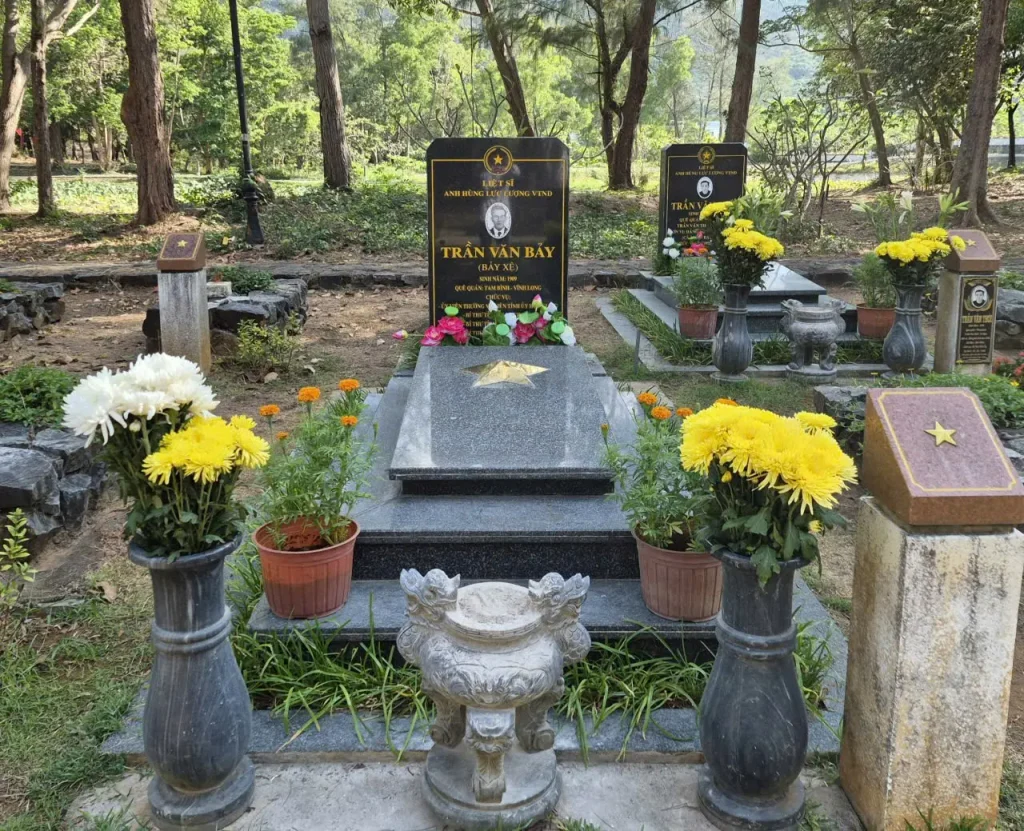
Remembering Hero Trần Văn Bảy on Côn Đảo
Each year, around the anniversary of Hero Trần Văn Bảy’s death, incense offerings and commemorations provide an opportunity to recall his life, activities and contributions.
Residents, heritage pilgrimage groups and visitors to Hàng Dương Cemetery can also learn about Trần Văn Bảy’s story during their visit to the historic site.
From the youth movement in Mỹ Quới and the years spent building revolutionary bases to his activities in Rạch Giá, Cần Thơ and Vĩnh Long, Trần Văn Bảy’s life reflects part of the history of the people of southwestern Vietnam’s struggle during the colonial period.
His final years on Côn Đảo also reveal the circumstances and spirit of those imprisoned for political activity.
Preserving records about Trần Văn Bảy matters for historical research, education about past traditions and introducing figures associated with the Côn Đảo prison system.
Trần Văn Bảy’s lasting place in Côn Đảo’s history
Trần Văn Bảy’s life was connected with many parts of southwestern Vietnam, from Mỹ Quới and Phước Long to Rạch Giá, Cần Thơ and Vĩnh Long.
During his revolutionary activities, he helped build organizations, mobilize the public, write newspaper articles and undertake important leadership responsibilities while still young.
In his final years, he was held at Côn Đảo Prison, where he maintained his resolve and assisted fellow prisoners.
Today, Trần Văn Bảy’s grave in Section D of Hàng Dương Cemetery remains a tangible link to his life.
His story helps readers understand both the revolutionary movement in southwestern Vietnam before 1945 and the individual lives within the history of Côn Đảo Prison.
Every grave at Hàng Dương is connected with a life and its own stories. For Trần Văn Bảy, it is the journey of a young man from a poor farming family who joined the revolution early and spent his final years in a colonial prison.
Reference sources
- “Historical Figures of Vĩnh Long Province”, Executive Committee of the Vĩnh Long Provincial Party organization, National Political Publishing House – Truth, pp. 29–30.
- Côn Đảo National Heritage Conservation Center, biographical records and the date of death of Hero of the People’s Armed Forces Trần Văn Bảy.
- Vĩnh Long Newspaper, “A family from Dừa Đỏ brings renown to the southern region”, 28 May 2025.
- Historical documents of the Vĩnh Long Provincial Party organization on preparations for the Southern Uprising of 1940.
- Côn Đảo National Heritage Conservation Center, introduction to Hàng Dương Cemetery Historic Site and its grave sections.