
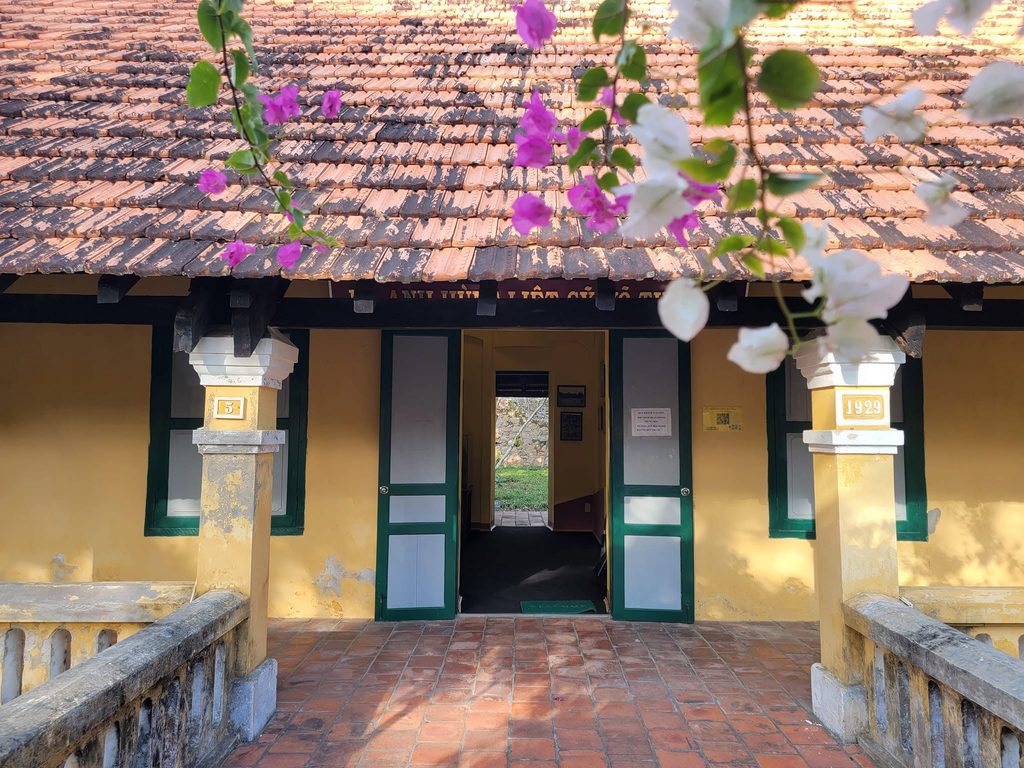
Sở Cò Historic Site, Côn Đảo is one of the important historical places associated with the life and sacrifice of Võ Thị Sáu, a Hero of the People’s Armed Forces. Built by the French colonial authorities in 1929, it served as the judicial police office within the Côn Đảo Prison administration and was later used as the Military Police headquarters under the Republic of Vietnam.
Unlike large prison camps such as Phú Hải, Phú Sơn and Phú Thọ, Sở Cò was an office with administrative, policing and temporary detention functions. Yet it was in the compound’s two small isolation cells that the revolutionary Võ Thị Sáu spent her final hours before the French colonial authorities took her to the execution ground on the morning of January 23, 1952.
Today, Sở Cò has been restored, conserved and used as a memorial exhibition space dedicated to Võ Thị Sáu. In central Côn Đảo, its yellow walls, tiled roof and green courtyard preserve traces of an unforgettable period of history.
Where is Sở Cò Historic Site in Côn Đảo?
Sở Cò Historic Site is on Lê Duẩn Street in central Côn Sơn, Côn Đảo Special Zone, Ho Chi Minh City.
The building stands in an area containing many of Côn Đảo’s important historical sites, close to the Island Governor’s Residence and other buildings once used by the prison administration.
Although modest in size, it holds particular historical significance, especially for visitors interested in Võ Thị Sáu’s life, revolutionary activities and sacrifice.
Key facts about the site:
- Site name: Sở Cò, Côn Đảo.
- Name reflecting its historical function: Judicial Police Office.
- Address: Lê Duẩn Street, Côn Đảo Special Zone, Ho Chi Minh City.
- Year built: 1929.
- Total compound area: 1,516.2 m².
- Layout: One main building, one auxiliary building, two isolation cells and a courtyard garden.
- Current use: Historic site and memorial exhibition space dedicated to Võ Thị Sáu.
- Heritage designation: Designated a provincial historical and cultural site in 2007; a component of the Côn Đảo Prison Special National Heritage Site designated in 2012.
The origin of the name Sở Cò
For many visitors beginning to explore Côn Đảo’s history, the name “Sở Cò” may be unfamiliar.
In the administration and police system of the French colonial period, the Vietnamese word “cò” was used when referring to certain police officials, in expressions such as “cò cảnh sát”.
On Côn Đảo, the colonial authorities built not only prison camps but also a network of offices to operate the apparatus governing prisoners.
These included the Telegraph Office, Treasury, judicial police office, guard posts and other administrative and logistical units.
According to Côn Đảo Prison 1862–1975, the prison superintendent oversaw the heads of administrative and operational offices, including the official responsible for policing.
Sở Cò was the familiar name for the judicial police office within this system.
Sở Cò should be distinguished from the main camps of Côn Đảo Prison. While the prison camps were built to hold large numbers of inmates for long periods, Sở Cò was primarily an administrative office, with isolation cells for people placed under special supervision.
This function made Sở Cò the place where Võ Thị Sáu was held immediately after being brought from the mainland to Côn Đảo for execution.
The construction of Sở Cò in 1929
Expansion of the Côn Đảo Prison system in the early twentieth century
From 1862, the French colonial authorities established a prison system on Côn Đảo, turning the remote archipelago into a place of imprisonment and exile for convicted people, including many patriots and revolutionaries.
The Côn Đảo Prison complex continued to expand through successive periods.
Alongside detention compounds such as Banh I, Banh II and Banh III, the colonial authorities built administrative offices, warehouses, facilities for daily needs and a security system to operate the entire prison establishment.
Administering an island far from the mainland required specialised agencies. The prison needed more than cells, guards and wardens: it also had police, communications, financial and logistical services.
It was in this context that Sở Cò was built in 1929 in the area known as Côn Đảo’s prison town.
The French colonial-style building was laid out to support administrative and police work within the system governing prisoners.
Sở Cò under French colonial rule
Sở Cò functioned as a judicial police office, maintaining security, exercising control and handling matters within the prison authorities’ jurisdiction.
Although it was not a large prison camp, Sở Cò had two cells used for separate confinement.
These spaces allowed the prison authorities to isolate people requiring special supervision before carrying out further procedures or decisions.
The existence of Sở Cò shows that Côn Đảo Prison was more than a collection of cells. It was an administrative system with a relatively comprehensive structure of government offices, police and supporting units.
A full understanding of Côn Đảo Prison’s history therefore also requires looking at offices such as Sở Cò, the Island Governor’s Residence and other facilities that operated the island’s governing apparatus.
Sở Cò after 1954
After French colonial rule ended in northern Vietnam and the Côn Đảo prison system was handed over to the Republic of Vietnam authorities, many existing buildings remained in use, with changes to their organisation and functions.
During this period, Sở Cò served as the Military Police headquarters.
Its role changed from a colonial judicial police office to a unit within the security and military control system of the later prison administration.
The continued use of a building under different administrations illustrates the continuity of the infrastructure supporting imprisonment on Côn Đảo between 1862 and 1975.
The architecture and size of Sở Cò Historic Site
According to materials from the Côn Đảo National Heritage Conservation Center, Sở Cò occupies a total compound area of 1,516.2 m².
The complex comprises one main building, an auxiliary building, two isolation cells and a courtyard garden.
Although modest compared with the large prison camps, Sở Cò is a representative example of the administrative buildings constructed on Côn Đảo during the French colonial period.
The main building: Sở Cò’s administrative space
The main building occupies the central position in the compound.
Its architecture reflects the colonial period, with a tiled roof, masonry walls, doors and windows, and details suited to an administrative office.
Unlike communal cell blocks, the main building was arranged for the police office’s administrative and operational work.
Today, this architecture helps visitors imagine a facility belonging to the Côn Đảo Prison administration under French colonial rule.
The yellow walls, red tiled roof and green courtyard create a quiet setting. Behind this appearance, however, are historical stories connected with prison administration, particularly the events of January 22 and 23, 1952.
The auxiliary building
Alongside the main building, the historic site includes an auxiliary building that supported the office’s activities.
This structure shows that Sở Cò was organised as an administrative unit with working areas and supporting facilities.
When studying colonial-era office architecture on Côn Đảo, considering both the main and auxiliary buildings helps explain the layout, land use and organisation of an administrative compound.
The two isolation cells at Sở Cò
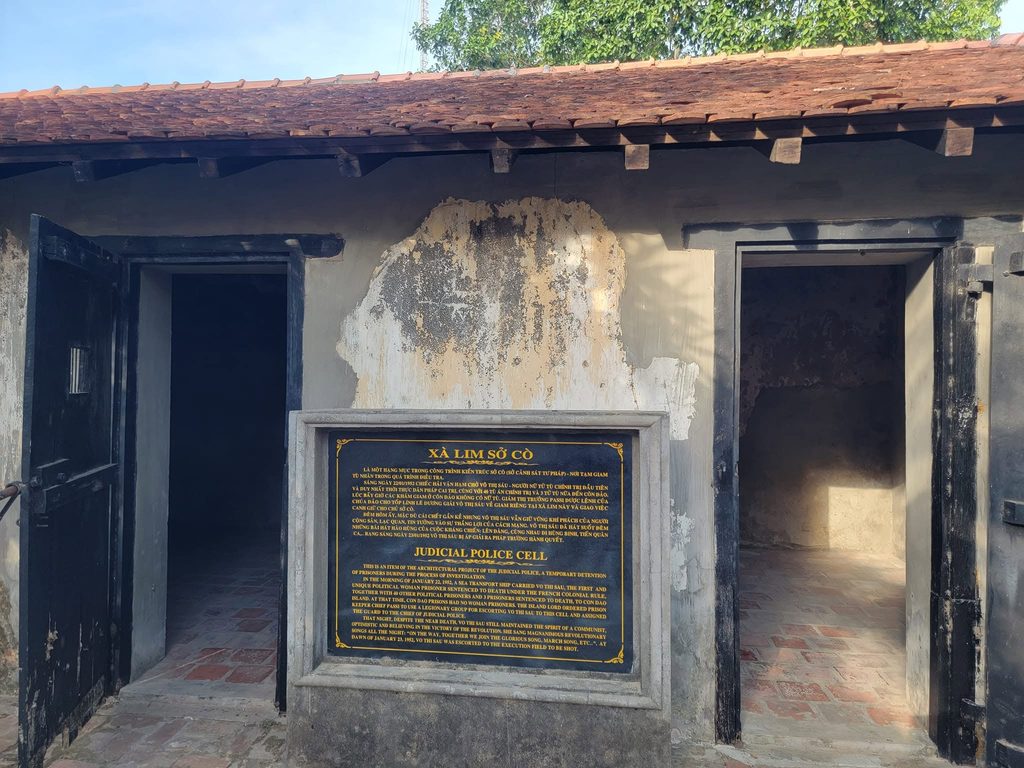
Within the historic site, the two isolation cells have particular historical significance.
An isolation cell is a separate detention space, generally used to keep a prisoner apart from the communal living environment.
Unlike the communal cells at Banh I, Banh II or Banh III, the cells at Sở Cò served the separate detention function of a police facility.
This was also where Võ Thị Sáu was held from January 22, 1952 until the morning of January 23, 1952, before being taken away for execution.
That event made the two cells important physical traces of the revolutionary’s life and final hours.
The courtyard garden
The courtyard garden forms part of Sở Cò’s layout.
Today, the trees, paths and flower beds create a landscape characteristic of historic buildings in central Côn Đảo.
The contrast between today’s peaceful setting and the events that once took place here emphasises the site’s commemorative importance.
For visitors, the Sở Cò grounds offer a place to observe the architecture, read the information boards and learn about the historical stories connected with the building.
Sở Cò: remembering Võ Thị Sáu’s final hours
The events involving Võ Thị Sáu are the most frequently recalled episode in Sở Cò’s history.
Võ Thị Sáu came from Đất Đỏ and joined revolutionary activities at a very young age.
During the resistance against French colonial rule, she joined the local resistance forces, carried out assigned tasks and became a prominent figure in the struggle in southeastern Vietnam.
After being arrested by the French colonial authorities, she was sentenced to death.
In early 1952, the colonial authorities took her to Côn Đảo to carry out the sentence.
Her final hours unfolded at Sở Cò and other related places within the prison system.
Dawn on January 22, 1952: Võ Thị Sáu arrives on Côn Đảo
According to the Côn Đảo National Heritage Conservation Center’s materials, a naval transport ship brought Võ Thị Sáu into Côn Đảo’s waters at dawn on January 22, 1952.
After the ship entered the bay, she was transferred to a launch to be taken ashore.
The prison authorities arranged for this prisoner awaiting execution to be guarded separately.
Island governor Jarty ordered that Võ Thị Sáu be held in an isolation cell at Sở Cò and placed the head of the police office in charge of guarding her.
Taking her directly to Sở Cò rather than placing her with other prisoners in one of the large camps reflected the exceptional nature of her case.
From that moment, Sở Cò became associated with the final day of the young revolutionary’s life.
Secret contact with revolutionary prisoners
News that Võ Thị Sáu had been brought to Côn Đảo for execution quickly reached the political prisoners’ organisation on the island.
According to historical materials, the island Party committee and the prisoners’ federation sought ways to offer her encouragement and support during her detention.
Some prisoners assigned to service duties at Sở Cò and the prison director’s office tried to contact her.
At midday on January 22, 1952, a prisoner working as an attendant brought food to her cell and conveyed greetings and encouragement from the revolutionary prisoners.
For someone held in isolation and aware of the sentence awaiting her, that contact held particular meaning.
According to an account preserved in the heritage management authority’s materials, Võ Thị Sáu calmly sent greetings to the island’s prisoners and reaffirmed her choice to struggle for national independence.
This story shows that even under strict administration and surveillance, political prisoners found ways to maintain contact, encourage one another and offer help.
For Võ Thị Sáu, it was also a spiritual meeting with people who shared her ideals during her final hours.
The night of January 22, 1952: songs in the Sở Cò cell
One of the most moving details in the story of Võ Thị Sáu at Sở Cò concerns the final night before her execution.
According to the recollection of a prisoner who had worked there as an attendant, Sáu stayed awake that night and sang several revolutionary songs.
The songs named in the materials include Lên Đàng (Onward), Cùng nhau đi Hồng binh (Together We Join the Red Army), Tiến quân ca (Marching Song) and Tiểu đoàn 307 (Battalion 307).
Held alone and knowing that she would soon face death, her singing expressed composure and faith in the path she had chosen.
These songs, associated with youth, homeland and the struggle for independence, became a distinctive part of the memory of her final night at Sở Cò.
The story still appears in historical materials about Võ Thị Sáu, helping explain why the image of the young revolutionary has endured in the cultural and spiritual life of many generations.
4 a.m. on January 23, 1952: leaving the Sở Cò cell
According to historical materials from the Côn Đảo National Heritage Conservation Center, at around 4 a.m. on January 23, 1952, the head of Sở Cò, whose name is recorded as Vol Peter, escorted Võ Thị Sáu to chief warden Passi’s office for the procedures preceding her execution.
This was the moment she left her place of detention at Sở Cò.
She was then taken to the execution ground for the death sentence to be carried out.
The specific record of 4 a.m. helps establish the sequence of events on Võ Thị Sáu’s final morning.
For those studying Côn Đảo’s history, this is an important time marker when examining the revolutionary’s execution.
7 a.m. on January 23, 1952: Võ Thị Sáu is executed
At around 7 a.m. on January 23, 1952, the French colonial authorities executed Võ Thị Sáu on Côn Đảo.
According to historical accounts passed down, she faced her sentence calmly, remaining steadfast in the ideals she pursued.
Võ Thị Sáu’s sacrifice left a deep mark on the history of Vietnam’s revolutionary movement.
The young revolutionary has been portrayed in many works of literature and art, heritage education programmes and commemorative activities throughout the country.
After her death, she was buried on Côn Đảo.
Today, Võ Thị Sáu’s grave is in Hàng Dương Cemetery, where many residents and visitors come to offer incense and pay their respects.
Sở Cò, where she spent her final hours before being taken to the execution ground, has also become an important historic site connected with her life.
The significance of January 22–23, 1952 in Sở Cò’s history
In terms of its original function, Sở Cò was a police office within the prison administration.
However, Võ Thị Sáu’s detention here changed the building’s historical meaning.
From a facility serving the governing apparatus, Sở Cò became a place preserving the memory of a revolutionary who died while still very young.
What has kept this story alive across generations is more than the death sentence or the events of the morning of January 23, 1952.
It is also Võ Thị Sáu’s spirit while held in isolation, her message to the revolutionary prisoners and the songs recalled from her final night at Sở Cò.
These details have both historical and human significance, helping readers understand the person behind a figure who became a symbol.
For heritage conservation, preserving Sở Cò’s physical traces also means protecting a place associated with an event whose timing, participants and sequence are recorded in considerable detail.
Sở Cò after 1975
After Côn Đảo was liberated in 1975, the prison system ceased to hold prisoners.
Many buildings that had served the prison administration were repurposed for conservation, research and historical education.
Sở Cò also underwent a change of function in this context.
Rather than continuing as a police facility or place of detention, the building gradually became part of Côn Đảo’s network of historical sites.
Conserving Sở Cò has two important purposes.
First, the building preserves part of the French colonial administrative architecture, offering a fuller picture of how Côn Đảo Prison was organised and operated.
It is also a place directly associated with Võ Thị Sáu’s life and final hours, making the preservation of its surviving traces particularly valuable for commemoration and heritage education.
Over time, the building was restored and renovated for use as a memorial exhibition space dedicated to her.
The Võ Thị Sáu memorial exhibition at Sở Cò
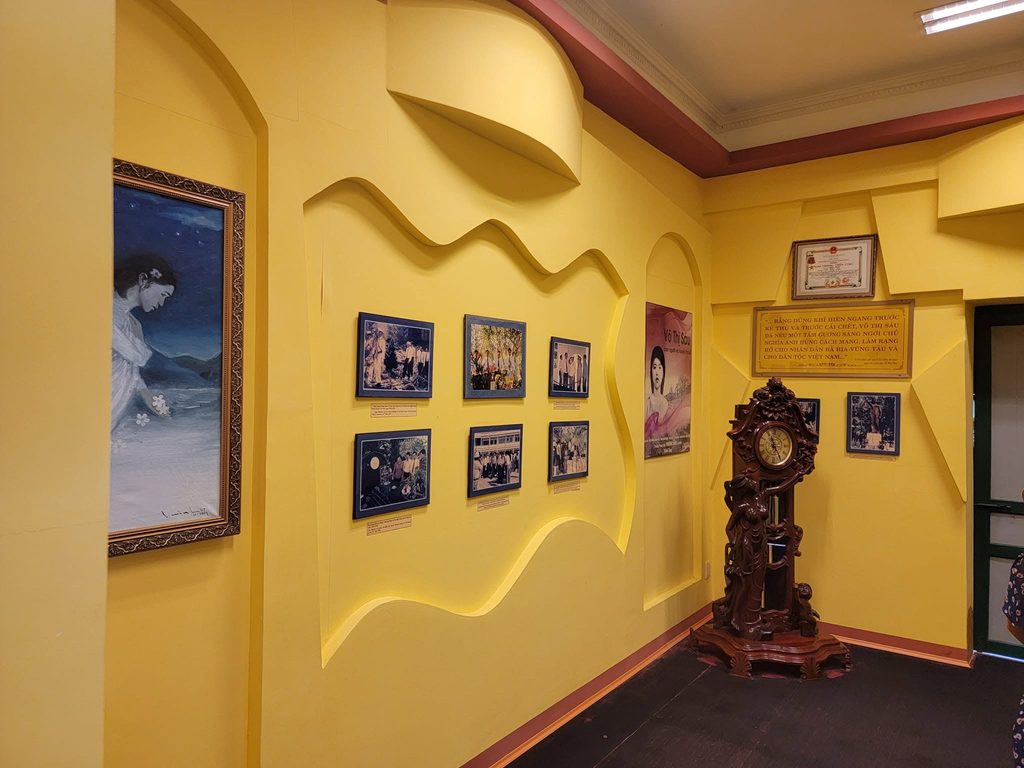
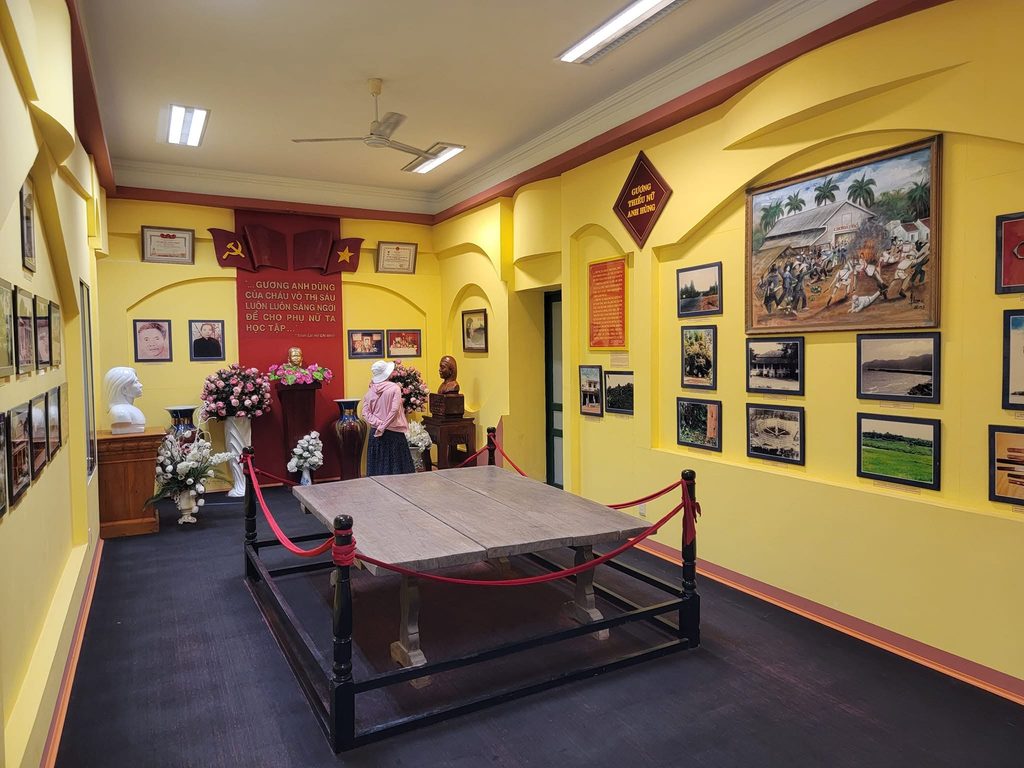
One of Sở Cò’s important roles today is to exhibit, explain and preserve the memory of Võ Thị Sáu.
The memorial space introduces visitors to her story through materials and displays about her life, revolutionary activities and sacrifice.
Learning about Võ Thị Sáu’s life
The displays help visitors understand her home region of Đất Đỏ, the historical context of the anti-French resistance in southeastern Vietnam and her involvement in the revolution.
Born in Đất Đỏ, Võ Thị Sáu became a fighter involved in resistance activities during the struggle against French colonial rule.
Her life was connected with local historical events before her arrest, sentencing and transfer to Côn Đảo.
Materials about this period place the story at Sở Cò in a wider context, helping visitors understand why she became a figure of particular significance in Vietnamese history.
Learning about her final hours on Côn Đảo
The central subject when exploring Sở Cò Historic Site is the sequence of events on January 22 and 23, 1952.
Through documents and guided explanations, visitors can learn about Võ Thị Sáu’s journey from the mainland to Côn Đảo, her time in the isolation cell, contact with revolutionary prisoners and the events preceding her execution.
This distinguishes Sở Cò from many other places commemorating Võ Thị Sáu.
Sở Cò preserves not only the story of a historical figure but the actual location of an important part of her final hours.
The value of the documents and exhibition space
Converting a building once used by the governing apparatus into a memorial space gives its conservation particular meaning.
The displays connect the architecture with people and historical events.
For visitors with limited knowledge of Côn Đảo Prison’s history, this is also a suitable place to begin learning about Võ Thị Sáu before visiting her grave at Hàng Dương Cemetery.
During a visit, allow time to read the information boards, observe the surviving historic features and listen to a guide if possible.
Distinguish between original documents, historical objects and reconstructed images or models in the exhibition. Each type of material has its own value and offers a different perspective on the past.
Recognition of Sở Cò as a historic site
State authorities have recognised Sở Cò’s historical value through heritage designation decisions.
April 18, 2007: provincial historical and cultural site designation
On April 18, 2007, the People’s Committee of Bà Rịa–Vũng Tàu Province issued Decision No. 1443/QĐ-UB, designating Sở Cò a provincial historical and cultural site.
This marked an important step in recognising and protecting the building’s historical value.
The designation provided a basis for conservation, management and interpretation while affirming Sở Cò’s importance to local history.
May 10, 2012: becoming part of a Special National Heritage Site
On May 10, 2012, the Prime Minister issued Decision No. 548/QĐ-TTg, designating the Côn Đảo Prison historical complex a Special National Heritage Site.
Sở Cò is one of the component sites within this complex.
The designation applies to the entire Côn Đảo Prison historical complex, rather than being a separate designation for Sở Cò alone.
Its protection within a Special National Heritage Site reflects Sở Cò’s role among the buildings that illustrate Côn Đảo’s history across different periods.
The historical and cultural value of Sở Cò
Traces of the Côn Đảo Prison administration
Sở Cò sheds light on an often-overlooked aspect of Côn Đảo Prison: the network of offices supporting its administration.
Alongside the prison camps were administrative, police, communications and logistical facilities.
Buildings such as Sở Cò provide evidence of the prison authorities’ organisational structure, methods of administration and control.
They enable a fuller understanding of Côn Đảo Prison’s history, not only through its cell blocks but through all the infrastructure that sustained the prison regime.
A place directly connected with Võ Thị Sáu’s life
Sở Cò’s most distinctive value lies in its direct connection with Võ Thị Sáu’s detention before her death.
The specific times recorded for January 22 and 23, 1952, together with preserved recollections, establish the building’s particular historical significance.
Sở Cò is therefore more than a place displaying documents about Võ Thị Sáu: it is part of the history itself.
French colonial architectural value
Built in 1929, Sở Cò belongs to the group of French colonial-era administrative buildings on Côn Đảo.
Its main building, auxiliary structure, cells and courtyard garden form the layout of a facility supporting prison administration in the first half of the twentieth century.
Conserving these elements helps preserve the architectural character of central Côn Đảo before 1975.
The value of heritage education
For school pupils, students and groups studying history, Sở Cò connects events learned from books with a real physical place.
The stories of Võ Thị Sáu, communication among revolutionary prisoners and her final hours offer lessons in patriotism, responsibility and appreciation of peace.
This value extends beyond remembering a historical figure to encouraging inquiry, reflection and respect for the past.
Visiting Sở Cò Historic Site in Côn Đảo
Sở Cò lies in central Côn Sơn, making it relatively easy to include in a historical sightseeing itinerary.
Depending on where they are staying, visitors can reach it by motorbike, car, taxi or on foot.
What to explore at Sở Cò
When visiting, take time to learn about both the building’s history and the story of Võ Thị Sáu.
Begin by observing the compound’s layout, the main and auxiliary buildings and the surviving architectural features.
Then explore Sở Cò’s role within the Côn Đảo Prison system, particularly its function as a judicial police office under French rule and Military Police headquarters in the period after 1954.
The most important part of the visit is learning about the two isolation cells and the events of January 22–23, 1952.
The stories of the secret meeting with the prisoner serving as an attendant, her final night at Sở Cò and the morning Võ Thị Sáu was taken to the execution ground help visitors understand the site’s historical significance more deeply.
Can visitors enter the Võ Thị Sáu exhibition room?
Sở Cò has been restored and renovated for use as a memorial exhibition room dedicated to Võ Thị Sáu.
However, access may be affected by maintenance schedules, conservation work or organised group programmes.
Check notices from the heritage management authority before visiting, particularly during holidays or when travelling with a large group.
How much time should visitors allow?
Individual visitors can plan roughly 20–40 minutes to explore Sở Cò’s architecture and historical displays.
An in-depth guided visit may take longer, depending on the programme.
This is a suggested planning allowance, not a compulsory visit duration set by the management authority.
Visitor guidance
Sở Cò is associated with the sacrifice of a historical figure, so visitors should behave respectfully and honour its commemorative setting.
Do not touch objects without permission, interfere with old structures or enter areas that are not open to visitors.
When taking photographs, follow the site’s rules, especially in exhibition areas containing objects, documents or materials under conservation.
Families with children may wish to introduce Võ Thị Sáu’s story beforehand, making the visit an accessible and meaningful learning experience.
The connection between Sở Cò and Hàng Dương Cemetery
Sở Cò and Hàng Dương Cemetery are two important stops when learning about Võ Thị Sáu’s life on Côn Đảo.
Sở Cò was where she was detained before her execution on January 23, 1952.
Hàng Dương Cemetery is her resting place, alongside many other revolutionaries and patriots who died on Côn Đảo.
The two locations have different functions and meanings.
Sở Cò is a historic site associated with Võ Thị Sáu’s final hours, where visitors can learn about the events through the building’s architecture, documents and displays.
Hàng Dương Cemetery is a place of remembrance, where residents and visitors offer incense at the graves of Võ Thị Sáu and other fallen heroes.
Learning about Sở Cò before visiting Hàng Dương Cemetery provides more historical context about her life and sacrifice.
It also connects the study of the past with present-day acts of remembrance.
Frequently asked questions about Sở Cò Historic Site
When was Sở Cò in Côn Đảo built?
Sở Cò was built by the French colonial authorities in 1929 to support the administration of Côn Đảo Prison.
Why is it called Sở Cò?
Sở Cò is the name associated with the judicial police office within the colonial prison administration. The word “cò” was used when referring to police officials at that time.
Was Sở Cò a prison?
Sở Cò was not a large communal prison camp. It was a police office with two cells for separate detention, belonging to the network of facilities supporting the Côn Đảo Prison administration.
When was Võ Thị Sáu detained at Sở Cò?
According to historical materials, Võ Thị Sáu arrived on Côn Đảo at dawn on January 22, 1952 and was held separately in a Sở Cò cell before being taken for execution on the morning of January 23, 1952.
When did Võ Thị Sáu die?
Võ Thị Sáu died on January 23, 1952 on Côn Đảo. According to the Côn Đảo National Heritage Conservation Center’s materials, the execution took place at around 7 a.m.
How large is Sở Cò Historic Site?
The Sở Cò compound covers a total area of 1,516.2 m², comprising one main building, an auxiliary building, two isolation cells and a courtyard garden.
Is Sở Cò recognised as a Special National Heritage Site?
Sở Cò was designated a provincial historical and cultural site on April 18, 2007. It is a component of the Côn Đảo Prison historical complex, which the Prime Minister designated a Special National Heritage Site on May 10, 2012.
What is Sở Cò used for today?
The site is conserved and used as a memorial exhibition space dedicated to Võ Thị Sáu, a Hero of the People’s Armed Forces.
Sở Cò Historic Site: preserving the memory of Võ Thị Sáu
Almost a century after its construction, Sở Cò remains a building of considerable historical value to Côn Đảo.
From a judicial police office within the colonial prison administration, it became a place commemorating Võ Thị Sáu’s life and final hours.
The site’s particular significance comes not from its architectural scale or appearance, but from the events that unfolded inside its two small cells in January 1952.
It is the story of a young revolutionary facing a death sentence, of the care revolutionary prisoners showed one another, and of steadfastness preserved in accounts from that period.
Today, visitors to Sở Cò can learn about part of Côn Đảo Prison’s history in the very space that witnessed important events.
Sở Cò therefore deserves to be preserved, studied and introduced as part of the exploration of Côn Đảo’s historical heritage.
Con Dao Express introduces Côn Đảo’s heritage sites, cultural destinations and historical stories, while providing information on high-speed ferry routes, timetables and reference fares to help visitors plan their journey to the island.
References
- Côn Đảo National Heritage Conservation Center, Sở Cò Historic Site (September 10, 2024).
- Côn Đảo Tourism Information Portal, Sở Cò Historic Site.
- Côn Đảo Tourism Management Board, Visiting Sở Cò Historic Site (June 11, 2019).
- Decision No. 1443/QĐ-UB of April 18, 2007, issued by the People’s Committee of Bà Rịa–Vũng Tàu Province.
- Prime Minister’s Decision No. 548/QĐ-TTg of May 10, 2012.
Google Maps: Sở Cò Nhà Lưu Niệm Võ Thị Sáu
The map shows the site’s location. Confirm the entrance and visiting hours with the site management before you go.