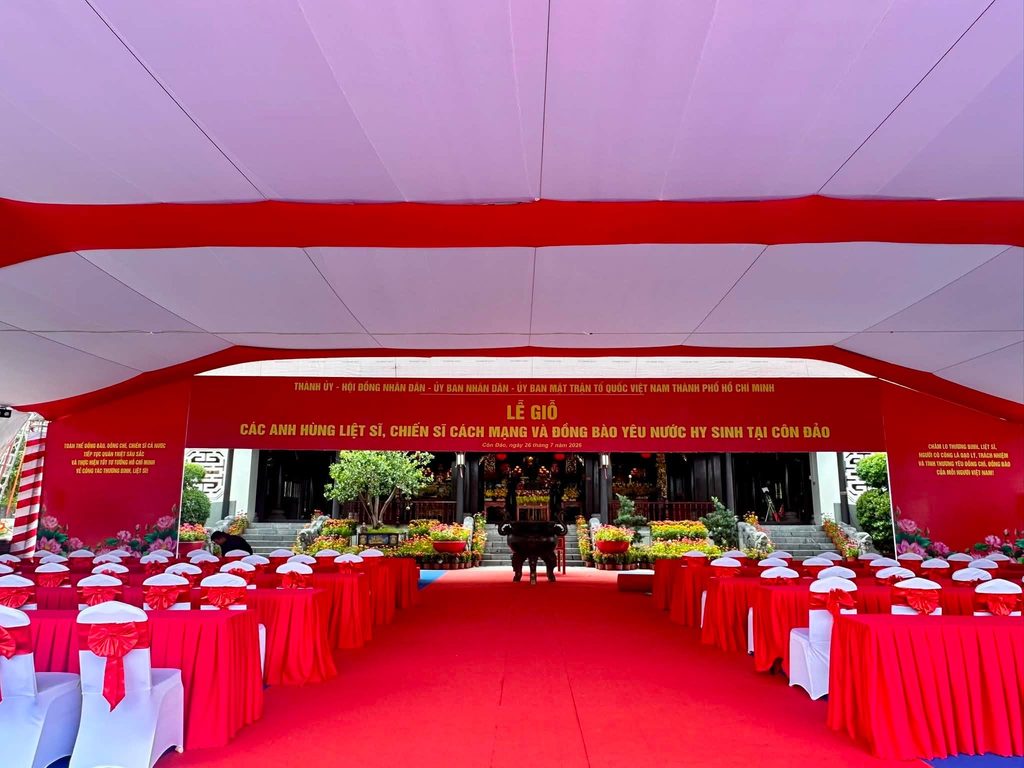
Every year on the 20th day of the sixth lunar month, Côn Đảo holds a collective death-anniversary ceremony for fallen heroes, revolutionary fighters and patriots who died during the 113-year existence of the Côn Đảo prison system. This event has deep historical, cultural and spiritual meaning, expressing gratitude to generations who endured imprisonment, hardship and sacrifice for national independence and freedom.
The ceremony remembers not only recorded historical figures but also thousands of prisoners who never left Côn Đảo, many of whose identities, hometowns or resting places are still not fully known.
The origins of Côn Đảo’s collective memorial anniversary
Remembering those who died in the prison system has always held a special place in Côn Đảo residents’ cultural and religious life.
The locality has long maintained commemorations of prominent figures such as Võ Thị Sáu, a female Hero of the People’s Armed Forces, the late General Secretary Lê Hồng Phong and patriot Nguyễn An Ninh.
Yet over the prison system’s century-plus existence, far more people died on Côn Đảo than those individually identified and commemorated.
Some are recorded in historical archives, others survive in only a few lines of documentation, and some lives still cannot be fully identified.
Wishing to set aside a day to remember everyone who died, former Côn Đảo political prisoners researched records, discussed the matter and agreed on a collective memorial date.
Since 2012, the 20th day of the sixth lunar month has been chosen as the anniversary to remember and honor revolutionary fighters and patriots who died on Côn Đảo.
The event gradually became a meaningful gathering and commemoration for former political prisoners, relatives of the deceased, residents and people interested in Côn Đảo’s history.
Why was the 20th day of the sixth lunar month chosen?
The choice was not arbitrary but connected with research into historical records of prisoners who died on Côn Đảo.
According to A new memorial anniversary on Côn Đảo, published by the Government Online Newspaper on 24 July 2019, former political prisoner and historian Dr. Bùi Văn Toản was among those researching and compiling information about the deaths.
Analyzing records for more than 3,200 prisoners for whom information had been found, researchers recorded these tragic figures for 1942:
- On 1 August 1942, corresponding to the 20th day of the sixth lunar month in the Nhâm Ngọ year, 124 prisoners died.
- August 1942 alone recorded 335 deaths.
- The whole of 1942 recorded 1,048 deaths.
These historical figures were published through research and reflect the severity of the prison regime at that time.
On the basis of these records and agreement among many former political prisoners, the Côn Đảo Former Prisoners’ Liaison Committee selected the 20th day of the sixth lunar month as the collective memorial date.
The anniversary remembers not only those who died in 1942, but generations of revolutionary fighters and patriots who died throughout the prison system’s existence from 1862 to 1975.
The ceremony’s meaning for Côn Đảo’s history
The Côn Đảo prison system was established by French colonial authorities in 1862 and continued to be used in subsequent periods until the island’s liberation on 1 May 1975.
For more than 113 years, generations of patriots, revolutionary fighters and political prisoners were confined in the island’s prisons.
Harsh living conditions, illness, forced labor, torture and repression prevented many from ever returning home.
Today, cemeteries, graves and prison remains provide important evidence of that period.
However, not everyone who died has a clearly identified grave.
Many remain at Hàng Dương Cemetery, Hàng Keo Cemetery and elsewhere on the island. In some cases, information about the deceased still requires further research, cross-checking and additions.
That gives the collective ceremony its particular meaning: remembering everyone who died, whether their names have been recorded or their identities remain unknown.
It also allows generations of former political prisoners to reunite, remember their comrades and share memories of prison life.
For young people, the anniversary is a chance to learn historical stories through records, witnesses and preserved sites.
The collective ceremony at Côn Đảo Memorial Temple
Côn Đảo Memorial Temple is one of the important places associated with the collective anniversary.
It commemorates fallen heroes, revolutionary fighters and patriots who died on Côn Đảo.
At documented ceremonies, solemn memorial rituals were attended by former political prisoners, representatives of agencies, associations and the armed forces, relatives and residents.
Incense offerings and remembrance are central to the ceremony, expressing reverence and gratitude to the deceased.
According to the People’s Public Security Newspaper, the 2023 ceremony took place at Côn Đảo Memorial Temple on the morning of 6 August, corresponding to the 20th day of the sixth lunar month in the Quý Mão year.
Nearly 200 former Côn Đảo and wartime prisoners attended that year, alongside representatives of various forces and many residents.
Bells, incense and stories of generations of prisoners made the gathering deeply meaningful.
The timing, attendees and accompanying activities may be adjusted each year. Visitors should therefore not assume that all rituals are identical from year to year.
Remembering those who remain on Côn Đảo
The ceremony is a collective remembrance, but behind the historical figures are individual human lives.
Many notable historical figures died on Côn Đảo, including:
Lê Hồng Phong (1902–1942): A revolutionary leader and former General Secretary of the Indochinese Communist Party, who died during imprisonment on Côn Đảo.
Nguyễn An Ninh (1900–1943): A patriot, journalist and influential thinker in the anti-colonial movement in southern Vietnam, who died on Côn Đảo.
Võ Thị Sáu (1933–1952): A female Hero of the People’s Armed Forces, executed by French colonial authorities on Côn Đảo, who became a symbol of courage and patriotism.
Vũ Văn Hiếu (1907–1940): A steadfast communist fighter who died during imprisonment on Côn Đảo.
Alongside widely known figures are many fighters and patriots whose names have not been fully recorded.
The collective anniversary is an occasion to remember all those lives.
Remembrance extends beyond people named on gravestones to those whose resting places have not been found, whose lives have become part of the islands’ historical memory.
Distinguishing the collective anniversary from 27 July and Vu Lan
The collective ceremony is often mentioned among remembrance activities, but it should be distinguished from other observances.
Côn Đảo’s collective anniversary on the 20th day of the sixth lunar month: A collective commemoration of fallen heroes, revolutionary fighters and patriots who died in the Côn Đảo prison system.
War Invalids and Martyrs Day on 27 July, Gregorian calendar: A nationwide day remembering and honoring fallen heroes, wounded and disabled veterans, veterans with service-related illness, martyrs’ families and people who rendered service to the revolution.
Vu Lan at the full moon of the seventh lunar month: An occasion associated with filial gratitude and remembrance of ancestors, parents and the deceased in Buddhist and folk cultural and religious life.
Although all three express gratitude and remembrance, they have different origins, meanings and ways of determining their dates.
In particular, the 20th day of the sixth lunar month does not correspond to a fixed Gregorian date every year.
For example, the ceremony in 2023 fell on 6 August in the Gregorian calendar. That conversion applies only to the Quý Mão year and must not be used as a fixed date for subsequent years.
Can visitors attend Côn Đảo’s collective ceremony?
The anniversary is a meaningful commemoration for former political prisoners, relatives and the Côn Đảo community.
Visitors interested in history can learn about the program and arrange to attend appropriate activities when permitted by the organizers.
Before traveling, check the Gregorian date corresponding to lunar 20/6 in the intended year, ceremony times, venue and participant guidance.
At Côn Đảo Memorial Temple and other remembrance sites, dress respectfully, maintain order, avoid pushing and follow the organizers’ instructions.
Keep offerings simple and in accordance with the place of worship’s rules; limit single-use plastic and non-biodegradable items.
Reverence is not measured by the scale of offerings but by respect for the memorial space, other participants and the place’s history.
Combining the ceremony with a historical journey on Côn Đảo
Visitors wishing to learn more about Côn Đảo’s history can combine a trip for the collective anniversary with visits to historic sites.
Hàng Dương Cemetery: The resting place of many revolutionary fighters and patriots who died on Côn Đảo.
Hàng Keo Cemetery: A historical burial ground for prisoners who died during the prison system’s existence.
Côn Đảo Museum: Preserves documents, photographs and artifacts reflecting the prison system’s establishment and existence and resistance movements.
The Côn Đảo Prison system: Includes Phú Hải, Phú Sơn and Phú Thọ prisons, the French Tiger Cages, American Tiger Cages and many other historic sites.
Take time to hear guided explanations, read materials and learn the stories associated with each place.
Approaching history carefully, respecting evidence and listening to witnesses can make the memorial journey more profound.
Preserving the memory of generations who sacrificed
In the decades since liberation, Côn Đảo has changed considerably. Roads, residential areas and facilities serving everyday life and tourism have developed, giving the islands a new appearance.
Yet historical values remain preserved in cemeteries, prison sites, museums and memorial spaces.
Amid that change, the collective anniversary on lunar 20/6 holds lasting meaning. It is a day to remember those who died, even when their names have not been fully recorded.
The ceremony also recalls the responsibility to continue research, verify information, preserve records and pass historical stories to future generations.
Côn Đảo’s collective anniversary on the 20th day of the sixth lunar month is more than a memorial ritual: it is a tribute to lives that helped shape the islands’ history.
Amid Côn Đảo’s sea and sky today, burning incense expresses gratitude, respect for the past and the wish to preserve the memory of those who sacrificed for national independence and freedom.