
In the history of the struggles of women political prisoners on Côn Đảo, Hero of the People’s Armed Forces Trần Thị Thanh, also known as Nguyễn Thị Hoa, devoted her youth to revolutionary activity and spent nearly nine years detained in several prisons.
Orphaned at an early age and raised in a poor farming family in the Đất Đỏ area, she soon joined the local women’s movement and revolutionary activities. Arrested in 1964, she passed through prisons in Bà Rịa, Tân Hiệp and Chí Hòa before being exiled to Côn Đảo in 1970.
On 30 April 1973, Trần Thị Thanh died at Côn Đảo Prison at just 30. In the memories preserved by former women prisoners, she is remembered not only for her steadfast resistance but also for her simple affection for family and comrades, especially the pillowcases and handkerchiefs she embroidered to send to loved ones.
Today, her grave is in Section C of Hàng Dương Cemetery, Côn Đảo, where residents and visitors offer incense and remember a woman who died so young.
Who was Hero Trần Thị Thanh (Nguyễn Thị Hoa)?
Trần Thị Thanh, also known as Nguyễn Thị Hoa, was born in 1943 and was a woman revolutionary associated with Phước Thạnh in the Đất Đỏ area.
According to the Southern Women’s Museum, she originally came from Quảng Nam, lost her parents as a child and was taken in and raised by Lê Văn Tiễn and his wife Trần Thị Nguyên in Phước Thạnh Commune.
Meanwhile, some local biographical records state that she was born in Phước Thạnh, in the former Đất Đỏ area.
Although accounts of her birthplace and family origins differ, the sources agree that Phước Thạnh was where she grew up, matured and began her revolutionary activities.
Her adoptive parents’ family faced financial difficulties and lived mainly by farming.
Because of these circumstances, Trần Thị Thanh could not complete her education. After learning to read and write, she had to leave school to help her parents.
Her deprived childhood instilled early independence, a sense of responsibility and a strong bond with her family.
In the memories of her contemporaries, she is described as a devoted daughter, sincere and close to local people, and always concerned for those around her.
Joining the women’s movement in Long Đất in 1963
In the early 1960s, political struggle and revolutionary activity in the Đất Đỏ area developed as the war grew increasingly intense.
Many local women took part in mobilizing the public, supporting revolutionary forces and organizing struggles in communes and hamlets.
In 1963, at the age of 20, Trần Thị Thanh left home to work in the women’s movement of Long Đất District.
This was an important turning point in her life.
From a girl raised in the countryside, she began taking on work mobilizing the public, building women’s organizations and participating in the local struggle.
With guidance from more experienced cadres, she gradually learned organizational work, communication and public mobilization.
Her enthusiasm and sense of responsibility led to additional assignments in the women’s movement in Phước Thạnh and surrounding areas.
Joining the Youth League and the Party in 1964
In January 1964, Trần Thị Thanh was admitted to the Revolutionary Youth League of Southern Vietnam.
During her activities, she received guidance and help from local cadres and Party members.
According to historical records, Party members Trần Văn Cương and Nguyễn Văn Trung helped recommend her for Party membership.
In June 1964, Bùi Văn Hải, also known as Hoàng, secretary of the Phước Thạnh Commune Party cell, organized her Party admission ceremony.
This marked a new stage in Trần Thị Thanh’s development as a revolutionary activist.
She continued to help build the women’s movement, mobilize the public and carry out the tasks assigned by the organization.
In wartime, these activities were often clandestine, requiring caution and close coordination with local bases.
The incident at Đất Đỏ Market and Trần Thị Thanh’s arrest
In mid-1964, the struggle in the Đất Đỏ area continued amid conflict between revolutionary forces and the Republic of Vietnam authorities.
According to historical documents, the local Party cell planned an attack on a commune chief known as Ba Cụt, whom revolutionary forces accused of taking part in suppressing the local movement.
Trần Thị Thanh volunteered for the assignment.
In preparation, she stayed at the home of a resident known as Má Hai in Phước Thạnh Commune, a convenient place from which to observe the situation.
One morning, she disguised herself as a market shopper and approached the target in the Đất Đỏ Market area.
According to the surviving accounts, at about 8 a.m., when Ba Cụt appeared in front of the market, Trần Thị Thanh carried out a grenade attack.
However, the grenade failed to explode.
After the incident, she tried to leave the scene but was pursued and arrested.
According to the Southern Women’s Museum, Trần Thị Thanh had an impairment in one leg that made running difficult. The guerrilla group positioned some distance away to support her was also unable to intervene in time.
She was arrested in the Đất Đỏ Market area.
Interrogations after her arrest
Following her arrest, Trần Thị Thanh was taken to the police office in Đất Đỏ for questioning.
According to accounts of her life, her interrogators tried to obtain information about the organization and individuals involved in preparing the attack.
She firmly refused to provide information about revolutionary bases.
Despite beatings and pressure, she accepted responsibility for her own actions and did not identify others involved in organizing them.
She was then put in a vehicle and transferred toward the Bà Rịa military subregion headquarters.
During the journey, Trần Thị Thanh tried to escape from the vehicle but failed and remained in custody.
This began years of imprisonment across several prisons, far from her family and home.
Years in Tân Hiệp Prison
After detention in Bà Rịa, Trần Thị Thanh was transferred to Tân Hiệp Prison.
There, she was held in Camp F, also called the sentence-enforcement camp.
Tân Hiệp was one of the facilities used to detain political prisoners during the war, where many were interrogated, held in isolation and subjected to harsh living conditions.
While at Tân Hiệp, Trần Thị Thanh met other women political prisoners and gradually joined resistance activities within the prison.
One person who influenced her was a woman political prisoner usually called Ba Hòa, a Party member involved in the prison Party cell’s activities.
From the isolation camp, Ba Hòa sent letters encouraging Trần Thị Thanh to participate in collective activities.
She responded actively and joined other women prisoners in raising demands concerning detention and living conditions.
According to former prisoners’ recollections, protests at Tân Hiệp were frequently suppressed. Many people were injured and weakened by torture, inadequate food and prison conditions.
In early 1969, the resistance movement of women political prisoners at Tân Hiệp grew stronger. Trần Thị Thanh continued protesting against the prison regime and defending the group’s demands alongside her comrades.
Transfer to Chí Hòa Prison in May 1969
On 4 May 1969, Trần Thị Thanh and several other women political prisoners were transferred from Tân Hiệp to Chí Hòa Prison in Saigon.
She was placed in the B4 isolation section together with Ba Hòa.
At Chí Hòa, the women’s resistance movement continued to be organized under the direction of the prison Party cell.
According to historical accounts, the struggle steering committee was headed by Trương Mỹ Hoa, with Trần Thị Hòa as deputy and members including Đoàn Thị Khánh and Đoàn Thị Hương.
Women prisoners were assigned to different groups, including logistics, first aid and political struggle.
Trần Thị Thanh joined the youth vanguard, supporting collective activities in very difficult conditions of detention.
Resistance at Chí Hòa took various forms, including hunger strikes, opposition to solitary confinement and demands for better living conditions.
Although years of imprisonment had already affected her health, she remained active in the group’s activities.
Commemorating President Hồ Chí Minh in Chí Hòa Prison
In September 1969, when President Hồ Chí Minh died, women political prisoners at Chí Hòa organized commemorative activities despite their confinement.
According to recorded recollections, they prepared a memorial ceremony together and held collective activities to express their remembrance.
Prison authorities obstructed these activities, leading to prolonged struggles.
During this period, Trần Thị Thanh continued to participate alongside the other women, assisting those in poor health and carrying out assigned tasks.
Besides joining protests, she and her comrades continued their general education, exchanged knowledge and organized activities to sustain their spirits in prison.
For many women political prisoners, the bond with fellow detainees became an important source of support throughout their years of confinement.
Those bonds remained with Trần Thị Thanh when she was transferred to Côn Đảo.
1970: Trần Thị Thanh is exiled to Côn Đảo
In 1970, Trần Thị Thanh was transferred from Chí Hòa Prison to Côn Đảo Prison with many other women political prisoners.
Those exiled to the island with her included Võ Thị Nguyệt, Út Ra, Ba Hòa, Cẩm Nhung, Hiền and others.
On arrival at Côn Đảo, Trần Thị Thanh was confined in Room 15 of Camp 4.
During this period, the Côn Đảo prison system continued to impose a strict regime on political prisoners, especially those involved in resistance movements within the camps.
Deprivation, illness and repeated crackdowns severely affected the health of many women prisoners.
In these circumstances, Trần Thị Thanh maintained contact with her comrades, took part in collective life and shared her few possessions with others in the same situation.
According to recorded memories, she was sociable and affectionate, always attentive to the sick and frequently encouraging other women prisoners.
Pillowcases, handkerchiefs and keepsakes for her family
One of the most moving stories about Trần Thị Thanh’s years on Côn Đảo concerns the pillowcases and handkerchiefs she embroidered by hand as keepsakes.
In the deprivation of prison, obtaining fabric and thread and finding time to make small items was not easy.
Nevertheless, she tried to make them in the hope of one day sending them to her adoptive parents, younger brother and other loved ones.
The items had little monetary value but held the feelings of a daughter who had been separated from her family for years.
According to former women prisoners, Trần Thị Thanh once told Ba Hòa that if she could not return, she hoped her comrades would deliver these keepsakes to her relatives.
Her request expressed her longing for her family and the quiet preparations of someone who had spent years in detention without knowing when she might have a chance to return home.
In later years, the story of the pillowcases and handkerchiefs became a special part of the memory of Hero Nguyễn Thị Hoa.
Comradeship and her words to Ba Hòa
Besides her affection for her family, Trần Thị Thanh is remembered for her concern for fellow prisoners.
According to accounts in materials about her life, Ba Hòa once suffered from malaria and was very weak.
Trần Thị Thanh visited and encouraged her, expressing a wish to bear the pain her comrade was enduring.
In the story that has been passed down, she referred to growing up in the homeland of Hero Võ Thị Sáu as a way of expressing pride and responsibility toward her comrades.
Former women prisoners remembered those heartfelt words as a lasting example of Trần Thị Thanh’s affection.
No one knows whether she then had any premonition of her own death.
But only a short time later, her comrades witnessed Trần Thị Thanh’s death in detention.
30 April 1973: Trần Thị Thanh dies on Côn Đảo
On 30 April 1973, Trần Thị Thanh died at Côn Đảo Prison at just 30.
According to historical accounts and former prisoners’ recollections, her health deteriorated seriously in her final days after years of imprisonment and torture.
Sources differ in their details about the circumstances immediately leading to her death.
Some recollections state that she developed a fever and rapidly became critically ill. Material from the Southern Women’s Museum also records testimony concerning an injection said to have seriously harmed her health.
Meanwhile, commemorative materials from the Côn Đảo heritage management authority emphasize the repression and torture she suffered amid coercive measures against political prisoners after the Paris Agreement.
Although sources differ on the final sequence of events, they consistently record her death on 30 April 1973 and her imprisonment on Côn Đảo.
Trần Thị Thanh’s death brought profound grief to her fellow prisoners.
She had been not only a comrade in their struggles, but someone who shared their years of deprivation, illness and hopes of returning home.
Women political prisoners bid farewell to Trần Thị Thanh
When they learned of Trần Thị Thanh’s death, women political prisoners on Côn Đảo organized protests against the prison regime and expressed their grief.
According to recollections, they used the loudspeaker system in the detention area to denounce repression and demanded permission to go outside to accompany their comrade to her resting place.
Under strict control, even arranging a farewell was difficult.
Nevertheless, her fellow prisoners found ways to express affection and respect for the deceased.
Trần Thị Thanh died very young, leaving behind comrades who had shared many difficult years with her.
For them, her death was not only the loss of an individual, but also a reminder of the fate of many women political prisoners detained during the war.
Keepsakes returned after liberation
One of the most memorable details of Trần Thị Thanh’s life is that her keepsakes eventually reached her family.
According to the Liaison Committee of Former Political Prisoners of Bà Rịa–Vũng Tàu Province, after national reunification, a former woman political prisoner from Bến Tre delivered the items Trần Thị Thanh had left behind to her relatives.
They were the pillowcases and handkerchiefs she had embroidered during her years at Côn Đảo Prison.
Her comrades had finally fulfilled the request she had made earlier.
These small gifts became keepsakes of a daughter who could not return to reunite with her family.
The story also illustrates the bond among people who had lived and struggled together in prison. Although the war had ended and they returned to different places, they kept their promise to their deceased comrade.
This detail helps preserve Trần Thị Thanh’s memory not only through events of resistance, but also through family affection and comradeship.
Trần Thị Thanh is posthumously named a Hero of the People’s Armed Forces
On 28 April 2000, the President posthumously awarded Trần Thị Thanh, also known as Nguyễn Thị Hoa, the title Hero of the People’s Armed Forces.
The honor recognizes her contributions to the revolutionary movement in the Đất Đỏ area, her resistance after arrest and her steadfast years within the prison system.
From joining the women’s movement in 1963 to her death on Côn Đảo in 1973, she lived through a decade of upheaval.
Nearly nine of her final years were spent in the prisons of Bà Rịa, Tân Hiệp, Chí Hòa and Côn Đảo.
Her life forms part of the history of women in southern Vietnam who joined the revolutionary movement, were arrested and continued resisting even in captivity.
Where is the grave of Hero Nguyễn Thị Hoa (Trần Thị Thanh)?
Today, the grave of Hero and martyr Nguyễn Thị Hoa, also known as Trần Thị Thanh, is in Section C of Hàng Dương Cemetery, Côn Đảo.
Hàng Dương Cemetery is the resting place of many revolutionary fighters, patriots and people held in the Côn Đảo prison system.
Section C is associated with prisoners who died during the wartime period from the 1960s to 1975.
Here, visitors can learn about other historical figures, including Hero Huỳnh Tấn Lợi, who also died at Côn Đảo Prison in May 1973.
The gravestone bears both the names Nguyễn Thị Hoa and Trần Thị Thanh, helping visitors identify the correct grave.
For visitors wishing to learn about Côn Đảo’s women political prisoners, this is a place of remembrance with particular significance.
Visitors should dress appropriately, preserve the quiet atmosphere and respect the cemetery management’s rules.
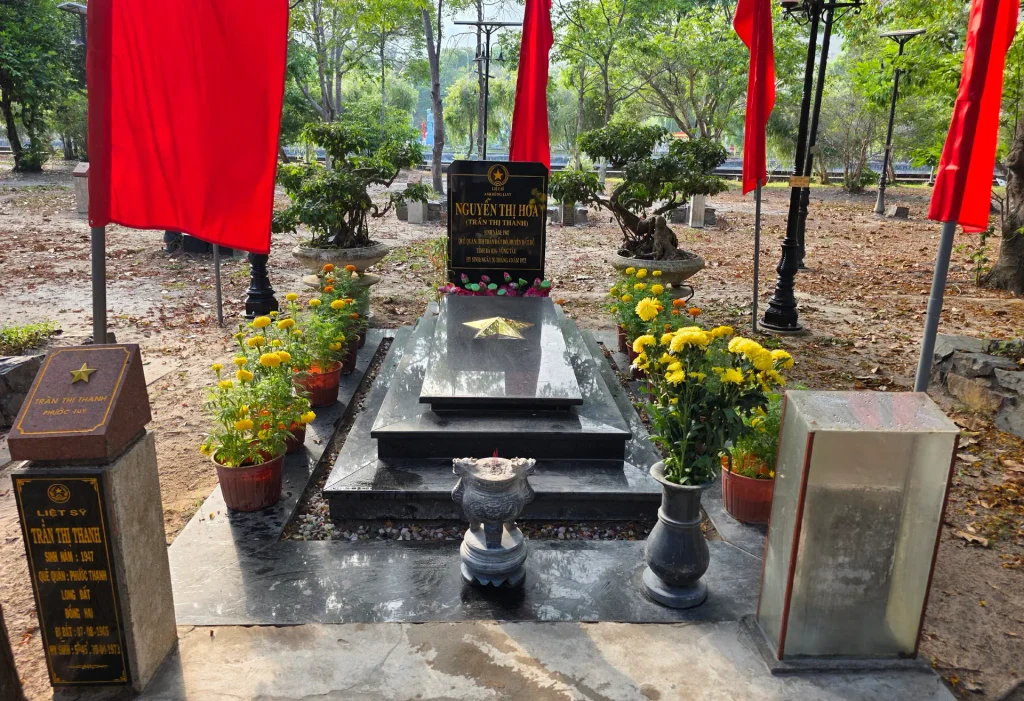
Commemorating Hero Nguyễn Thị Hoa on 30 April
Each year, 30 April marks not only the anniversary of national reunification but also the remembrance of Hero and martyr Nguyễn Thị Hoa’s death.
On Côn Đảo, heritage management agencies have organized incense and flower offerings and recalled her revolutionary life.
On 30 April 2025, a ceremony marking the 52nd anniversary of her death was held on Côn Đảo, attended by officials and staff of the heritage management authority.
Then, on 30 April 2026, the 53rd anniversary ceremony took place in Section C of Hàng Dương Cemetery and at Côn Đảo Memorial Temple.
These activities express gratitude and help introduce Nguyễn Thị Hoa’s life to later generations.
Through the stories retold, participants can better understand the experiences of women once imprisoned, wartime losses and the importance of preserving historical memory.
Trần Thị Thanh and the memory of Côn Đảo’s women political prisoners
The history of Côn Đảo Prison records not only collective struggles, crackdowns and important political events, but also the stories of individuals.
Among them were women who were very young when arrested, separated from their families and subjected to years of detention.
Trần Thị Thanh was one of them.
From an orphaned girl raised in a poor farming family in the Đất Đỏ area, she joined the women’s movement, became a Party member and took part in revolutionary activity in her early twenties.
After her arrest in 1964, she passed through several prisons before dying on Côn Đảo on 30 April 1973.
Those years are preserved in historical works, accounts by fellow prisoners and small keepsakes returned to her family.
While the accounts of resistance reveal Trần Thị Thanh’s steadfast spirit, the story of the pillowcases and handkerchiefs shows a very everyday aspect of her life.
It is her longing for her parents, affection for her younger brother and concern for comrades sharing the same ordeal.
Today, her grave in Section C of Hàng Dương Cemetery is a place where residents and visitors can pause to remember and learn about a woman revolutionary who died very young.
Learning about her life is also a way to approach Côn Đảo’s history through memories of human kindness, courage and the irreplaceable losses of war.
Reference sources
- “Steadfast and Unyielding”, Liaison Committee of Former Political Prisoners of Bà Rịa–Vũng Tàu Province, 2009, pp. 135–137.
- “History of the Struggle of Patriotic and Revolutionary Fighters in Côn Đảo Prison (1862–1975)”, National Political Publishing House, 2010, pp. 460–463.
- Southern Women’s Museum, “The story of Hero of the People’s Armed Forces Nguyễn Thị Hoa (Trần Thị Thanh)”, 19 November 2020.
- Côn Đảo National Heritage Conservation Center, materials for the 52nd anniversary commemoration of Nguyễn Thị Hoa’s death, 30 April 2025.
- Côn Đảo National Heritage Conservation Center, materials for the 53rd anniversary commemoration of Nguyễn Thị Hoa’s death, 30 April 2026.