
Hero of the People’s Armed Forces Phan Đình Tựu (1936–1968) was a revolutionary from Quảng Nam who died during the struggle against compulsory flag salutes at Côn Đảo Prison. Despite disability, imprisonment and torture under harsh conditions, he remained steadfast and used revolutionary songs to encourage his comrades. His singing has become part of the memory of political prisoners’ resistance in Côn Đảo’s Tiger Cages.
Who was Phan Đình Tựu?
Phan Đình Tựu was born in 1936 in Bảo An village, Điện Quang commune, Điện Bàn district, Quảng Nam Province, now part of Gò Nổi commune, Đà Nẵng.
His father was Phan Quang Đình and his mother was Huỳnh Thị Tao. In 1946, when he was ten, he moved with his mother to Giảng Hòa village, Đại Thắng commune, Đại Lộc district, Quảng Nam Province.
Phan Đình Tựu grew up during the intense resistance against French colonial rule. His home province of Quảng Nam had a strong revolutionary movement, with many residents joining resistance forces and building local revolutionary networks.
In 1961, at the age of 25, Phan Đình Tựu left his family to join the revolution. He went to a resistance base, adopted the name Phan Tề and was assigned to Unit V10 of Quảng Nam Province’s main forces.
From then on, he took part directly in armed operations in the mountainous and upland areas of Quảng Nam.
Wounded, captured and sentenced to life imprisonment
In 1963, during fighting in the western Quế Sơn and Hiệp Đức area, Phan Đình Tựu was seriously wounded, unable to move and captured by opposing forces.
After capture, he was imprisoned in Hội An. He was subsequently transferred to Thừa Phủ Prison in Huế for trial.
According to accounts of his life, at trial he rejected accusations intended to discredit his revolutionary activities. Rather than submit, he openly stated his position and opposed the suppression of the struggle for the liberation of the South.
Because of this firm stance, he was sentenced to life imprisonment.
On 26 June 1965, Phan Đình Tựu was transferred from the mainland to Côn Đảo Prison, where he spent nearly three further years in detention and resistance before his death.
His first days of exile on Côn Đảo
In the mid-1960s, Côn Đảo was one of the Republic of Vietnam government’s major places of detention for political prisoners.
Many prisoners convicted in mainland prisons were transferred to the island to continue serving their sentences under strict surveillance and isolation.
According to accounts recorded in sources on Côn Đảo political prisoners, from the moment they landed, Phan Đình Tựu and the prisoners travelling with him faced threats and beatings intended to force compliance with prison regulations.
He was placed in Room 1 of Camp II with many other prisoners.
One requirement imposed by the prison administration was participation in the Saigon government’s flag-saluting ceremony.
Political prisoners who did not recognize that government regarded compulsory flag salutes as a means of forcing them to abandon their convictions.
Those refusing were subjected to disciplinary measures, solitary confinement and torture.
Phan Đình Tựu chose to join the resistance to compulsory flag salutes early in his imprisonment at Côn Đảo.
Two years of struggle amid illness and imprisonment
During 1966–1967, Phan Đình Tựu continually faced repression because of his firm opposition to compulsory flag salutes.
The injuries dating from his capture, together with torture and deprivation in prison, caused his health to deteriorate.
According to historical sources, both his legs were paralysed, making movement extremely difficult.
Nevertheless, Phan Đình Tựu actively participated in general education, political discussions and activities supporting morale with his cellmates.
He also wrote poems, memorized revolutionary songs and used his singing to encourage his comrades.
In cramped detention spaces lacking light and air, these seemingly simple activities were profoundly important to prisoners’ inner lives.
Studying, reciting poetry and singing helped them endure isolation and maintain solidarity within the group.
For Phan Đình Tựu, although he could no longer walk normally, he could continue his struggle through his will, words and singing.
The anti-flag-salute movement at Côn Đảo in 1968
In late 1967 and early 1968, resistance to compulsory flag salutes among convicted political prisoners at Côn Đảo grew strongly.
From a small group still persevering after earlier repression, the movement gradually gained members as new prisoners arrived on the island.
According to sources on the political prisoners’ movement, the roughly five people still resisting in early 1967 had grown to around 70 participants in the isolation area by 1968.
Phan Đình Tựu was among those who remained steadfast during this period.
As the movement expanded, the prison administration intensified repression and transferred many political prisoners to the Tiger Cages.
There, prisoners were held in small cells with their feet shackled, deprived of adequate drinking water and food, and frequently punished.
Recorded forms of repression included crowding many people into one cage, scattering powdered lime from above and restricting medical care.
Prisoners who continued to resist organized hunger strikes, demanding an end to torture, improved living conditions and treatment consistent with their status as political prisoners.
Repression in the Tiger Cages in May 1968
In early May 1968, repression of Côn Đảo political prisoners became especially severe.
According to prison histories, island governor Nguyễn Văn Vệ, the administration and prison order forces implemented various measures to break the prisoners resisting flag salutes.
Phan Đình Tựu was among those repeatedly tortured.
During interrogations, he was often questioned about his refusal to perform the Republic of Vietnam government’s flag-saluting ceremony.
According to a record of the exchange, when asked why he lived under the Saigon government but refused to salute its flag, he stated:
“I am a fighter of the National Liberation Front of South Vietnam, and the Front represents the people of the South. Therefore, I do not recognize the Saigon government.”
The answer clearly expressed Phan Đình Tựu’s position while imprisoned.
After his protests, he continued to be beaten, placed in solitary confinement and shackled. Already disabled, his health became even more serious.
However, the repression did not make him abandon his views.
Phan Đình Tựu’s singing in Côn Đảo’s Tiger Cages
One of the most frequently recalled images of Phan Đình Tựu is his singing during his detention in the Tiger Cages.
When many prisoners were exhausted after torture, Phan Đình Tựu still tried to sing revolutionary songs to raise his comrades’ spirits.
His voice rang through the rows of cells, past iron doors, walls and the isolation area’s narrow courtyard.
For prisoners suffering from hunger, illness and isolation, it was encouragement that they were not alone in their struggle.
The songs also allowed prisoners to maintain a sense of connection even when they could not meet or speak directly.
In these circumstances, Phan Đình Tựu’s singing meant more than ordinary artistic activity.
It became a form of resistance through morale, expressing refusal to submit to coercion.
For that reason, the prison continued to intensify repression to stop him and other prisoners from encouraging one another.
Phan Đình Tựu dies during the 1968 struggle
According to essays and recollections about Côn Đảo political prisoners cited in the original material, in late May 1968 Phan Đình Tựu continued to face repression for his determined resistance and use of singing to encourage his comrades.
Some accounts allege that a member of the prison order forces known as Tám Kính secretly injected him with a substance at night. This detail comes from memoirs and requires further comparison with historical records to fully establish the circumstances of his death.
The Côn Đảo National Relics Conservation Centre records that Phan Đình Tựu died on the night of 28 May 1968, following repression in the French Tiger Cages.
He was just 32, after nearly three years of exile on Côn Đảo.
Phan Đình Tựu’s death brought grief to his fellow prisoners, while becoming a milestone in the movement to preserve their integrity in prison.
In the following months, resistance to compulsory flag salutes continued intensely, with many prisoners undertaking prolonged hunger strikes to demand an end to repression and improved detention conditions.
These struggles helped force the prison administration to change some coercive measures applied to political prisoners.
Posthumously awarded the title of Hero of the People’s Armed Forces
On 26 April 2018, the President posthumously awarded Phan Đình Tựu the title of Hero of the People’s Armed Forces, recognizing his contributions and sacrifice in the struggle for national liberation.
This prestigious title recognized the life of the revolutionary from Quảng Nam who fought in his homeland, was wounded and captured, received a life sentence and continued resisting during his years of imprisonment on Côn Đảo.
Although short, Phan Đình Tựu’s life was marked by memorable milestones, especially his refusal to submit during the movement against compulsory flag salutes.
The image of a paralysed prisoner still singing to encourage his comrades became one of the stories preserved in the history of Côn Đảo political prisoners’ struggle.
Where is Hero Phan Đình Tựu’s grave on Côn Đảo?
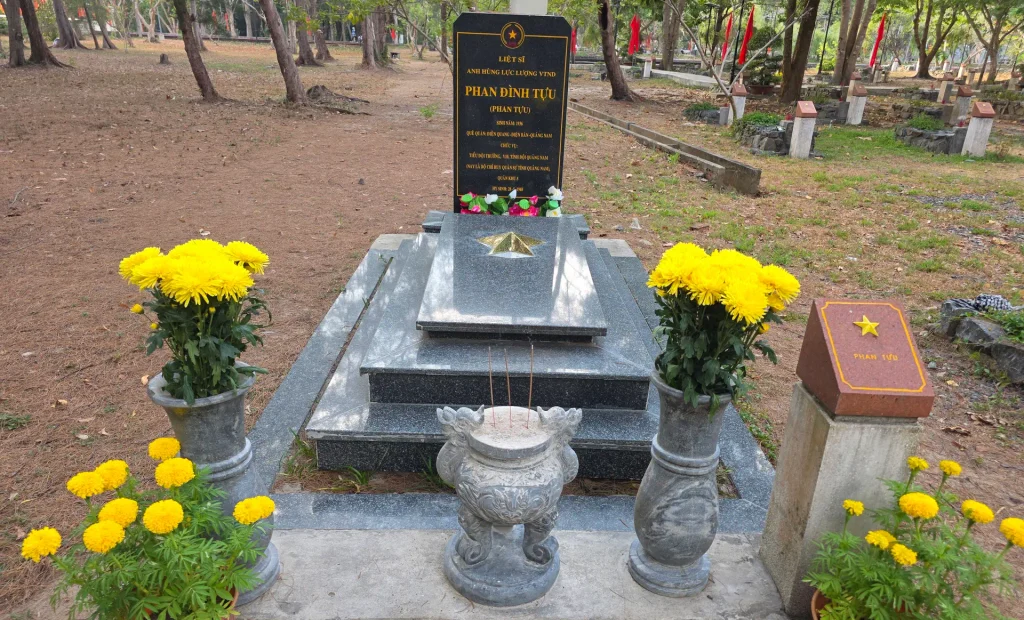
The grave of Hero of the People’s Armed Forces Phan Đình Tựu is now in Section C of Hàng Dương Cemetery, Côn Đảo.
This is the resting place of many revolutionaries and patriots who died while imprisoned at Côn Đảo, particularly from around 1960 onwards.
Section C also contains the graves of numerous heroes and martyrs, including Lê Tự Kình, Lê Văn Việt, Huỳnh Tấn Lợi and Nguyễn Thị Thanh.
Visitors to Phan Đình Tựu’s grave can follow the signs to Section C or ask cemetery staff for help locating it.
When visiting, dress respectfully, maintain the quiet atmosphere, follow the rules for incense offerings and protect the heritage setting.
Learning about Phan Đình Tựu’s life beforehand helps visitors understand the grave’s significance and the struggles that took place on Côn Đảo.
Visiting Côn Đảo’s Tiger Cages and learning about Phan Đình Tựu’s struggle
To better understand Phan Đình Tựu’s detention and resistance, visitors can combine Hàng Dương Cemetery with a visit to the French Tiger Cages.
This is an important site within the historical complex of Côn Đảo Prison.
The French Tiger Cages were built with small cells and overhead iron bars allowing guards to observe and control prisoners. The walkway above the cells was once used for various forms of repression.
Today, the preserved cell blocks, prison yards and objects help visitors imagine aspects of prisoners’ living conditions in the past.
Stories of the anti-flag-salute movement, hunger strikes and political prisoners’ solidarity are also presented through guided interpretation at the site.
Among them, Phan Đình Tựu’s story and his singing in the Tiger Cages form a memorable part of Côn Đảo’s history of resistance.
Commemoration day for Hero Phan Đình Tựu
Each year, 28 May in the Gregorian calendar marks the anniversary of Hero of the People’s Armed Forces Phan Đình Tựu’s death, according to Côn Đảo’s heritage management body.
On 28 May 2026, the 58th anniversary of his death was commemorated at Hàng Dương Cemetery and the Côn Đảo Memorial Temple.
Representatives of the heritage management body, officials, staff and visitors attended, offering incense and flowers to honour the fallen revolutionary.
For visitors exploring Côn Đảo’s history, this is also an occasion to recall political prisoners’ struggles in 1965–1968, especially the movement against compulsory flag salutes in the Tiger Cages.
Remembering a revolutionary and his unyielding voice
Phan Đình Tựu devoted his youth to revolutionary activity, fought in his native Quảng Nam and maintained his determination during imprisonment on Côn Đảo.
From a fighter in Unit V10 to a prisoner serving a life sentence, he endured many trials, injuries and losses.
What has made his story memorable across generations is not only his firmness during interrogations but also the way he encouraged his comrades when he seemingly had no strength left.
Despite paralysis in both legs, illness and harsh detention conditions, he still used singing to strengthen fellow prisoners’ spirits.
Today, at Hàng Dương Cemetery or Côn Đảo’s Tiger Cages, Phan Đình Tựu’s story helps visitors understand another aspect of prison history: alongside direct confrontation, moral strength was sustained through words, poems and songs.
Phan Đình Tựu died, but the story of the revolutionary singing in the Tiger Cages remains in Côn Đảo’s historical memory, recalling steadfastness, comradeship and the sacrifice of those who endured years of imprisonment.
Sources
People of Quảng Nam and Côn Đảo, Liaison Committee of Former Côn Đảo Political Prisoners in Đà Nẵng, Đà Nẵng Publishing House.
Steadfast and Unyielding, various authors, Quảng Nam Association of Patriotic Former Prisoners, 2005, pp. 204–219.
Red Seeds, documentary essays, pp. 12–13 (as cited in the original material).
Côn Đảo National Relics Conservation Centre, Ceremony Marking the 58th Anniversary of the Death of Hero of the People’s Armed Forces Phan Đình Tựu, 28 May 2026.
Côn Đảo tourism portal, Hàng Dương Cemetery: A Sacred Symbol of Revolutionary Tradition.