
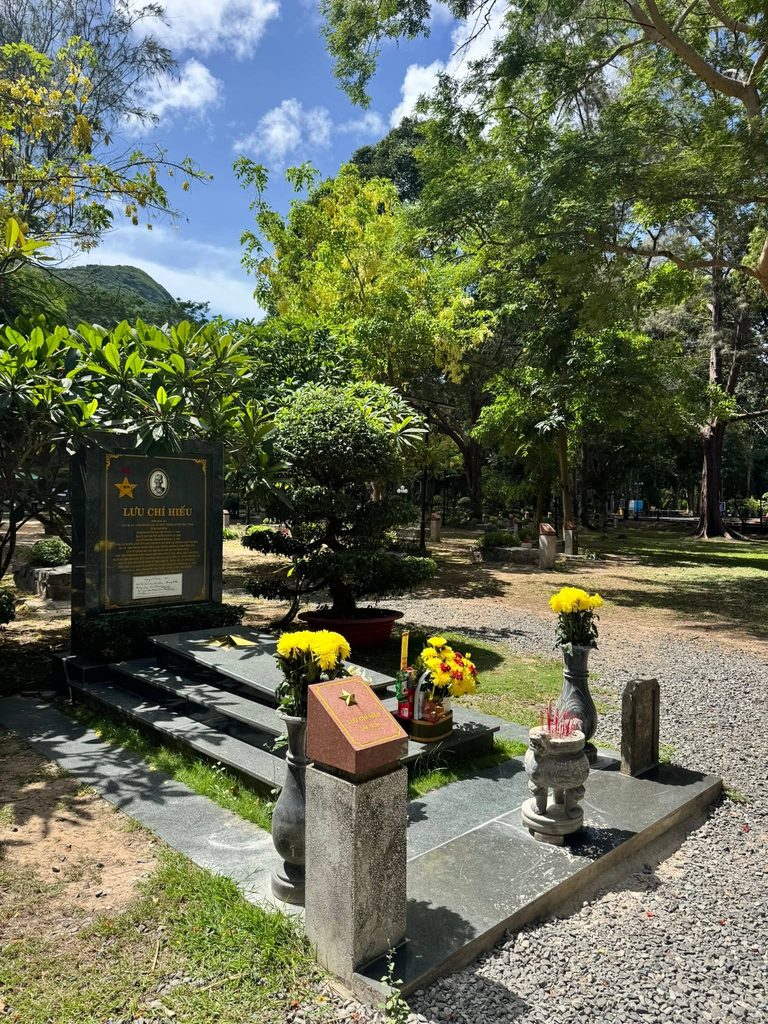
Hero of the People’s Armed Forces Lưu Chí Hiếu (1913–1961) was a prominent political prisoner in the struggle against forced renunciation of Party membership at Côn Đảo Prison. After more than four years of imprisonment and torture, he remained steadfast and refused to abandon his revolutionary ideals. He died in the Tiger Cages on the night of 24 December 1961, aged just 48. His grave is now in Section B2 of Hàng Dương Cemetery, Côn Đảo.
Who was Lưu Chí Hiếu?
Lưu Chí Hiếu, whose birth name was Lưu Đình Tập, was born in 1913 in Hương Cát village, Trực Thành commune, Trực Ninh district, Nam Định Province, now part of Cát Thành commune, Ninh Bình Province.
Born into a working family, he lost his parents at an early age and was raised by his paternal uncle, who sent him to the village school. He later went to Hải Phòng to learn shoemaking.
From a young age, Lưu Chí Hiếu encountered the patriotic movement and revolutionary ideas. He took part in liaison work, propaganda, printing documents and mobilizing the public in his home region.
In late 1934, he sought to restore contact with the revolutionary movement, helped build the Democratic Youth organization and encouraged local residents to campaign for their rights.
In 1942, Lưu Chí Hiếu moved to Saigon and continued revolutionary activities among industrial and urban workers.
Having trained as a craftsman, he understood working people’s hardships. His close ties with the public helped him develop within the revolutionary movement in Saigon–Gia Định.
Revolutionary activity in Saigon–Gia Định
In May 1945, Lưu Chí Hiếu joined the Vanguard Youth movement, an organization that played an important role in mobilizing the public in southern Vietnam before the August Revolution.
In August 1945, he joined the revolutionary administration in Saigon–Gia Định. When resistance against French colonial rule broke out in the South, he continued participating in armed forces and activities supporting the resistance.
In April 1946, Lưu Chí Hiếu was recruited into Operations Committee 4. In the following years, he remained active in revolutionary units involved in organizing local resistance forces, including the 950th Determined-to-Die Battalion.
After the Geneva Accords of 1954, the political situation in southern Vietnam changed considerably. Revolutionary networks had to move underground under increasingly strict surveillance and pursuit.
In July 1954, Lưu Chí Hiếu was transferred to a district Party committee’s labour mobilization section in Saigon, where he continued organizing workers and maintaining revolutionary networks.
On 6 July 1955, he was arrested by the Saigon authorities while carrying out his activities.
After nearly two years of imprisonment, on 20 March 1957, Lưu Chí Hiếu was sent to Côn Đảo, beginning the harshest years of struggle in his life.
The struggle against forced renunciation of Party membership at Côn Đảo
From 1957 to 1961, the Côn Đảo prison authorities used various measures to force political prisoners to abandon their revolutionary convictions.
Prisoners were required to declare their renunciation of the Communist Party, take part in anti-communist denunciation activities, salute the flag and perform political ceremonies prescribed by the Saigon authorities.
Those who firmly refused were subjected to especially harsh detention. They were isolated, given limited drinking water and inadequate food, denied sufficient medical care and frequently tortured.
In these circumstances, resistance to forced renunciation became one of the defining movements among Côn Đảo’s political prisoners.
As soon as he arrived on the island, Lưu Chí Hiếu joined those determined to resist this coercion.
He and his comrades maintained solidarity, encouraging one another to endure beatings and defend their chosen convictions.
Throughout the four years from 1957 to 1961, despite continuous imprisonment and abuse, Lưu Chí Hiếu refused to sign pledges abandoning his revolutionary ideals.
Lưu Chí Hiếu’s declaration that he would not renounce the Party
The prolonged struggle exhausted many prisoners. Some died, some suffered severe injuries and others could no longer endure the suffering.
As the number of prisoners firmly resisting renunciation dwindled, some suggested making partial concessions to preserve their lives.
In response, Lưu Chí Hiếu stated his position:
“Discuss whatever you wish, but do not discuss renouncing the Party. Do not decide that I should renounce it. I am not going anywhere.”
He continued encouraging his comrades to remain resolute, believing that their struggles in prison would eventually be recognized by history.
According to accounts of his life, Lưu Chí Hiếu once said:
“The Party taught us to fight, not to surrender.”
For Lưu Chí Hiếu, remaining steadfast was not simply an individual prisoner’s choice. He believed it was also a responsibility towards comrades who had died and those continuing the struggle outside the prison.
In a written statement of his position, he affirmed that he would not renounce the Party and was prepared to take responsibility for that decision.
His words and determined stance became a source of moral support for political prisoners sharing his circumstances.
His final days in Côn Đảo’s Tiger Cages
The Tiger Cages were among the harshest detention areas in the Côn Đảo prison system.
The cramped cells, cement floors, overhead iron bars and deprivation made this a place associated with many tragic stories in the prison’s history.
Between 1957 and 1961, many political prisoners who firmly resisted renunciation were sent to the Tiger Cages for further repression.
Lưu Chí Hiếu was one of them.
After years of imprisonment and torture, his health steadily deteriorated. On one occasion, he vomited blood following a beating, yet the abuse continued.
According to historical sources, in the final days of 1961 the prison authorities intensified torture involving cold water to break the prisoners who continued to resist renunciation.
During one such episode, dozens of buckets of water were poured over Lưu Chí Hiếu in succession amid the harsh detention conditions.
On the night of 24 December 1961, he died in Côn Đảo’s Tiger Cages.
Lưu Chí Hiếu’s death caused profound grief among contemporary political prisoners and became a memorable milestone in the struggle against forced renunciation at Côn Đảo Prison.
A revolutionary remembered by his comrades
In Côn Đảo Prison’s history, the anti-renunciation movement of 1957–1961 is associated with many political prisoners who steadfastly defended their convictions and died during repression.
Alongside Lưu Chí Hiếu were people such as Cao Văn Ngọc, Phạm Thành Chung, Ngô Đến, Hoàng Chất, Nguyễn Công Tộc and many other fighters.
Their sacrifices contributed to defeating coercive attempts to make political prisoners abandon their ideals.
Generations of political prisoners have remembered Lưu Chí Hiếu as one of the most outstanding examples of this struggle.
Notably, on 3 February 1972, political prisoners in Camp VI, Section B of Côn Đảo Prison established a Party organization named Lưu Chí Hiếu.
Naming the prison Party organization after a fallen comrade expressed the respect and remembrance of those continuing the struggle.
For them, Lưu Chí Hiếu was not only a prisoner who had died, but also a symbol of steadfastness and comradeship in harsh circumstances.
Posthumously awarded the title of Hero of the People’s Armed Forces
On 23 February 2010, President Nguyễn Minh Triết signed a decision posthumously awarding the martyr Lưu Chí Hiếu the title of Hero of the People’s Armed Forces, recognizing his contributions and sacrifice in the revolutionary cause.
This honoured the life’s work of a revolutionary who began as a shoemaker, struggled in Saigon–Gia Định and maintained his integrity in Côn Đảo Prison.
Lưu Chí Hiếu is remembered not only on Côn Đảo but also in his hometown of Hương Cát and at reunions of former political prisoners.
Stories about him continue to be preserved in memoirs, historical documents, his comrades’ accounts and memorials.
Where is Hero Lưu Chí Hiếu’s grave on Côn Đảo?
The grave of Hero of the People’s Armed Forces Lưu Chí Hiếu is in Section B2 of Hàng Dương Cemetery, Côn Đảo.
This is one of the resting places for revolutionaries and patriots who died during imprisonment on Côn Đảo.
His grave has a memorial stone recording the main milestones of his life, his date of death and the title of Hero of the People’s Armed Forces posthumously awarded by the State.
Visitors to Hàng Dương Cemetery can locate his grave in Section B2 by following the signs or asking cemetery management staff for assistance.
When visiting, dress respectfully, preserve the quiet atmosphere, offer incense only in designated places and protect the heritage setting.
If time allows, visitors can also explore the French Tiger Cages to better understand the detention conditions and political prisoners’ struggles on Côn Đảo.
Commemoration day for Hero Lưu Chí Hiếu
Each year, 24 December in the Gregorian calendar is the day commemorating Hero of the People’s Armed Forces Lưu Chí Hiếu, marking his death at Côn Đảo Prison in 1961.
For many years, agencies and organizations on Côn Đảo, together with family members and former political prisoners, have held incense-offering ceremonies in his memory at Hàng Dương Cemetery.
On 24 December 2025, the 64th anniversary of Lưu Chí Hiếu’s death was commemorated in Section B2 of Hàng Dương Cemetery and at the Côn Đảo Memorial Temple, with government representatives, relatives and visitors attending.
These commemorations not only honour the deceased but also introduce later generations to the history of political prisoners’ struggle on Côn Đảo.
Remembering Lưu Chí Hiếu and Côn Đảo’s political prisoners
Lưu Chí Hiếu’s life spans important stages of Vietnam’s revolutionary history, from the patriotic movement in his home region and Saigon’s labour movement to his years of imprisonment on Côn Đảo.
He did not hold senior leadership positions, but his steadfastness in prison left a deep impression on his comrades.
In the harshest days in the Tiger Cages, when his life was constantly threatened, he still chose not to abandon the ideals he had followed.
Today, visitors to Lưu Chí Hiếu’s grave at Hàng Dương Cemetery can learn about an ordinary man of powerful resolve and the struggles that took place behind the walls of Côn Đảo Prison.
Lưu Chí Hiếu’s story is also part of Côn Đảo’s historical memory, recalling the sacrifices of people who contributed to the country’s independence, peace and unification.
Sources
- Materials supplied by the family of the martyr Lưu Chí Hiếu.
- History of the Struggle of Patriots and Revolutionaries at Côn Đảo Prison (1862–1975), National Political Publishing House, 2010, pp. 351–367.
- Côn Đảo National Relics Conservation Centre, Commemorating the 53rd Anniversary of the Death of Vietnamese Hero of the People’s Armed Forces Lưu Chí Hiếu.
- Côn Đảo National Relics Conservation Centre, The 64th Commemoration Ceremony for Hero of the People’s Armed Forces Lưu Chí Hiếu, 24 December 2025.
- Bà Rịa–Vũng Tàu Museum, Political Prisoners’ Struggle against Renunciation through Côn Đảo Prison Documents.
- Nam Định newspaper, Lưu Chí Hiếu: A Steadfast Revolutionary, 29 April 2016.