
Võ Thị Sáu’s grave is in Section B of Hàng Dương Cemetery, on Côn Sơn Island in the Côn Đảo Special Zone, Ho Chi Minh City. It is the resting place of Võ Thị Sáu, a female Hero of the People’s Armed Forces from Đất Đỏ, who died on Côn Đảo on 23 January 1952 while still very young.
Today, her grave is one of the places where many local residents and visitors come to offer incense and pay their respects. She is affectionately known as Cô Sáu, so phrases such as “Cô Sáu’s grave,” “visiting Cô Sáu on Côn Đảo” and “Cô Sáu cemetery” often appear in travel information.
However, several historic places are associated with Võ Thị Sáu. The memorial house in her hometown of Đất Đỏ, the Sở Cò historic site, Côn Đảo Memorial Temple and her grave in Hàng Dương Cemetery are separate locations. To offer incense at the grave itself, visitors need to find Section B of Hàng Dương Cemetery.
According to the published opening hours, the cemetery welcomes visitors from 07:00 to 11:30 and from 13:00 to midnight every day, including public holidays and Tết. You may visit during the day or in the evening; there is no requirement to wait until midnight.
This article explains where Võ Thị Sáu’s grave is, how to reach it from the high-speed ferry ports and Côn Đảo Airport, visiting hours, how to find the grave, what offerings to prepare and important advice for a smooth, respectful visit.
Where is Võ Thị Sáu’s grave on Côn Đảo?
Võ Thị Sáu’s grave is in Section B of Hàng Dương Cemetery, in the central area of Côn Sơn Island.
Hàng Dương Cemetery is part of the Côn Đảo Prison historic complex, designated a Special National Heritage Site under Decision No. 548/QĐ-TTg of 10 May 2012.
The cemetery lies along Võ Thị Sáu Street, with its main entrance on Nguyễn An Ninh Street, near Côn Đảo Memorial Temple.
For first-time visitors, the easiest option is to search for “Nghĩa trang Hàng Dương” on a map, go to the main gate and follow the signs to Section B.
Location details for Cô Sáu’s grave
| Information | Details |
|---|---|
| Name of grave | Grave of Võ Thị Sáu, Hero of the People’s Armed Forces |
| Location | Section B, Hàng Dương Cemetery |
| Main entrance | Nguyễn An Ninh Street |
| Area | Central Côn Sơn Island |
| Administrative area | Côn Đảo Special Zone, Ho Chi Minh City |
| Date of death | 23 January 1952 |
| Cemetery opening hours | 07:00–11:30 and 13:00–24:00 |
| Admission | Free, according to local tourism information |
| Parking | Free parking is available, according to the cemetery’s information |
Note that some documents further divide Section B of Hàng Dương Cemetery into B1 and B2. Older articles may therefore describe the location differently.
When looking for Võ Thị Sáu’s grave, follow the current signs in the cemetery or ask the management staff to ensure you reach the correct grave.
What makes Hàng Dương Cemetery significant?
Hàng Dương Cemetery is the resting place of generations of revolutionary fighters, patriots and prisoners who died on Côn Đảo while the prison system was in operation.
According to the Hàng Dương Cemetery information portal, the cemetery covers nearly 20 hectares and maintains 1,922 graves. Of these, 714 have been identified and 1,208 remain unidentified.
These figures should be distinguished from the estimated 20,000 people who died in the Côn Đảo Prison system. Not all of those people have a grave within Hàng Dương Cemetery today.
The four burial sections: A, B, C and D
The cemetery is divided into four main sections, reflecting different historical periods.
Section A: Mainly contains the graves of people who died before 1945. It includes the graves of former General Secretary Lê Hồng Phong, patriot Nguyễn An Ninh and Vũ Văn Hiếu, a Hero of the People’s Armed Forces.
Section B: Mainly associated with the period from 1945 to 1960 and part of the subsequent period. Võ Thị Sáu’s grave is here, alongside those of Cao Văn Ngọc, Hồ Văn Năm, Lưu Chí Hiếu and many other fighters.
Section C: Contains many graves of people who died between 1960 and 1975, including Lê Văn Việt, Trần Thị Thanh and other revolutionary fighters.
Section D: Holds remains relocated from Hàng Keo Cemetery, Hòn Cau and other burial places on Côn Đảo.
In addition to the burial sections, the cemetery has a ceremonial courtyard, a memorial, sculptures and paths set among trees and greenery.
Many delegations hold a collective remembrance ceremony here before visiting individual graves.
How to find Võ Thị Sáu’s grave inside Hàng Dương Cemetery
For first-time visitors to Côn Đảo, Cô Sáu’s grave is fairly easy to find by following the cemetery’s signs.
Step 1: Go to the main gate on Nguyễn An Ninh Street
Go to the main gate of Hàng Dương Cemetery, which provides access for visitors and those coming to offer incense.
Here you can check the site map, opening-hour notices and rules for protecting the grounds.
If you arrive by motorbike or car, park in the designated area as directed.
Step 2: Find the ceremonial courtyard
After entering the cemetery, you can proceed to the ceremonial courtyard and central memorial.
This is where ceremonies are held to offer incense and flowers and remember the heroes and martyrs who died on Côn Đảo.
For groups holding an official memorial visit, the ceremonial courtyard is usually the starting point.
Individual visitors may spend some time in remembrance here, following the guidance provided, before continuing to the burial sections.
Step 3: Follow the signs to Section B
From the ceremonial courtyard, follow the marked route to Section B.
According to the official itinerary of the Côn Đảo National Heritage Conservation Centre, visiting groups usually pass through Section A and then continue to Section B to offer incense at Võ Thị Sáu’s grave.
If your main purpose is to visit Cô Sáu’s grave, ask a member of staff for the most suitable route.
Do not take shortcuts between rows of graves or enter areas marked as restricted.
Step 4: Identify Võ Thị Sáu’s grave
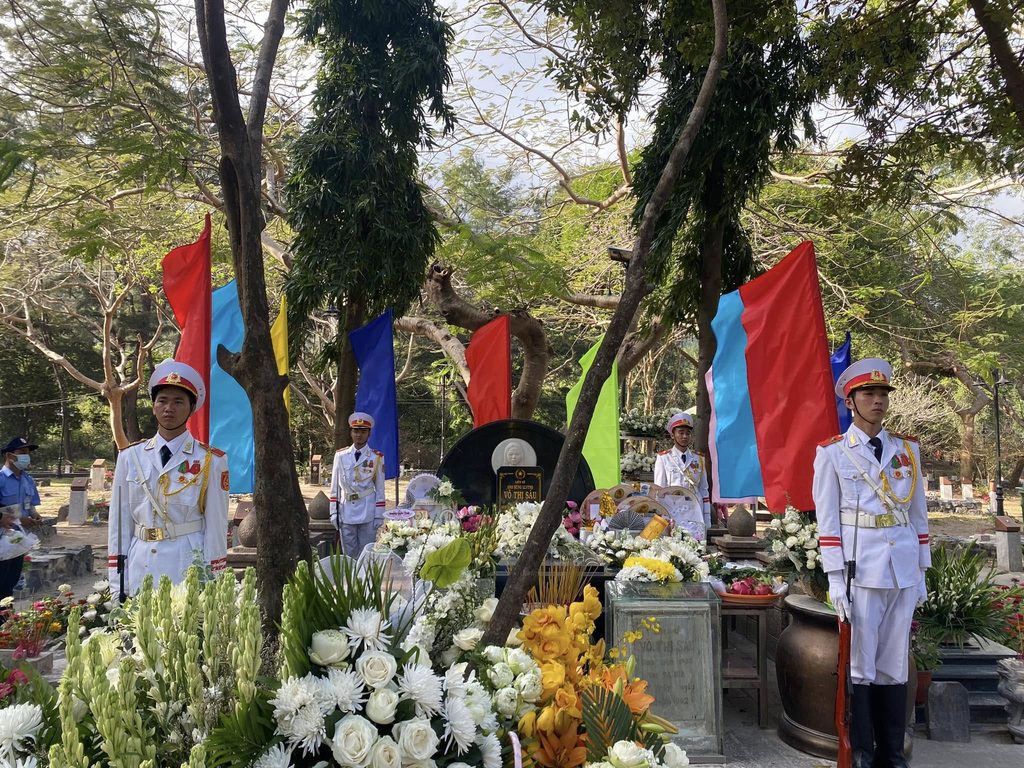
Võ Thị Sáu’s grave is built from dark stone and has a headstone bearing her name and portrait.
The area around the grave often contains fresh flowers and memorial offerings left by local residents and visitors.
On holidays, weekends and other busy occasions, you may have to queue to approach the incense-offering area.
Follow staff instructions, do not push through the crowd and do not place objects on the grave where signs prohibit this.
Visiting hours for Võ Thị Sáu’s grave at Hàng Dương Cemetery
The Hàng Dương Cemetery information portal of Ho Chi Minh City publishes the following visiting hours:
| Session | Hours |
|---|---|
| Morning | 07:00–11:30 |
| Afternoon and evening | 13:00–24:00 |
| Days open | Monday to Sunday |
| Public holidays and Tết | Open according to the published schedule |
Please note the midday break from 11:30 to 13:00. Access to some areas may be adjusted for major memorial ceremonies, maintenance or security requirements.
This information was cross-checked in November 2026. Visitors should check again before travelling, particularly if planning a visit on a major holiday.
Can you visit Cô Sáu’s grave at midnight?
The cemetery’s afternoon and evening visiting session ends at 24:00, or midnight.
If you want to visit late in the evening, arrive before closing time to allow enough time to walk to the grave and offer incense.
Do not arrive just before midnight and assume you will still be admitted.
In particular, there is no rule requiring visitors to visit Võ Thị Sáu’s grave at exactly midnight.
Some people choose this time because of their customs or personal beliefs. Offering incense during the day or in the evening is equally appropriate, provided you visit during opening hours and follow the rules.
Can you visit Cô Sáu’s grave in the morning?
Yes.
Morning is a good choice for visitors who want to combine a visit to the grave with learning about Hàng Dương Cemetery’s history.
Daylight makes it easier to read the headstones, view the sculptures and find your way around.
For families with young children, older visitors or anyone who wants more time to explore the history, a morning visit is often easier to fit into the itinerary.
What is different about visiting Cô Sáu’s grave in the evening?
Many people choose to visit Hàng Dương Cemetery in the evening.
Lighting makes remembrance activities possible, while the weather is often cooler than during the day.
However, some evening periods can be very crowded, especially on weekends, death anniversaries and public holidays.
To allow more time to offer incense and avoid the largest crowds, consider visiting early in the evening or on a weekday.
Choose a time that suits your health, transport arrangements and itinerary. You do not need to follow beliefs that a visit is meaningful only at a particular hour.
How to reach Võ Thị Sáu’s grave from central Côn Đảo
If you are staying in central Côn Sơn, you can reach Hàng Dương Cemetery by taxi, electric shuttle, motorbike or on foot if your hotel is nearby.
From the centre, take streets connecting to Võ Thị Sáu and Nguyễn An Ninh to reach the cemetery’s main gate.
As the distance depends on your hotel’s location, open a map and select “Cổng chính Nghĩa trang Hàng Dương” (Hàng Dương Cemetery main gate), rather than entering only Võ Thị Sáu’s name.
This helps you find the correct entrance for visitors.
By taxi or electric shuttle
Taxis and electric shuttles are convenient for families, groups of friends and parties with older travellers.
The vehicle takes you to the main gate, after which you continue on foot to the grave as directed.
When booking transport, specify Hàng Dương Cemetery’s main entrance on Nguyễn An Ninh Street.
If you plan to visit late in the evening, ask about arranging a return pickup in advance so you are not left searching for transport after your visit.
By motorbike
A motorbike suits small groups that want to manage their own schedule.
From central Côn Sơn, follow your map towards Nguyễn An Ninh Street.
Slow down as you approach the cemetery and watch for pedestrians and vehicles entering or leaving.
Park in the designated area and do not block the gate or paths.
Walking from your hotel
Some hotels close to Hàng Dương Cemetery are within walking distance.
For a daytime walk, bring drinking water, a hat and suitable footwear.
In the evening, choose well-lit streets and walk with relatives or friends where appropriate.
Older visitors and people with limited mobility should favour a transfer, as there is also walking between the burial sections inside the cemetery.
How to reach Cô Sáu’s grave from Bến Đầm Port
Bến Đầm Port is one of the arrival points for high-speed ferries and other sea transport to Côn Đảo.
It is in the south of Côn Sơn Island, approximately 12–15 km from the central area, depending on the route and exact destination.
If your ferry arrives at Bến Đầm, you need to travel by road from the port towards the centre before reaching Hàng Dương Cemetery.
From Bến Đầm Port to Hàng Dương Cemetery
After disembarking, passengers should proceed to the waiting area or vehicle pickup point as directed by port staff.
From there, you can take a taxi, a pre-booked transfer or another suitable vehicle.
The road from Bến Đầm to central Côn Sơn follows stretches of mountain and coastal scenery, before continuing to Hàng Dương Cemetery.
If you have only two days and one night on Côn Đảo, arrange transport before boarding the ferry, especially when travelling in a large group.
Should you go directly from the port to Cô Sáu’s grave?
You can, provided the ferry arrives at a suitable time, you do not have much luggage and transport is already arranged.
However, after the sea crossing, consider how you feel and whether you need to rest.
If the ferry arrives around midday, you can leave your luggage at the hotel, have lunch and rest before visiting the cemetery in the afternoon or evening.
This is often more convenient for groups with older people or young children.
How to reach Võ Thị Sáu’s grave from Côn Đảo Passenger Port
Côn Đảo Passenger Port is a sea-passenger facility on Tôn Đức Thắng Street in central Côn Sơn.
This modern port opened in 2023 and is separate from the historic Pier 914.
If your ferry arrives here, you can reach Hàng Dương Cemetery from the central area without the longer journey from Bến Đầm Port.
Taxis, electric shuttles and other suitable transport are available options.
However, not every high-speed ferry to Côn Đảo arrives at the central Passenger Port.
Before arranging a pickup, check the actual arrival port on your electronic ticket. Pickup and drop-off locations depend on the operator, route and daily operating plan.
For updates, see the Côn Đảo Express ferry schedule.
How to get from Côn Đảo Airport to Cô Sáu’s grave
Côn Đảo Airport, also known as Cỏ Ống Airport, is in the north of Côn Sơn Island.
The journey from the airport to the central area is approximately 12–14 km, depending on the destination.
After collecting your luggage, you can take a taxi or a pre-booked transfer to Hàng Dương Cemetery.
If your flight arrives in the morning, you could visit Côn Đảo Museum or go to your hotel before heading to the cemetery.
If you arrive in the afternoon, consider checking in and resting first, then offering incense in the evening if the cemetery is still open.
Groups should agree on the pickup point and destination with their transport provider to avoid confusion between Hàng Dương Cemetery and other memorial sites.
What should you prepare for a visit to Võ Thị Sáu’s grave?
One common question when visiting Côn Đảo is what offerings to prepare for Cô Sáu’s grave.
There is no single mandatory set of offerings for every visitor.
Your choice depends on your customs, personal circumstances and the cemetery’s current rules.
Fresh flowers
Fresh flowers are a simple, common offering that suits the memorial setting.
You may bring white chrysanthemums, lotus flowers, tuberoses or other fresh flowers.
Choose a reasonably sized bouquet and limit floral foam, plastic bags and non-biodegradable plastic accessories.
Fruit and simple offerings
Some visitors prepare fruit, cakes or vegetarian offerings.
Bring an appropriate amount and avoid buying too much, which creates waste and extra rubbish.
Groups can prepare a shared offering basket to make transport and the ceremony easier.
Do you need to bring a mirror, comb, hat or scarf?
As part of the customs associated with visiting Cô Sáu, some people bring a mirror, comb, hat or scarf.
These items are linked to the religious customs of some members of the community; they are not compulsory offerings.
If you choose to bring them, select real, compact items and place them only where the management permits.
There is no need to buy expensive offering sets or to assume that more offerings make a visit more meaningful.
Do not use votive paper or single-use plastics
This is an especially important rule for visitors to Hàng Dương Cemetery.
Côn Đảo has introduced the Green Offering Basket programme to reduce waste and encourage respectful, environmentally friendly remembrance practices.
Under the published rules, visitors must not burn votive paper money or paper offerings within the cemetery, or use plastic bags and single-use plastic products.
Older advice about bringing large amounts of votive paper, burning offerings or leaving plastic items should therefore be updated to reflect the current rules.
Suggested order for offering incense at Hàng Dương Cemetery
Individual visitors do not have to arrange a lengthy ceremony or hire someone to guide the rituals.
However, if you would like a formal itinerary to follow, you can use the route introduced by the Côn Đảo National Heritage Conservation Centre.
Pay respects at the central ceremonial area
First, you can visit the ceremonial courtyard and memorial to spend some time remembering the fallen heroes and martyrs.
For official visiting groups, this is where participants gather, observe a minute of silence and offer incense as part of the programme.
Visit the graves in Section A
Next is Section A, which contains the graves of Lê Hồng Phong, Nguyễn An Ninh and Vũ Văn Hiếu.
These graves are associated with important stories in the history of the revolutionary movement and the Côn Đảo Prison system.
If possible, take time to learn about the historical figures who rest here.
Visit Võ Thị Sáu’s grave in Section B
After Section A, continue to Section B.
This is where Võ Thị Sáu and many other fighters are buried.
At the grave, queue as directed, offer flowers or incense in the designated places and remain quiet.
Do not put offerings directly on the grave if signs prohibit this.
Visit Sections C and D
If time permits, continue to Sections C and D to offer incense in memory of those who died or whose remains were brought to the cemetery.
The management’s suggested itinerary allows approximately 45 minutes for a visit to the whole of Hàng Dương Cemetery.
Large groups or visitors wishing to explore the history in detail may need longer.
Should you also visit Côn Đảo Memorial Temple?
Côn Đảo Memorial Temple is next to Hàng Dương Cemetery. It was built to commemorate the heroes, martyrs, revolutionary fighters and patriots who died on Côn Đảo.
It is a suitable place to include in the same remembrance itinerary.
However, the temple’s opening hours may differ from those of Hàng Dương Cemetery, especially in the evening.
If you intend to visit both, consider going to the temple during the day and choosing a suitable time for Hàng Dương Cemetery.
For groups holding a formal memorial ceremony, the Côn Đảo National Heritage Conservation Centre asks for registration at least one working half-day in advance, during office hours.
You can call 0254 3830 517 for guidance.
Learn more in the article about Côn Đảo Memorial Temple.
Why do so many people visit Võ Thị Sáu’s grave?
Võ Thị Sáu was a revolutionary fighter from Đất Đỏ who joined the resistance against French colonial rule at a very young age.
After her arrest in 1950, she was imprisoned in Bà Rịa and Saigon before being sent to Côn Đảo in January 1952.
On 22 January 1952, she was held separately at Sở Cò, a judicial police facility within the Côn Đảo Prison system.
On the morning of 23 January 1952, the French colonial authorities took her to be executed.
Her life and sacrifice became an important part of the history of the resistance movement in southeastern Vietnam.
She was later posthumously awarded the title Hero of the People’s Armed Forces.
Beyond her historical significance, Võ Thị Sáu has become a figure in literature, music and the religious lives of many people.
The affectionate name Cô Sáu conveys the community’s closeness, respect and fondness for her.
Today, many visitors come to her grave to offer incense in remembrance, learn about history or carry out rituals according to their own customs.
Beliefs about her sacred powers belong to the realm of folk religion and should be distinguished from documented historical events.
Must you visit on Võ Thị Sáu’s death anniversary?
No.
You can visit Võ Thị Sáu’s grave on other days of the year during Hàng Dương Cemetery’s opening hours.
23 January in the Gregorian calendar commemorates the date she died on Côn Đảo.
Meanwhile, the death-anniversary ceremony in her hometown of Đất Đỏ is held on the 27th day of the twelfth lunar month.
On the anniversary, official commemorations may take place at her grave and at Côn Đảo Memorial Temple.
However, not every event is held directly in front of the grave. Times, locations and participants depend on each year’s programme.
If you do not wish to attend an official ceremony, choose an ordinary day for a more flexible itinerary.
See the article Võ Thị Sáu’s death anniversary in the lunar and Gregorian calendars to understand the different commemorative dates.
Important advice for visiting Cô Sáu’s grave
Dress respectfully
Hàng Dương Cemetery is a historical place of remembrance.
Wear modest, respectful clothing suitable for walking and offering incense.
Avoid very short clothing or anything inappropriate for a solemn setting.
Keep noise down
Inside the cemetery, speak quietly, do not play loud music and avoid activities that disturb others offering incense.
At Võ Thị Sáu’s grave in particular, follow instructions when it is crowded.
Do not touch graves or artefacts without permission
Do not sit or stand on graves, or move offerings or objects placed in the memorial area without permission.
Help preserve the site’s buildings, headstones and historical artefacts.
Do not bring pets into the cemetery
Under Hàng Dương Cemetery’s rules, pets are not allowed inside.
Arrange suitable care for them before your visit.
Reduce waste and follow the Green Offering Basket rules
Do not use votive paper or single-use plastics.
After offering incense, handle belongings, packaging and offerings according to the management’s instructions.
Do not leave rubbish or food at graves without permission.
Take care when visiting in the evening
For an evening visit, use well-lit paths, wear suitable footwear and watch for steps.
Older people, young children and anyone who needs help walking should have someone accompany them.
Do not enter poorly lit areas or go beyond permitted areas.
Travelling to Côn Đảo by high-speed ferry to visit Võ Thị Sáu’s grave
For visitors coming from the mainland, high-speed ferries are one way to reach Côn Đảo.
Routes may connect Côn Đảo with Trần Đề, Vũng Tàu or Saigon, depending on the operating schedule for the period.
However, island ferry times and frequencies can change with the season, weather and operator’s plans.
If your main purpose is to visit Cô Sáu’s grave, choose a ferry that reaches Côn Đảo early enough on the first day to allow time to check in, rest and offer incense.
For a two-day, one-night trip, you can visit Hàng Dương Cemetery on the first evening and use the following morning to see other historic sites or prepare for your return.
If you plan to attend an anniversary ceremony with a fixed start time, consider arriving on the island the previous day rather than taking a ferry on the morning of the ceremony.
Check both outward and return sailings before booking non-refundable accommodation.
You can consult our guide to visiting Cô Sáu on Côn Đảo by ferry to prepare for the trip.
Frequently asked questions about Võ Thị Sáu’s grave
Where is Võ Thị Sáu’s grave?
Võ Thị Sáu’s grave is in Section B of Hàng Dương Cemetery, Côn Đảo Special Zone, Ho Chi Minh City.
Is Cô Sáu’s grave in Section A or Section B?
Cô Sáu’s grave is in Section B. Section A contains the graves of historical figures including Lê Hồng Phong, Nguyễn An Ninh and Vũ Văn Hiếu.
How do you get to Cô Sáu’s grave?
Go to Hàng Dương Cemetery’s main gate on Nguyễn An Ninh Street, then follow the signs to Section B or ask the management staff at the site.
What time does Hàng Dương Cemetery close?
According to the published schedule, the cemetery is open daily from 07:00 to 11:30 and from 13:00 to midnight.
Can you visit Cô Sáu in the evening?
Yes. You may visit during the permitted evening hours, but arrive before closing time and follow the cemetery’s instructions.
Do you have to visit Cô Sáu at midnight?
No. There is no requirement to visit at exactly midnight. Residents and visitors may offer incense during the day or evening within opening hours.
Is there an admission fee to visit Võ Thị Sáu’s grave?
According to local tourism information, entry to Hàng Dương Cemetery to offer incense and pay respects is free. Transport, offerings and visits to other attractions that charge admission are paid for separately.
Can you visit Cô Sáu’s grave independently?
Yes. Individuals and families can visit independently during opening hours without having to buy a tour or hire someone to conduct a ceremony.
Is Cô Sáu’s grave at the Võ Thị Sáu Memorial House?
No. The memorial house is in her hometown of Đất Đỏ on the mainland. Võ Thị Sáu’s grave is in Hàng Dương Cemetery on Côn Sơn Island.
Is it far from Bến Đầm Port to Cô Sáu’s grave?
Bến Đầm Port is approximately 12–15 km from central Côn Sơn, depending on the route. Visitors need road transport to reach Hàng Dương Cemetery.
What should you bring when visiting Cô Sáu?
You may bring fresh flowers, fruit or simple offerings. There is no need to bring many items. Follow the Green Offering Basket rules and do not use votive paper or single-use plastics.
Are the visiting hours the same for Cô Sáu’s grave and Côn Đảo Memorial Temple?
Not necessarily. Hàng Dương Cemetery has evening visiting hours until midnight, while Côn Đảo Memorial Temple has its own schedule. Check ahead if you intend to visit both.
When is Cô Sáu’s death anniversary observed on Côn Đảo?
On Côn Đảo, the anniversary is associated with 23 January in the Gregorian calendar, commemorating her death on 23 January 1952. Follow the announcements for the specific programme each year.
Võ Thị Sáu’s grave: an important place of remembrance on Côn Đảo
Among the trees and greenery of Hàng Dương Cemetery, the grave of the heroine Võ Thị Sáu is one of the places that many residents and travellers visit on Côn Đảo.
It is associated with the life and sacrifice of a female revolutionary fighter and forms part of the heritage sites preserving the memory of more than a century of Côn Đảo Prison’s existence.
For first-time visitors, finding the right location, understanding the opening hours and knowing the cemetery’s rules will make the journey easier.
But the value of the visit goes beyond finding the grave or performing an incense-offering ritual.
Taking time to learn about Võ Thị Sáu’s life, the story of Sở Cò and the history of Hàng Dương Cemetery helps visitors understand the circumstances, choices and sacrifices of people who lived through a turbulent period.
You can visit the grave on any day during opening hours; there is no need to choose the anniversary or midnight.
Whether you travel to Côn Đảo by high-speed ferry or plane, the most important things are careful preparation, a respectful attitude and a willingness to learn about history when entering this place of remembrance.
Check high-speed ferry schedules to Côn Đảo
If you plan to travel by sea to visit Võ Thị Sáu’s grave, check the ferry schedule, departure port, arrival port and return sailing before booking accommodation.
Con Dao Express provides information about high-speed ferry routes to Côn Đảo, schedules, indicative ticket prices and practical guidance for planning your journey.
See the Côn Đảo Express ferry schedule to choose suitable outward and return dates.
Ferry schedules may change due to weather and operating plans. Confirm your sailing’s status before departure.
Reference sources
- Hàng Dương Cemetery Information Portal, Ho Chi Minh City: grave locations, opening hours, rules and visitor guidance.
- Côn Đảo National Heritage Conservation Centre: itineraries for visiting Hàng Dương Cemetery and Côn Đảo Memorial Temple.
- Côn Đảo Tourism Information Portal: information about the cemetery, historic sites, commemorative activities and the Green Offering Basket programme.
- Vietnam News Agency, Võ Thị Sáu profile: biography and historical milestones.
- Prime Minister’s Decision No. 548/QĐ-TTg of 10 May 2012 on the designation of Special National Heritage Sites.
Map of Võ Thị Sáu’s grave
Open Võ Thị Sáu’s grave on Google Maps. The map shows the place listed as “Mộ AHLLVTNDVN Võ Thị Sáu” inside Hàng Dương Cemetery. Once there, follow the signs to Section B or ask the management staff for the correct route.