
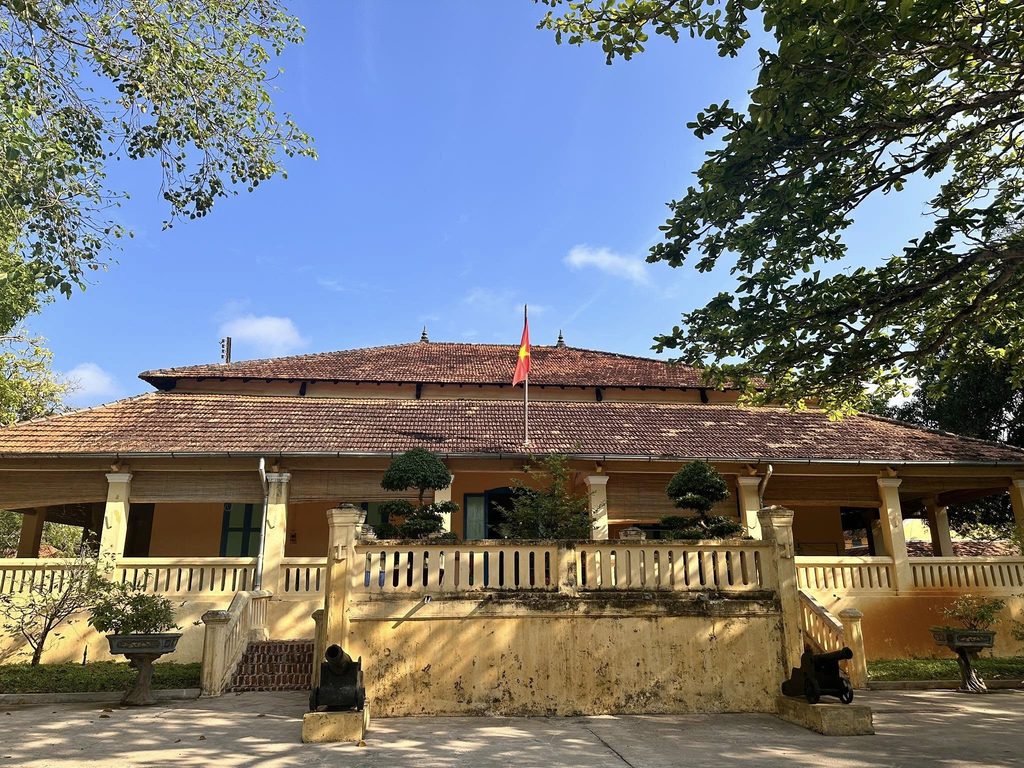
On Tôn Đức Thắng Street, opposite the historic Pier 914, Dinh Chúa Đảo, the Island Governor’s Residence in Côn Đảo, is a particularly significant building within the Côn Đảo Prison heritage complex. With its old French-style architecture, yellow walls, red-tiled roofs and spacious garden, the residence was home and workplace to the heads of the prison administration for more than a century.
From 1862 to 1975, Côn Đảo recorded 53 tenures as island governor: 39 under French colonial rule and 14 during the Republic of Vietnam period. These officials directed administration, security, detention and labor across the prison system.
Behind the residence’s peaceful appearance lies a turbulent history. Orders governing the management and punishment of prisoners were issued here, while many prisoners also performed forced labor within the grounds to support successive governors’ daily lives.
The residence is also associated with important historical events, including the killing of Governor Andouard in 1919, the formation of a revolutionary administration in Côn Đảo in 1945 and the changes that led to the end of the prison regime on 1 May 1975.
Today, the residence is conserved and restored, with displays introducing its history. It helps visitors understand another aspect of Côn Đảo Prison: this was not a place where prisoners were confined, but the center of power of the administration that ran the prison system.
Where is the Island Governor’s Residence in Côn Đảo?
The residence stands on Tôn Đức Thắng Street in central Côn Sơn Island, Côn Đảo Special Zone, Ho Chi Minh City.
It faces Côn Sơn Bay, opposite the historic Pier 914, a site associated with prisoner transportation and forced labor during French colonial rule.
This was an important location in the layout of Côn Đảo’s former administrative center.
From the residence, the prison governor had relatively convenient access to the pier, government offices and prison camps. The surrounding area also contained many buildings serving the colonial administration and its officials’ daily needs.
Today, visitors can reach the residence by motorbike or taxi, or walk from accommodation in central Côn Sơn.
The trees, gardens and old buildings outside present a very different setting from the cell blocks at Phú Hải Prison Camp, Phú Sơn Prison Camp or the French Tiger Cages.
Key facts about the Island Governor’s Residence
- Historic site: Dinh Chúa Đảo, the Island Governor’s Residence.
- Other names: Nhà Chúa Đảo, Dinh Ông Lớn and Dinh Tỉnh Trưởng.
- Location: Tôn Đức Thắng Street, Côn Đảo Special Zone, Ho Chi Minh City.
- Formation period: Approximately 1862–1876.
- Grounds: Approximately 2 hectares.
- Components: Main building, annexes, service buildings, courtyards and gardens.
- Historical function: Residence, workplace and administrative headquarters of the head of the Côn Đảo Prison system.
- Recorded tenures as island governor: 53, including 39 during French colonial rule and 14 in the later period.
- First governor: Félix Roussel.
- Last governor: Lâm Hữu Phương.
- Current function: Historic site with exhibitions and reconstructed interiors.
- Heritage status: A component site of the Côn Đảo Prison Special National Historic Site.
The origins of the name Dinh Chúa Đảo
Historical documents refer to the building by several names, including Nhà Chúa Đảo, Dinh Ông Lớn and Dinh Tỉnh Trưởng.
These names varied with the administrative period and the terms used by island residents and prisoners.
Why was the governor called “Chúa đảo”?
Under French colonial rule, the head of the Côn Đảo Prison system was an official appointed by the colonial authorities.
This official controlled many activities on the island, from prisoner management and prison organization to security and the administration of labor establishments.
Because of the office’s extensive powers, prisoners often called the prison chief “Ông Lớn” (“the big man”) or “Chúa đảo” (“lord of the island”).
The name reflects the prison governor’s exceptional position within the ruling administration on an island far from the mainland.
For prisoners, the governor was more than the head of an administrative office. This was also the person with authority to decide or direct matters that immediately affected detention regimes, living conditions and forms of discipline.
The officeholder’s residence and workplace therefore became known as Nhà Chúa Đảo or Dinh Chúa Đảo, the island governor’s house or residence.
Dinh Ông Lớn and Dinh Tỉnh Trưởng
The name Dinh Ông Lớn came from the term that prisoners and residents used for the prison chief.
Later, as Côn Đảo’s administrative structure changed, the building was also called Dinh Tỉnh Trưởng, the provincial governor’s residence.
The different names reflect changes in administrative organization over time.
Whatever its name, however, the residence retained its important role as the home, workplace and headquarters of the head of Côn Đảo’s administration.
Dinh Chúa Đảo remains the name commonly used in historical materials and in presentations of the site today.
The residence’s history from 1862
The establishment of the Côn Đảo Prison system
On 1 February 1862, the French colonial authorities issued a decision establishing a prison on Côn Đảo.
Separated from the mainland, surrounded by sea and covered in mountains and forests, Côn Đảo was chosen as a place of imprisonment and penal exile for convicted people.
In the early years, the colonial authorities began building cells, military facilities, government offices, a pier and other infrastructure needed to maintain operations on the island.
Running a prison far from the mainland required its head to have a place to live, work and receive instructions from superiors.
The Island Governor’s Residence developed as part of the construction of these first administrative facilities.
1862–1876: The residence takes shape
According to the Côn Đảo National Heritage Conservation Center, the residence developed between approximately 1862 and 1876, during the creation of the island’s initial infrastructure.
Some sources state that construction began in 1862 and was completed in 1876.
However, the development of the residence complex should be distinguished from the dates of its individual components, as the buildings were repaired, expanded and altered over many periods.
The grounds were laid out with a main building, ancillary structures, courtyards and gardens.
The coastal location provided convenient access to the pier, which received people, goods and vessels from the mainland.
As the prison system expanded, the residence became an important administrative center in the management of Côn Đảo.
The development of the administration
As prisoner numbers grew and new prison camps were built, the organization of Côn Đảo Prison became more complex.
Alongside the governor were departments responsible for prison camps, security, finance, government offices, medical services and labor establishments.
These departments performed different duties but all operated under the direction and supervision of the prison administration.
The residence was therefore more than a house for the governor: it was associated with the direction of the entire system.
53 governorships across 113 years of history
According to materials from the Côn Đảo National Heritage Conservation Center, 53 tenures as island governor were recorded between 1862 and 1975.
Of these, 39 belonged to the French colonial period and 14 to the period after 1954.
This list traces changes in the leadership of the prison administration over 113 years. It does not mean that every architectural component of a single residence remained unchanged throughout that time.
Félix Roussel, the first governor
The first recorded island governor was Félix Roussel, a French naval officer.
Côn Đảo historical materials describe him as a lieutenant and a ship’s second-in-command in the French navy.
The appointment of a naval officer to oversee the island prison reflects Côn Đảo’s circumstances at the time.
Transport, supplies and communications with the mainland depended mainly on sea routes. The colonial authorities needed an administration capable of managing the prison, maintaining security and sustaining administrative operations.
In subsequent years, the governorship passed to many different officeholders.
Thirty-nine governorships during French colonial rule
Over approximately 92 years of French colonial administration, 39 tenures as island governor were recorded.
Under successive governors, the prison system continued to expand.
Many prison camps and forced-labor establishments were built. Some later became historic sites, including Phú Hải, Phú Sơn and Phú Thọ prison camps, the Lime Kiln Labor Site and Ma Thiên Lãnh Bridge.
These structures reflect both the expansion of prison facilities and the use of prisoners’ forced labor.
Among the French-period governors, Andouard is frequently mentioned in accounts of the harsh prison regime of the early twentieth century.
Fourteen governorships in 1954–1975
After 1954, Côn Đảo continued to serve as a place of imprisonment under the Republic of Vietnam authorities.
During this period, 14 tenures at the head of the prison administration were recorded.
Existing prison camps remained in use, while many new detention areas were built.
Policies governing political prisoners, solitary confinement and prison resistance became important aspects of Côn Đảo’s history in this period.
One figure mentioned in the records is Nguyễn Văn Vệ, associated with the period when the Côn Đảo Tiger Cages were exposed to international public scrutiny in 1970.
The last governor recorded in the list is Lâm Hữu Phương.
After 1 May 1975, the prison system ceased to function as a place of detention, bringing the historical role of the island governorship within Côn Đảo’s prison administration to an end.
The residence as the prison system’s center of power
The residence’s particular historical significance lies not only in its age or the number of people who lived here.
More important is the building’s function within the administration of Côn Đảo Prison.
It was a center of administrative authority, security and the direction of detention on the island.
Where administrative orders were issued and implemented
From the residence, the governor and supporting staff organized the implementation of prison policies and regulations.
Prisoner classification, labor organization, discipline and security were administered through the prison camps and relevant departments.
Although specific decisions could fall within the authority of different agencies in different periods, the residence remained an important center of direction.
Prison camps and labor establishments were scattered around the island, but all were connected to this administration.
Understanding the residence’s function helps visitors see that the prison camps did not operate independently. They formed parts of a closely organized and managed system.
Connections with the prison camps
Throughout Côn Đảo’s history, prison camps were built, renamed and assigned different functions over several periods.
Banh I, Banh II and Banh III were major detention establishments during French colonial rule.
Later, many camps bore names such as Phú Hải, Phú Sơn and Phú Thọ.
Alongside communal cells were isolation areas, disciplinary cells and the Tiger Cage system.
The prison chief provided overall direction to the administration, while the departments directly responsible for each camp carried out its day-to-day operations.
The residence is therefore an important site for understanding how the entire system was organized.
Connections with forced-labor establishments
In addition to prison camps, Côn Đảo had many labor establishments where prisoners were sent to perform work supporting the prison administration.
These included stone quarrying, lime burning, salt production, farming, logging and road construction.
Work at the Lime Kiln Labor Site and on the construction of Ma Thiên Lãnh Bridge shows that forced labor extended beyond the prison compounds.
Through an administrative hierarchy running from the governor to subordinate units, prisoners’ labor was mobilized for construction, production and everyday services on the island.
This highlights an important aspect of the prison regime: detainees not only lost their freedom but could also be compelled to work under exceptionally arduous conditions.
The architecture of the Island Governor’s Residence
From the outside, the residence resembles an old French-style mansion built for a tropical environment.
Its distinctive features include yellow walls, red-tiled roofs, green doors and broad verandas.
Unlike prison camps, with their high walls and cell rows designed to control prisoners, the residence has airy spaces, abundant greenery and areas devoted to domestic life.
Grounds of approximately 2 hectares
The residence complex comprises a main building, ancillary structures, gardens and courtyards, and spaces serving the prison governor’s activities.
Published sources give different figures for its area, ranging from approximately 18,600 m² to more than 20,000 m².
Despite these differences in how the area is defined, it is clearly a relatively large compound compared with many offices in Côn Đảo’s former center.
Gardens and courtyards occupy a substantial part of the grounds, separating the main residence from surrounding structures.
This spacious setting reflects the distinct living conditions enjoyed by those at the top of the governing administration.
The main building, tiled roof and broad veranda
The main building forms the center of the residence complex.
Its red-tiled roof and yellow walls create the characteristic appearance often shown in photographs introducing the site.
Columns and balustrades line the veranda, creating a transitional space between the garden and the rooms inside.
Doors and windows are positioned to admit light and catch the breeze.
These features suit the island’s hot, humid climate.
The building combines colonial residential architecture with adaptations to its natural surroundings.
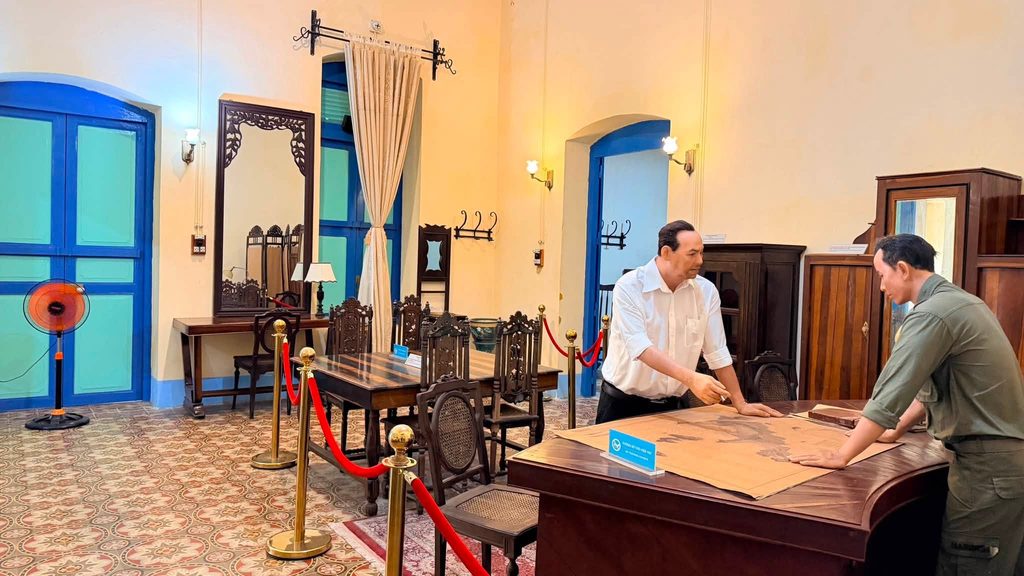
The governor’s office
The governor’s office is one of the notable spaces to examine when exploring the building.
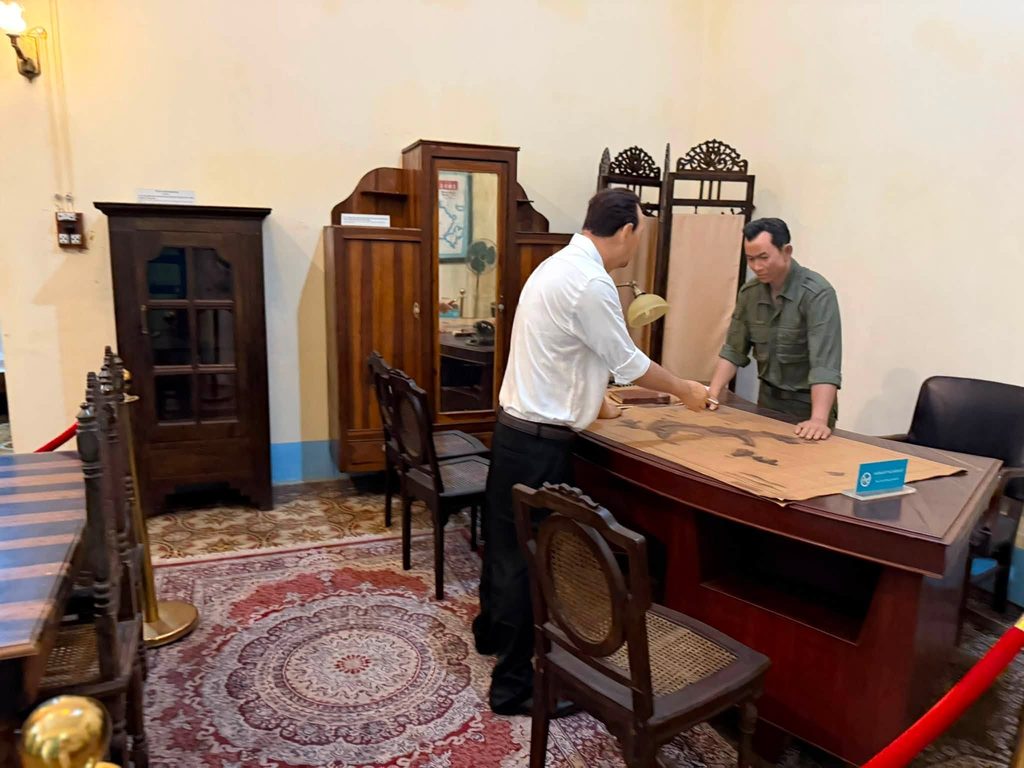
According to documents and exhibition photographs, it contains a desk, chairs, cupboards and objects recalling former administrative activities.
The objects illustrate how the head administrator’s office was arranged during different historical periods.
Seemingly ordinary items such as desks, chairs and telephones help visitors imagine the administrative work once conducted in the residence.
This was the workplace of people with considerable power within the prison system, so the office should be understood in relation to prisoner-management policies and practices.
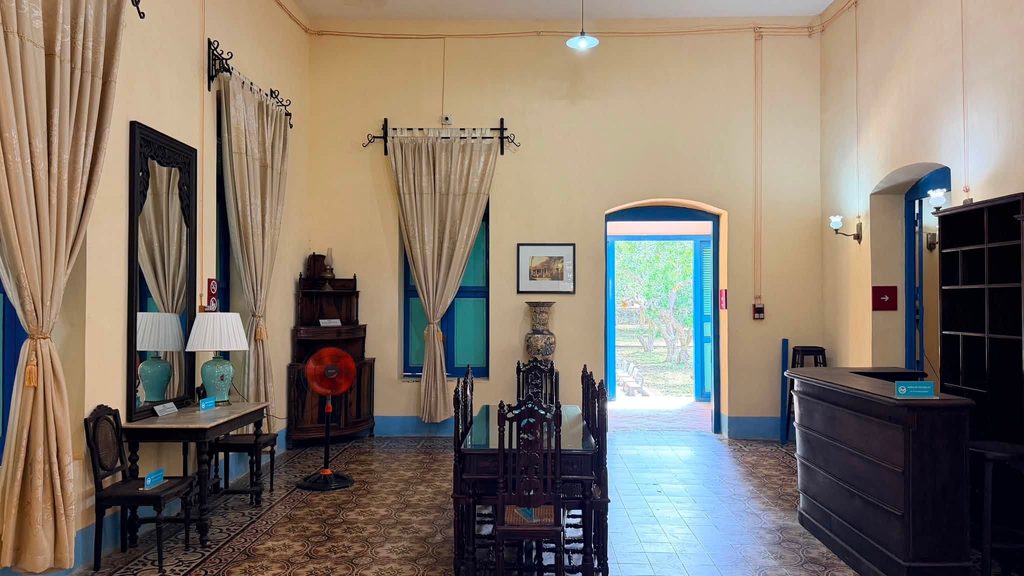
Reception rooms and visitor areas
Alongside the office, the residence also had spaces for receiving visitors and for domestic life.
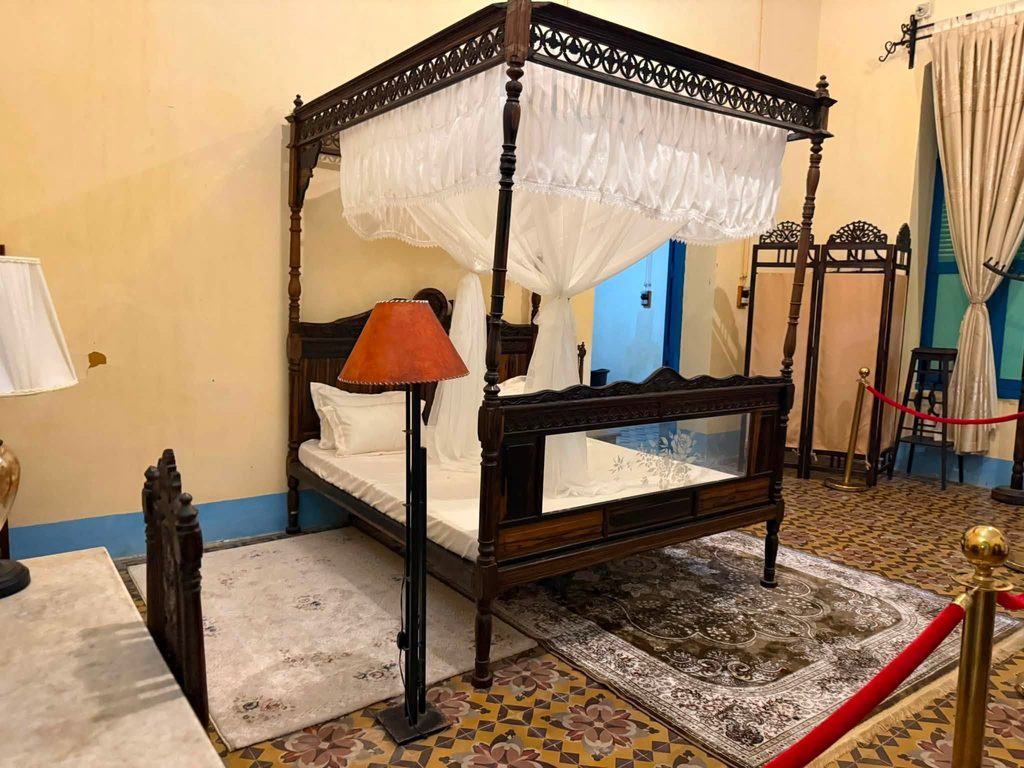
Photographs of the displayed objects show wooden tables and chairs, cupboards, decorative items and furnishings associated with the lifestyles of high-status households in the colonial period.
The spacious rooms, patterned tile floors and architectural details contrast sharply with living conditions in communal prison cells.
For visitors, observing these spaces offers insight into the lives of Côn Đảo’s administrators in different periods.
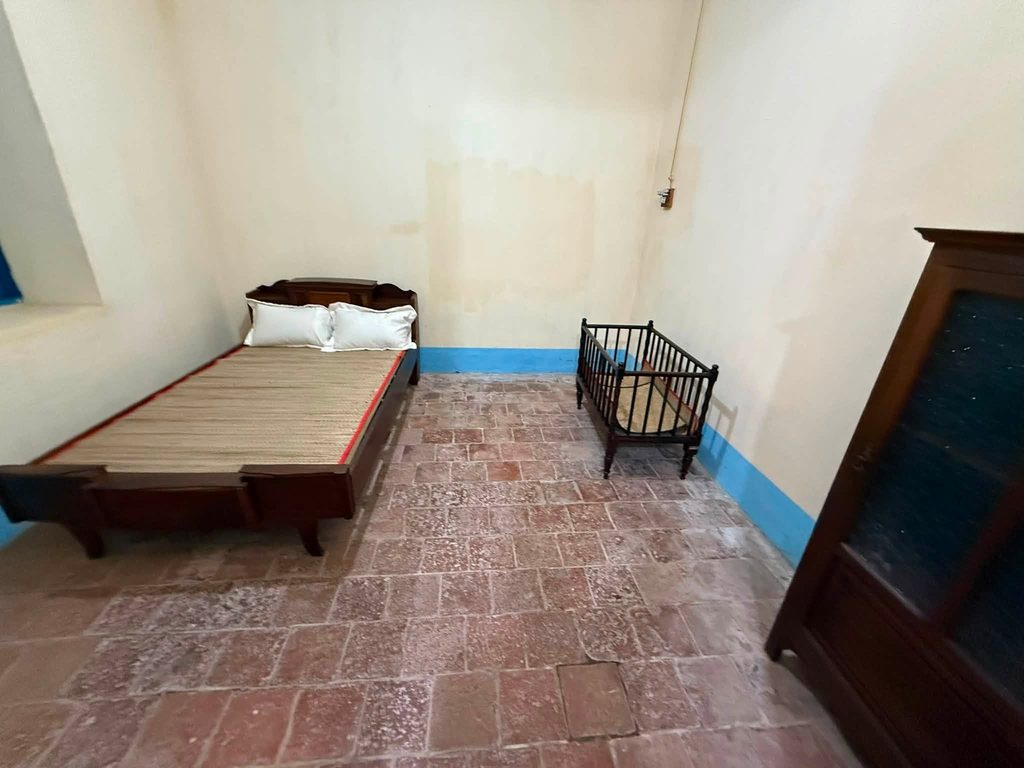
Bedrooms and domestic spaces
Bedrooms, dining areas and ancillary buildings once served the daily needs of the prison governor, family members or service staff.
These rooms were equipped with the objects needed for everyday life.
Following restoration, some interiors have been reconstructed to evoke the lives of successive governors.
It is important to note that not every object now on display is necessarily an original artifact that has remained in the same position since before 1975.
Heritage conservation may combine original objects, collected artifacts and reproductions to illustrate a historical setting.
Distinguishing between these categories helps visitors understand the displays more accurately.
Sở Rẫy Ông Lớn: A garden maintained through prisoners’ labor
One of the residence’s most notable historical details is the garden once known as Sở Rẫy Ông Lớn, the governor’s garden labor establishment.
According to the Côn Đảo National Heritage Conservation Center, dozens of prisoners regularly had to work here and attend to the prison governor’s daily needs.
Their duties could include tending the garden, growing crops, cleaning and other domestic services.
This was not ordinary voluntary employment.
Those carrying out the work were prisoners under the control of the prison system.
Two contrasting ways of life
Visitors looking at the residence today see spacious rooms, airy verandas and a tended garden.
A short distance away, however, stand prison camps that once held large numbers of detainees in entirely different living conditions.
On one side were the living quarters of the head of the administration.
On the other were communal cells, disciplinary cells and isolation areas where everyday life was strictly controlled.
Prisoners were not only confined but also required to work in support of the very people who ran the prison.
This contrast is an important theme in many accounts of the residence.
The garden’s historical significance
Today, the trees, courtyards and ancillary buildings create a relatively quiet setting.
To understand the residence’s history properly, however, the grounds should not be viewed simply as those of an old house.
The garden was also connected with forced labor, reflecting the service arrangements within the prison system.
This is why the areas outside the main building also need to be studied, interpreted and conserved alongside the offices and living rooms.
Governor Andouard and the events of 1919
Among the 53 recorded governorships, Andouard is one of the figures frequently discussed in materials on harsh prisoner management.
His name also appears in Vietnamese transcriptions such as Angdua and Anduara.
According to Côn Đảo historical accounts, Andouard held the governorship in the late 1910s and became known for severe treatment of prisoners.
A period of growing discontent in the prison
Under Andouard, prisoners faced a strict regime of control and punishment.
Repressive measures led to increasing discontent among the prisoners.
Materials from the Côn Đảo National Heritage Conservation Center describe Andouard as one of the most notoriously brutal governors of the French colonial period.
The incident involving him later came to be recorded as a distinctive milestone in the residence’s history.
1919: Andouard is killed at the residence
In 1919, Andouard was killed by a prisoner in his own working area.
Recorded in historical accounts, the incident became one of the notable events directly associated with the residence.
The head of the prison administration had been killed at his own workplace.
The event reflects the intensity of tensions between the ruling administration and prisoners at that time.
This story should be considered in the context of the detention regime and longstanding conflicts at Côn Đảo Prison, rather than simply as an isolated act of violence.
For the building’s history, 1919 shows that the residence witnessed not only administrative activities but also events directly related to the prison regime.
The residence after 1954
After French colonial rule ended, the Côn Đảo Prison system continued to operate under the Republic of Vietnam authorities.
The residence remained the home and workplace of the head of the administration.
During this period, the prison system underwent numerous changes in names, organization and facilities.
Some older camps remained in use, while new isolation areas were built to accommodate the administration of growing numbers of political prisoners.
Changes in the prison system
Côn Đảo’s prison camps were renamed several times after 1954.
Alongside communal cells, isolation areas continued to be used as a means of controlling and punishing prisoners.
One characteristic facility of this period was Phú Bình Prison Camp, commonly known as the American Tiger Cages.
Prisoner management, security controls and the repression of political prisoners continued within the prison administration’s organizational structure.
The residence remained an important location within that system.
The Tiger Cages exposure of 1970
In July 1970, a delegation of United States congressmen and others investigating detention conditions in Côn Đảo gained access to the French Tiger Cages.
Photographs taken by Tom Harkin were published in LIFE magazine on 17 July 1970, exposing the harsh conditions in the isolation area.
The revelations prompted a strong international reaction.
For a study of the residence, the events of 1970 help explain the context in which the prison administration operated during its final years.
Detention policies, the treatment of prisoners and administrators’ responsibilities became matters of concern to many organizations and individuals.
The exposure was also an important milestone in the history of Côn Đảo Prison before 1975.
The residence and the revolutionary milestones of 1945 and 1975
Another aspect of the residence’s historical significance is its changing role at moments when prison rule came to an end.
According to the Côn Đảo National Heritage Conservation Center, the site is associated with the formation of Côn Đảo’s first revolutionary administration in 1945 and the island’s liberation in 1975.
The milestone of 1945
The success of the August Revolution in 1945 changed the political situation in many parts of Vietnam, including Côn Đảo.
Political prisoners and revolutionary forces on the island took part in organizing and establishing an administration in the new historical circumstances.
The residence is recorded as a place associated with the founding of Côn Đảo’s first revolutionary administration.
This marked a remarkable change in the building’s meaning.
A former center of power for the prison administration became a place marking the emergence of a revolutionary government.
However, developments after 1945 meant that the prison system continued to exist for several more decades.
1 May 1975: The end of the Côn Đảo Prison regime
After 30 April 1975, the situation on Côn Đảo changed rapidly.
Political prisoners organized an uprising, took control and brought the prison system’s operations to an end.
1 May 1975 is recognized as the date of Côn Đảo’s complete liberation.
The event marked the end of 113 years of the prison system, dating from 1862.
The residence remained connected with organizational activities and the establishment of an administration during the transition.
It was no longer a place from which the former detention regime was directed.
The residence entered a new phase associated with administration, historical research and heritage conservation.
The residence after 1975
After Côn Đảo Prison ceased operating, many buildings that had served its administration and detention functions were put to other uses.
The prison camps became places where historical remains were preserved, while former offices gradually became the subject of research, artifact collection and exhibitions.
The residence was one of the buildings used for many years to present the history of Côn Đảo Prison.
From a governor’s residence to a historical exhibition space
After 1975, the residence was used to display documents and artifacts relating to the Côn Đảo historic complex.
The materials presented the history of the prison camps, the lives of political prisoners and the resistance activities that had taken place on the island.
Before the new Côn Đảo Museum opened, the residence played an important role in historical exhibitions.
Accounts of the former exhibition rooms mention themes including Côn Đảo’s land and people, the prison regime, revolutionary struggles and the significance of the historic sites.
Using the residence as an exhibition space completely changed the building’s purpose.
From a house serving the prison administration, it became a public space for learning about and remembering history.
Collecting records, artifacts and photographs
Historical materials relating to Côn Đảo were collected over many years.
Sources included prisoner files, portraits, administrative documents, photographs of the prison camps, everyday objects and mementos provided by former prisoners or their families.
These materials help expand the stories of the many generations brought to Côn Đảo.
For research, archival records and photographs are particularly important because they can help establish names, detention dates and other information about individuals.
Although not all these materials are displayed at the residence today, collecting them and using the building to present history played an important role in conserving the heritage sites.
Restoration and interior reconstruction in 2019
According to the Côn Đảo National Heritage Conservation Center, the residence was restored and refurbished in 2019, with interiors reconstructed to evoke the lives of successive governors.
This was an important milestone in the building’s conservation.
The restoration helped preserve the residence’s architectural features while reorganizing spaces so visitors could understand how the building had been used.
Reconstructing the office
Some spaces are furnished with objects characteristic of offices in earlier times, including desks, chairs, cupboards and items connected with administrative work.
The arrangement of the furnishings helps visitors imagine the working environment of the head of the prison administration.
It also provides an appropriate setting for understanding the difference between the residence’s function and that of the prison camps.
Reconstructing domestic spaces
Alongside the office, domestic spaces are presented with furnishings such as beds, dining tables, chairs and household objects.
These objects help evoke the living conditions of the island governors.
Visitors should read the information panels to distinguish original artifacts from reconstructed items.
This is particularly important in a building that has passed through many phases of use, alteration and repair.
The importance of conservation
Restoring a historic building is not simply about making it more attractive.
An important aim is to protect architectural components, limit deterioration and retain features valuable for research.
At the residence, conservation must address several needs at once: preserving colonial-period architecture, accurately explaining its historical function and ensuring visitor safety.
Reconstructed interiors can make historical accounts easier to visualize, but they must be based on evidence and conservation principles to avoid introducing unsupported details.
What visitors can learn at the residence
Unlike prison camps, where visits focus largely on cells and imprisonment conditions, the residence presents history through domestic rooms, offices and traces of the administrative system.
The prison governor’s working environment
This is an important theme when exploring the residence.
Visitors can observe the office layout and objects on display while learning about the administrator’s role within the prison system.
This helps illustrate how administrative work, security and detention were directed across different periods.
Old furniture and interiors
The residence contains spaces displaying furniture associated with colonial domestic life.
Wooden tables and chairs, beds, cupboards and other room furnishings convey aspects of the lives of those who once headed the prison.
Their significance goes beyond their period design.
They also illustrate the administrators’ relatively comfortable living conditions, in contrast to the deprivation experienced by prisoners in the camps.
Corridors and patterned tile floors
Some rooms in the residence have decorative floors laid with patterned tiles.
The doors, columns and openings between rooms create an architectural setting characteristic of the colonial period.
Details such as floor tiles, wooden doors, ceilings and arches are valuable for studying residential architecture in Côn Đảo in the late nineteenth and early twentieth centuries.
Gardens and ancillary buildings
Outside the main building lie grounds with trees and ancillary structures.
These spaces once supported the daily lives of successive governors.
They are also associated with the history of Sở Rẫy Ông Lớn, where prisoners had to work to maintain and service the residence.
Learning about this forced-labor context while looking at the gardens gives visitors a fuller understanding of the site’s historical significance.
The residence’s historical and cultural value
Evidence of the Côn Đảo Prison administration
The residence is one of the buildings that helps explain how the prison system was organized across different periods.
While the camps directly show prisoners’ living conditions, the residence reveals the administration and management mechanisms behind them.
Preserving the building provides further evidence for studying the history of administration, security and detention in Côn Đảo.
The value of its French colonial architecture
Developed in the late nineteenth century and used over many decades, the residence is among the older buildings in central Côn Sơn.
Its tiled roofs, masonry walls, wooden doors, corridors and gardens form an architectural ensemble valuable for research.
The surviving components also help preserve the appearance of central Côn Đảo before the island developed into the visitor destination it is today.
A witness to political change
The residence is connected with many important events in Côn Đảo’s history.
From the 53 recorded governorships and the Andouard incident in 1919 to the political changes of 1945 and 1975, the building witnessed successive administrative regimes.
Its transformation from a prison headquarters into a historical exhibition site is especially meaningful in the process of heritage conservation.
Learning about power and human dignity
Exploring the residence allows visitors to see the relationship between administrative power and the lives of those subject to it.
Decisions made by the administration could directly affect the detention conditions, labor and health of thousands of prisoners.
The contrast between the residence and prison cells reveals inequalities within the prison regime.
The site therefore has educational value not only for history, but also for the responsibilities that accompany power, human dignity and the importance of protecting basic rights.
Part of the Côn Đảo Prison Special National Historic Site
After 1975, conservation of the historic Côn Đảo Prison complex proceeded through several stages.
On 29 April 1979, the Ministry of Culture and Information issued Decision No. 54-VHTT.QĐ recognizing the Côn Đảo Revolutionary Historic Complex as a site of particular national importance.
On 10 May 2012, the Prime Minister signed Decision No. 548/QĐ-TTg, designating the Côn Đảo Prison Historic Site as a Special National Historic Site.
The residence is one of the component sites within the designated complex.
The 2012 decision applies to the entire Côn Đảo Prison historic complex, rather than constituting a separate designation for the residence alone.
Protection as part of the special national historic complex provides a basis for continued research, restoration and presentation of the building to the public.
Admission fees for the residence in 2026
Under Resolution No. 29/2026/NQ-HĐND of 27 August 2026 issued by the Ho Chi Minh City People’s Council, effective from 1 October 2026, admission to the Côn Đảo Prison Special National Historic Complex, including Côn Đảo Museum, is VND 60,000 per person per visit for visitors required to pay the fee.
According to visitor arrangements, the combined ticket covers five principal sites:
- Côn Đảo Museum.
- The Island Governor’s Residence historic site.
- Phú Hải Prison Camp.
- The French Tiger Cages.
- Phú Bình Prison Camp, also known as the American Tiger Cages.
This is the fee for the combined group of historic sites, not a separate VND 60,000 charge solely to enter the residence.
Visitors should check the information when buying tickets, as inclusion in the ticket does not mean that every exhibition area will be open at the time of their visit.
Fee exemptions
Under Resolution No. 29/2026/NQ-HĐND, exempt groups include children, school pupils, students, people with exceptionally severe disabilities, and people from households classified as poor or near-poor.
Visitors eligible for free admission should bring appropriate supporting documents and ask staff about the procedure.
Groups eligible for a 50% reduction
Eligible groups under the resolution, including older people, people with severe disabilities, people recognized for meritorious service to the revolution and certain groups covered by preferential cultural policies, receive a 50% reduction.
With a standard fee of VND 60,000, eligible visitors pay VND 30,000 per visit.
Concessions are applied in accordance with the relevant rules and eligibility conditions.
Visiting hours
According to the visit-registration schedule published by the Côn Đảo National Heritage Conservation Center, heritage visits are organized in two time periods:
- Morning: 7:30 a.m. to 11:30 a.m.
- Afternoon: 2 p.m. to 5 p.m.
Groups may be assigned specific sessions depending on the program and the number of visitors.
At old buildings such as the residence, some areas may temporarily close during maintenance, restoration or artifact conservation work.
Visitors should therefore confirm whether the site is receiving visitors and which rooms are accessible before arriving.
Contact for visit registration:
Côn Đảo National Heritage Conservation Center
Telephone: 0254 3830 517.
Website: https://trungtambaotonditichquocgiacondao.vn/
Tips for visiting the residence
How much time should you allow?
Visitors wishing to observe the architecture, office and domestic spaces, and gardens can allow approximately 30–45 minutes.
A guided group visit or a more detailed exploration of the historical material may take longer.
This is a suggested duration for planning, not a compulsory time limit.
When is a good time to visit?
Morning is often convenient for looking at the architecture and exploring the grounds.
Natural light makes it easier to see details of the tiled roofs, windows and building colors.
In the afternoon, the gardens and waterfront road in front of the residence also offer attractive views of the exterior.
Visits inside, however, must follow the managing authority’s opening schedule.
What should you keep in mind around the artifacts?
When visiting reconstructed rooms, read the information panels and accompanying labels.
Do not touch tables, chairs, beds, cupboards or artifacts under conservation without permission.
Do not move objects for photographs or enter roped-off areas.
In rooms with reconstructed interiors, the explanations help distinguish original objects from elements added during conservation.
Dress and conduct
The residence is a historic building within the Côn Đảo Prison heritage complex.
Visitors should dress respectfully, keep noise down and follow the site’s instructions.
When taking photographs, check the rules on flash, especially in areas containing artifacts or documents vulnerable to light.
Do not interfere with old architectural elements, including walls, doors or floors.
The residence and the historic Pier 914
One of the residence’s clearest geographical and historical connections is its location opposite Pier 914.
The French colonial authorities began constructing the pier in 1873 as part of the island’s developing infrastructure.
To build the pier and stone embankments, the colonial authorities forced prisoners to quarry and transport large blocks of stone under arduous conditions.
The number 914 in the pier’s name is a commemorative, approximate figure remembered by prisoners to honor those who died during the forced labor used to build it.
The two sites are very close together but had entirely different historical functions.
The residence was the headquarters of the prison administration, while Pier 914 was associated with receiving prisoners, transporting goods and forced-labor activities.
Considering the two structures within the same setting clarifies the contrast between administrative power and the circumstances of the detained.
Today, the area in front of the residence opens onto Côn Sơn Bay, while the pier remains a notable trace of Côn Đảo’s transport and labor history.
Distinguishing the residence from Côn Đảo Museum
A possible source of confusion is that the residence once housed historical exhibitions, while Côn Đảo now also has a separate museum building.
The two sites have different functions and histories.
The Island Governor’s Residence
This is a historic architectural complex that developed in the nineteenth century.
While the prison was operating, the residence was the home, workplace and headquarters of the head of the administration.
After 1975, it was repurposed for historical exhibitions and conservation.
Its principal value lies in the architecture itself, its historical function, and the preserved or reconstructed working and domestic spaces.
Côn Đảo Museum
Côn Đảo Museum today is a modern building whose construction began in 2009 and was completed in 2010. It officially opened to visitors on 6 September 2013.
Its exhibitions provide an overview of Côn Đảo’s nature, people, prison history, resistance movements and development after 1975.
Where the museum offers an overview of the island’s history, the residence enables visitors to examine the prison administration more closely through a building that actually served that purpose.
The two sites therefore complement one another and should not be treated as the same building or as having identical content.
Frequently asked questions about the residence
When was the Island Governor’s Residence built?
The residence developed between approximately 1862 and 1876 under French colonial rule. Some sources state that construction began in 1862 and was completed in 1876.
Where is the residence?
It is on Tôn Đức Thắng Street, opposite the historic Pier 914, in central Côn Sơn Island, Côn Đảo Special Zone, Ho Chi Minh City.
What other names does the residence have?
It is also known as Nhà Chúa Đảo, Dinh Ông Lớn and Dinh Tỉnh Trưởng.
How many governorships were there in Côn Đảo?
Historical materials record 53 tenures as island governor from 1862 to 1975: 39 under French colonial rule and 14 during the Republic of Vietnam period.
Who was the first governor?
The first recorded governor was Félix Roussel, a French naval officer.
Who was the last governor?
The last recorded holder of the office was Lâm Hữu Phương, before the prison system ceased operating in 1975.
In what year was Governor Andouard killed?
According to Côn Đảo historical materials, Andouard was killed by a prisoner in 1919 in his working area at the residence.
How large is the residence complex?
The grounds cover approximately 2 hectares, including the main building, annexes and gardens. Published figures range from around 18,600 m² to more than 20,000 m² because records and the boundaries used differ.
Was the residence itself a prison?
No. It was the home and workplace of the head of the Côn Đảo Prison administration. The building belongs to the prison heritage complex but was not a communal detention camp.
Is the residence recognized as a Special National Historic Site?
The residence is a component of the Côn Đảo Prison Historic Site, which was designated a Special National Historic Site under Decision No. 548/QĐ-TTg of 10 May 2012.
How much does admission cost in 2026?
From 1 October 2026, admission to the combined Côn Đảo Prison Special National Historic Complex is VND 60,000 per person per visit for visitors required to pay. The residence is one of the sites included in this group.
What is the residence used for today?
The building is conserved as a historic site, with exhibitions and reconstructed interiors introducing the lives and work of those who once headed the prison system.
From a center of rule to a place of historical remembrance
Over more than a century, the residence witnessed many changes in Côn Đảo’s history.
As the home and workplace of successive governors, it was the headquarters of a large prison system in which generations of Vietnamese people were detained and made to work under harsh conditions.
The offices, furniture, tiled floors and gardens preserved today recall a time when the prison governor’s power could profoundly affect the lives of those imprisoned.
But the building’s history did not end with its role as a colonial office.
It also bears witness to the political changes of 1945 and 1975, before its conversion into a place for conservation, research and historical education.
Today, a visit to the residence offers more than the chance to admire an old French-style mansion or explore period furnishings.
Its value lies in understanding the building’s relationship with the entire Côn Đảo Prison system, from camps and isolation areas to forced-labor establishments.
Where the old cells help visitors imagine prisoners’ lives, the residence reveals the structure of power that once directed their detention.
Together, these perspectives provide a fuller understanding of Côn Đảo’s history, through both the people imprisoned and the system that organized and maintained their confinement.
Conserving the residence therefore means more than preserving a building over a century old. It also preserves an important part of history for future generations to study and reflect upon.
Con Dao Express introduces Côn Đảo’s historic sites, architectural landmarks and cultural destinations, while providing information on high-speed ferry routes, schedules and indicative fares to help visitors plan their journey to the island.
References
- Côn Đảo National Heritage Conservation Center: The Island Governor’s Residence historic site.
- Côn Đảo Tourism Portal: The Island Governor’s Residence.
- Côn Đảo Tourism Portal: The Island Governor’s Residence (Dinh Ông Lớn, Dinh Tỉnh Trưởng).
- Bà Rịa–Vũng Tàu Museum: Conserving and promoting the Côn Đảo Prison historic sites from a management perspective.
- Báo Tin tức, Vietnam News Agency: The Island Governor’s Residence, a place to visit in Côn Đảo.
- Resolution No. 29/2026/NQ-HĐND of 27 August 2026 issued by the Ho Chi Minh City People’s Council, effective from 1 October 2026.
- Decision No. 548/QĐ-TTg of 10 May 2012 issued by the Prime Minister.
Google Maps: Dinh Chúa Đảo
The map shows the site’s location. Confirm the entrance and visiting hours with the site management before you go.