
Nguyễn An Ninh (1900–1943) was a patriot, journalist, thinker and political activist with far-reaching influence in Cochinchina during the early decades of the twentieth century. From public platforms in Saigon and newspaper pages advocating freedom and democracy to his final years in Côn Đảo Prison, he left a distinctive mark on the history of Vietnam’s patriotic movement.
On 14 August 1943, Nguyễn An Ninh died on Côn Đảo after prolonged imprisonment under a harsh prison regime. Today, his grave at Hàng Dương Cemetery commemorates a historical figure while also recalling comradeship, resistance and political prisoners’ determination to defend human dignity.
Who was Nguyễn An Ninh?
Nguyễn An Ninh was born on 15 September 1900 in the Cần Giuộc area, into a family of Confucian scholars with a patriotic tradition.
His father, Nguyễn An Khương, was a patriotic scholar connected with prominent figures in the Duy Tân reform movement. His paternal family was associated with Hóc Môn in the former Gia Định province, while his maternal family came from Cần Giuộc in the former Chợ Lớn province.
As a child, Nguyễn An Ninh encountered Chinese characters and traditional learning. He later studied in Saigon, where he gained access to Western education and new ideas about society, humanity, freedom and democracy.
His family background and education helped shape an independent mind. He recognized the injustices of colonial rule early on and believed that knowledge should go hand in hand with responsibility toward one’s country.
Rather than pursuing a purely academic life, Nguyễn An Ninh chose to use his knowledge, writing and public-speaking abilities to influence society.
Study in France and the Five Dragons group
In 1918, Nguyễn An Ninh travelled to France to study law at the Sorbonne in Paris.
Within France’s academic and political environment, he explored the progressive ideas of the era more deeply, studying human rights, national rights and political systems.
During this period, he also worked with Vietnamese patriots living in France.
Nguyễn An Ninh was close to Nguyễn Ái Quốc, Phan Châu Trinh, Phan Văn Trường and Nguyễn Thế Truyền. These five figures are often called the “Five Dragons”, a group of intellectuals and patriotic activists influential within the Vietnamese community in early-twentieth-century France.
Although their views and approaches did not entirely coincide, all were concerned with their country’s future, opposed colonial oppression and sought a path forward for the Vietnamese people.
For Nguyễn An Ninh, his time in France provided not only professional knowledge, but also ways of pursuing change through journalism, ideas and public mobilization.
On returning to Vietnam, he did not choose the secure life available to an educated intellectual. Instead, he began directly engaging in activities intended to awaken patriotic feeling in Cochinchinese society.
Speeches that inspired Cochinchina’s young people
One of Nguyễn An Ninh’s outstanding qualities was his ability to address an audience.
In 1923, he delivered speeches at the Cochinchina Society for the Promotion of Learning in Saigon, discussing national culture, education and young people’s role in the country’s future.
In particular, his speech on “The Ideal of Annamese Youth”, associated with the work known as “The Aspirations of Annamese Youth”, made a strong impression on intellectuals and young people of the time.
While Vietnam was under French colonial domination, Nguyễn An Ninh raised questions about the younger generation’s responsibility toward the nation.
He criticized complacency, a life devoted only to personal gain and indifference to the country’s lack of freedom.
In his view, young people needed to broaden their understanding, learn from humanity’s cultural achievements, cultivate ideals and actively help transform society.
These appeals were not directed only at intellectuals. Nguyễn An Ninh also hoped to spread new awareness among the wider population, particularly working people in Cochinchina.
His ideas helped shape the Thanh niên Cao vọng, or Youth Aspirations, movement, fostering a section of the public with political awareness and a desire for social change.
La Cloche Fêlée and the struggle through writing
Alongside public speaking, journalism was a particularly important means of Nguyễn An Ninh’s activity.
On 10 December 1923, he launched the French-language newspaper La Cloche Fêlée, usually translated as The Cracked Bell.
The title evokes an imperfect bell that nevertheless rings out to awaken society.
Through the paper, Nguyễn An Ninh openly criticized the injustices of colonial rule, advocated freedom and democratic rights, and introduced numerous progressive political ideas.
He also worked closely with the lawyer Phan Văn Trường in journalism and the dissemination of ideas.
Articles in La Cloche Fêlée addressed important issues including freedom of expression, the rights of colonized people, education, culture and struggles around the world.
Notably, in 1926 the newspaper published the French text of Karl Marx and Friedrich Engels’ Communist Manifesto, helping introduce revolutionary ideas to readers in Cochinchina.
Nguyễn An Ninh’s journalistic work was continually monitored, controlled and obstructed by the colonial authorities.
These pressures, however, did not make him abandon writing as a way to express his views.
In Vietnamese press history, The Cracked Bell is a notable example of the legal press openly challenging colonial rule during the 1920s.
Five arrests and the road to Côn Đảo
His speeches, journalism and public mobilization made Nguyễn An Ninh a figure of particular concern to the French colonial authorities.
Over the course of his patriotic activities, he was repeatedly arrested and imprisoned.
The first time, in 1926, he received a prison sentence following his public political activities.
In subsequent years, Nguyễn An Ninh continued building a mass movement and mobilizing young people, workers, farmers and other patriotic groups in Cochinchina.
He was repeatedly arrested, tried and detained, yet resumed his activities after release.
In October 1939, Nguyễn An Ninh was arrested for the fifth time. He was sentenced to five years in prison and subsequently exiled to Côn Đảo.
This was the final imprisonment of his life.
Côn Đảo was then one of the harshest places of confinement in the colonial prison system. Thousands of patriots and revolutionary fighters were sent to the island, enduring isolation, deprivation, disease and severe repression.
For Nguyễn An Ninh, an intellectual who had been active on public platforms, the years on Côn Đảo were especially painful, but also clearly revealed his character and integrity.
Nguyễn An Ninh’s years in Côn Đảo Prison
In prison, Nguyễn An Ninh endured harsh conditions that seriously damaged his health.
Historical accounts record periods of isolation, deprivation and inadequate medical care when he became gravely ill.
Nevertheless, Nguyễn An Ninh maintained the spirit of a patriotic intellectual.
He was not a Communist Party member, but had close relationships with many communist revolutionaries and expressed sympathy and support for the struggle for national liberation.
Contemporaries recalled his honesty, self-respect and commitment, which remained unchanged even through years of imprisonment.
Commemorative accounts describe his wish to be an anonymous fighter who, though not a Party member, remained wholeheartedly alongside those struggling for national independence.
This is another notable aspect of his life: Nguyễn An Ninh thought independently and chose his own methods, while consistently placing the nation’s interests above personal gain.
When did Nguyễn An Ninh die?
On 14 August 1943, corresponding to the fourteenth day of the seventh lunar month in the Quý Mùi year, Nguyễn An Ninh died in Côn Đảo Prison, at the age of 43 as recorded in the source.
After years of imprisonment, disease and harsh living conditions had severely weakened him.
His death was a major loss to Vietnam’s patriotic movement, especially in Cochinchina, where he had deeply influenced intellectuals, young people and working communities.
He died just two years before the victory of the August Revolution in 1945.
Although he did not witness the country regain its independence, his ideas and activities became an important part of the history of the national liberation struggle.
The story of Nguyễn An Ninh’s grave at Hàng Dương Cemetery
One of the moving stories associated with Nguyễn An Ninh’s final days concerns his burial and the preservation of his grave.
According to materials on Côn Đảo Prison, after Nguyễn An Ninh died, someone tried to obtain permission from the prison authorities to bury him in a wooden coffin.
The request, however, was not approved.
He was buried in extremely rudimentary conditions. Accounts state that his body was placed in bags woven from bàng sedge, a form of burial used for many prisoners who died on Côn Đảo.
Amid the countless prisoners’ graves at Hàng Dương Cemetery, others who shared his plight sought to mark Nguyễn An Ninh’s resting place.
Prisoners doing forced labor collected stones and bricks, carrying them back to build up his grave.
They did so under strict surveillance, expressing the deep affection and respect fellow prisoners held for Nguyễn An Ninh.
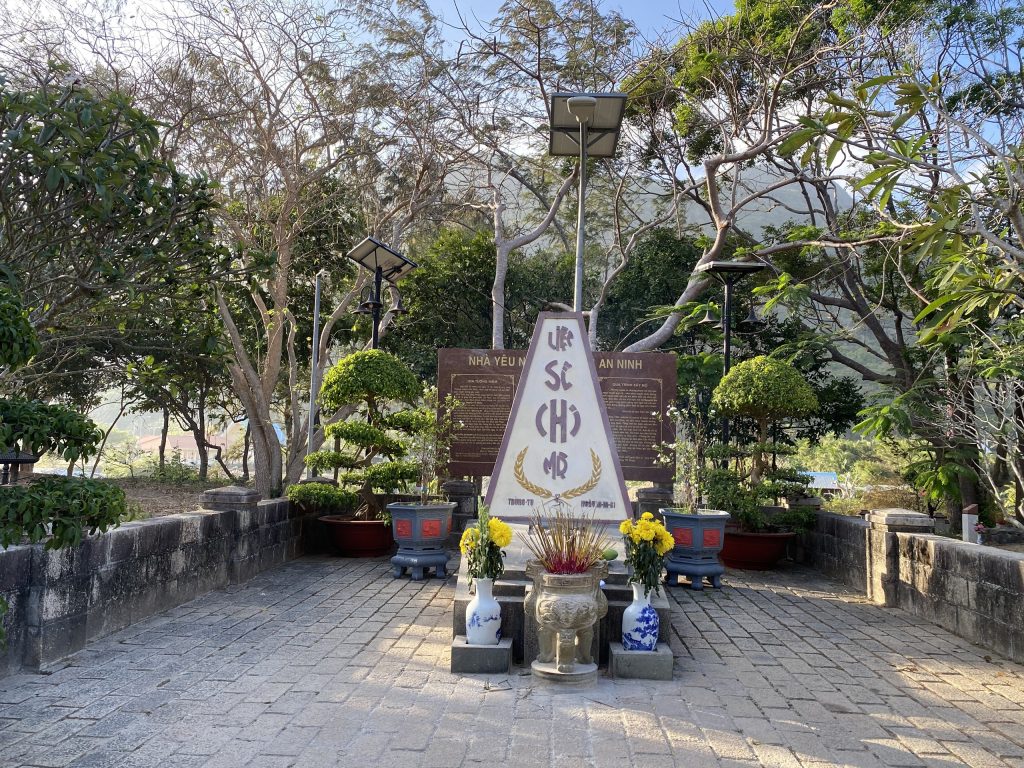
Fellow prisoners built Nguyễn An Ninh a stone grave
According to former prisoners’ recollections preserved in heritage records, in 1944 some political prisoners sought to build a stone grave for Nguyễn An Ninh.
During work, they quietly prepared materials, brought stones to the cemetery and found ways to construct the grave.
The prison authorities demolished it, but the prisoners persisted in rebuilding it.
Through repeated repairs, a stone grave took shape and became a memorial to Nguyễn An Ninh within the vast cemetery.
Historical accounts also mention a stone stele bearing his name in Chinese characters.
This story is about more than building a grave.
It was also the prisoners’ way of asserting that someone who had died for his country deserved remembrance, even when almost every freedom had been taken away.
1961 and the resistance to disturbing prisoners’ graves
The history of Nguyễn An Ninh’s grave is also linked to an unusual event in 1961.
During the Republic of Vietnam administration of Côn Đảo, Nguyễn An Ninh’s grave was included in a restoration plan.
However, historical accounts of political prisoners’ struggles on Côn Đảo state that construction of a road to the grave provoked fierce resistance.
The road plan required the digging up, removal or disturbance of other deceased prisoners’ graves at Hàng Dương Cemetery.
For the political prisoners, this was unacceptable.
They considered Nguyễn An Ninh a respected patriot, but the thousands resting around him had also endured imprisonment and died.
Commemorating one individual could not justify violating the graves of other deceased people.
More than 50 political prisoners opposed digging up graves for the road
According to the historical studies cited in the records, more than 50 political prisoners held in continued detention opposed the demand to dig up graves to create a road to Nguyễn An Ninh’s tomb.
The confrontation became intense and led to waves of repression.
Many prisoners were beaten, sent to the infirmary, placed in solitary confinement or transferred to harsh detention areas.
Despite punishment, those involved firmly refused to dig up their comrades’ remains themselves.
In their view, respect for Nguyễn An Ninh did not conflict with respect for unnamed prisoners.
All deserved rest and remembrance.
Historical materials also record that, after failing to force this group of political prisoners to do the work, the prison administration mobilized other groups of prisoners to build the road.
Disturbing graves to construct the path left a painful memory in Hàng Dương Cemetery’s history.
“The prisoners’ road of blood and bones”
Prisoners once called the road leading to Nguyễn An Ninh’s grave “the prisoners’ road of blood and bones”.
The name was associated with the resistance of 1961, the beatings political prisoners endured and the disturbance of numerous graves during road construction.
This story needs to be understood in its specific historical context, through research, memoirs and records of people formerly imprisoned on Côn Đảo.
Today, visitors paying respects at Nguyễn An Ninh’s grave see a dignified memorial, but not everyone knows the stories behind its construction and restoration.
The site’s history reminds us that remembrance belongs not only to people whose names are inscribed on stone, but also to the many unidentified individuals resting at Hàng Dương.
Where is Nguyễn An Ninh’s grave on Côn Đảo?
The grave of patriot Nguyễn An Ninh is in Section A of Hàng Dương Cemetery, Côn Đảo.
This section contains many graves of patriots and revolutionary fighters who died before 1945.
Section A also holds the grave of former General Secretary Lê Hồng Phong and those of numerous other historical figures.
Today, Nguyễn An Ninh’s grave has been respectfully built and restored, with a named stele and historical information panels.
Over its history, it has undergone several phases of construction, repair and restoration, notably the work in 1961 and later improvements.
Beside the grave, information presents Nguyễn An Ninh’s life and career and the efforts to preserve his resting place.
Nguyễn An Ninh’s memorial day
14 August each year, according to the Gregorian calendar, marks the anniversary of patriot Nguyễn An Ninh’s death.
Commemorations commonly include incense offerings and reflections on his life and contributions to Vietnam’s patriotic movement.
Visitors to Hàng Dương Cemetery can combine paying respects at Nguyễn An Ninh’s grave with learning about prison history, other grave sections and memorials within the heritage complex.
To keep the visit respectful, wear appropriate clothing, maintain quiet, do not disturb the grave and follow the cemetery management authority’s rules.
Check visiting hours, commemorative activities and site guidance before travelling.
Nguyễn An Ninh’s intellectual legacy and contributions
Although his life spanned only 43 years according to the source’s account, Nguyễn An Ninh left a notable legacy in several fields.
In journalism, he helped develop the legal press’s open opposition to colonial rule, placing freedom and human dignity at the center of its concerns.
As a thinker, Nguyễn An Ninh encouraged self-education, national awareness, intellectual openness and young people’s social responsibility.
In politics, he helped mobilize and unite different social groups, expanding the patriotic movement’s influence in Cochinchina.
Works associated with him, including The Aspirations of Annamese Youth, The Social Contract, France in Indochina, Religion and A Critique of Buddhism, alongside newspaper articles and speeches, reflect his deep concern for the country’s future.
A distinctive feature of Nguyễn An Ninh’s life was his refusal to confine his activities to a single field. He used education, journalism, ideas and public mobilization as mutually supporting methods.
In 1980, the Vietnamese State posthumously recognized Nguyễn An Ninh as a martyr, acknowledging his contributions and sacrifice.
Today, many streets, schools and public facilities across the country bear his name.
Ho Chi Minh City also has the Nguyễn An Ninh Memorial House, which preserves and presents materials about his life, family and career.
Remembering Nguyễn An Ninh while exploring Côn Đảo’s history
Côn Đảo offers more than beaches, forests and distinctive natural scenery. The islands also preserve traces of more than a century of prison history.
Nguyễn An Ninh’s life helps those studying history better understand intellectuals’ role in the patriotic movement of the early twentieth century.
He did not personally witness the day of national independence, but his speeches, newspaper pages and commitment helped awaken social awareness during a turbulent period.
His grave at Hàng Dương also carries special meaning. It commemorates a patriot while recalling the respect, comradeship and sacrifices of the prisoners who preserved his resting place.
For visitors to Côn Đảo, learning about Nguyễn An Ninh offers a way to understand more deeply the layers of historical memory still present on the islands.
Remembering Nguyễn An Ninh also means remembering generations of Vietnamese people who chose to devote their lives to independence, freedom and national dignity.
References
- Nguyễn Quang Thắng and Nguyễn Bá Thế, Dictionary of Vietnamese Historical Figures, Culture Publishing House, 1999, pp. 479–480.
- Political Prisoners’ Liaison Committee and Department of Culture and Information, Côn Đảo: Chronicles and Documents, Trẻ Publishing House, Ho Chi Minh City, 1996, pp. 111–117.
- History of the Struggle of Patriotic and Revolutionary Prisoners at Côn Đảo Prison (1862–1975), National Political Publishing House, 2010, p. 380.
- Vietnam National Museum of History: Nguyễn An Ninh, a true revolutionary intellectual.
- Côn Đảo National Heritage Conservation Centre: Ceremony commemorating the 83rd anniversary of Nguyễn An Ninh’s death.
- Cần Thơ Newspaper: Patriot Nguyễn An Ninh, “Living for eternity, engraved in history”.
- Hàng Dương Cemetery: Information on grave sections and historical significance.
Source note: Details concerning the burial, construction of the grave and resistance to the disturbance of prisoners’ graves in 1961 follow the historical studies and memoir materials cited above. Testimonial passages are presented within the context of their recorded sources, rather than treated as independent administrative records of the events.