
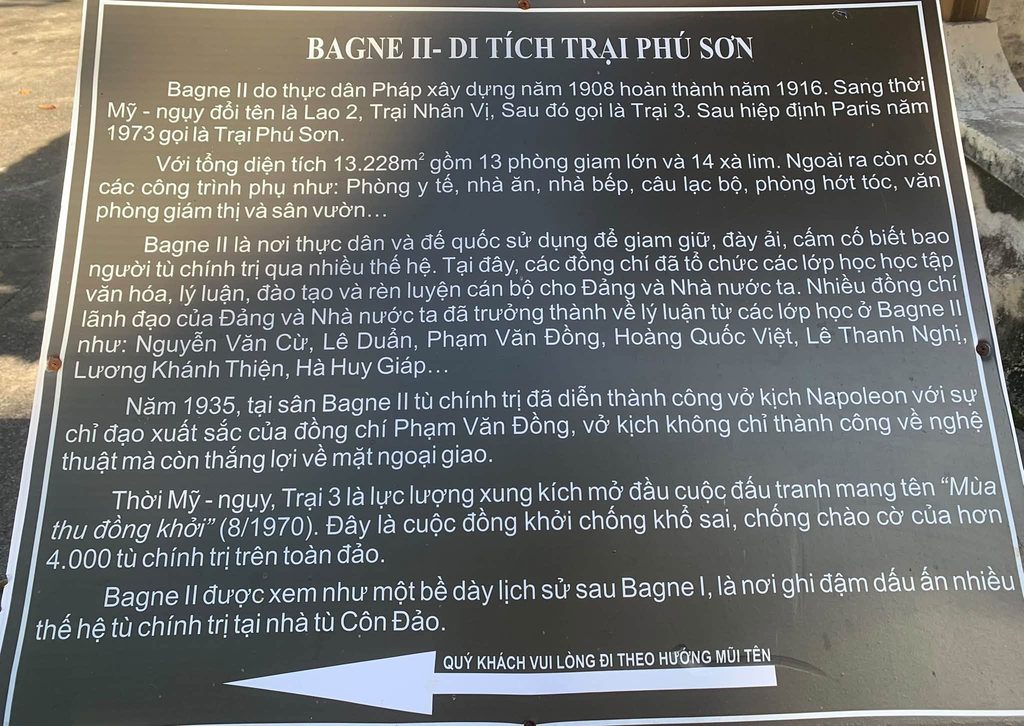
Near Phú Hải Prison in central Côn Sơn, Phú Sơn Prison, Côn Đảo is one of the major structures in the Côn Đảo Prison system. Construction by the French colonial authorities began in 1908 and was completed in 1916. The compound was known as Banh II, Lao II, Nhân Vị Camp and Camp 3 before receiving the name Phú Sơn.
Unlike Phú Hải Prison, whose origins date to 1862, Phú Sơn was built when the prison system had already expanded and its administration was becoming increasingly strict. The compound included 13 large communal cells, an isolation section with 14 solitary cells, a dark cell, and facilities for administration and everyday needs.
Over many decades, Banh II held revolutionary activists including Nguyễn Văn Cừ, Lê Duẩn, Phạm Văn Đồng, Hoàng Quốc Việt and Lê Thanh Nghị. It is also associated with the final years of former General Secretary Lê Hồng Phong, who died in solitary cell No. 5 on 6 September 1942.
Yet Phú Sơn’s history also includes more than imprisonment and loss. Political prisoners organized classes, cultural activities and protests demanding better living conditions inside the compound. Notably, during the Lunar New Year in 1935, a play about Napoleon was performed in the Banh II courtyard, leaving an unusual mark on the prisoners’ cultural life.
Today, Phú Sơn is a component of the Côn Đảo Prison Special National Heritage Site. Its preserved cell blocks, stone walls and solitary confinement section help visitors learn about prison architecture, different historical periods, and life in detention.
Where is Phú Sơn Prison on Côn Đảo?
Phú Sơn Prison is in the central area of Côn Sơn Island, Côn Đảo Special Zone, Ho Chi Minh City.
According to the Côn Đảo Tourism Portal, the compound stands near Tôn Đức Thắng and Nguyễn An Ninh streets, adjoining Phú Hải Prison.
This location makes it convenient to explore two longstanding prison complexes side by side: Banh I, now Phú Hải Prison, and Banh II, now Phú Sơn Prison.
From accommodation in central Côn Sơn, visitors can travel by motorbike, taxi or car. On a guided tour of the Côn Đảo Prison system, Phú Sơn may be included alongside other historic sites.
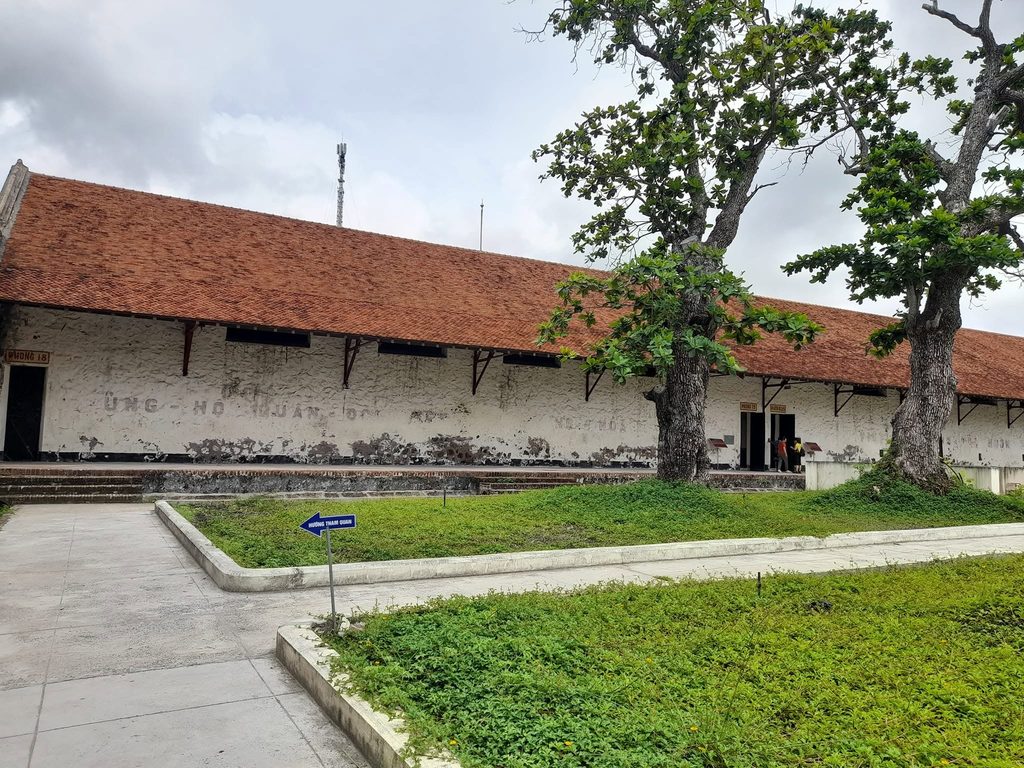
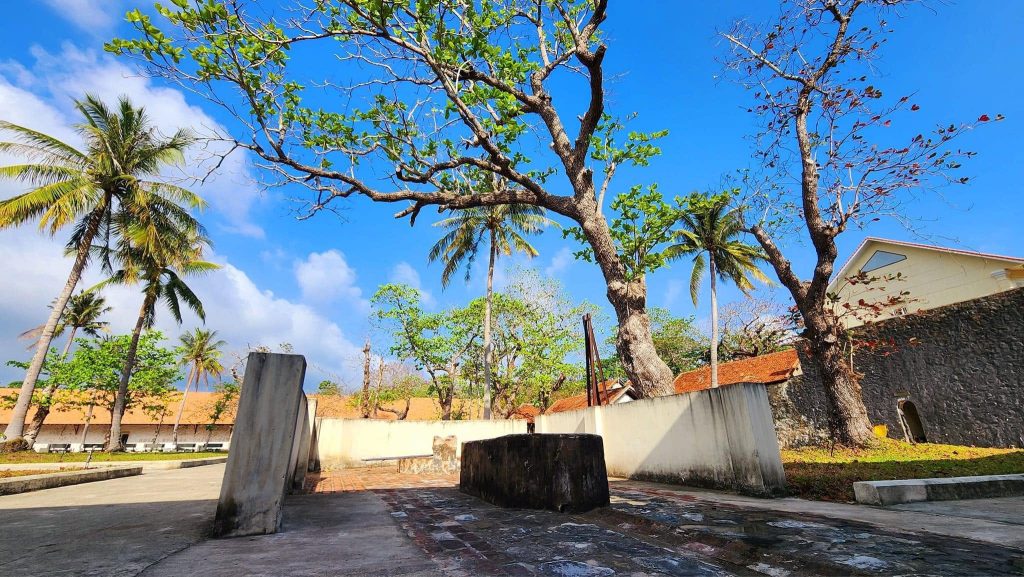
The entrance retains features of the old architecture, with substantial masonry walls and an inner courtyard. However, the site has undergone several phases of use, alteration and conservation, so not every detail remains unchanged from 1916.
Phú Sơn Prison at a glance
| Item | Information |
|---|---|
| Historic site name | Phú Sơn Prison |
| Historical names | Banh II, Bagne II, Lao II, Nhân Vị Camp, Camp 3 |
| Location | Tôn Đức Thắng–Nguyễn An Ninh street area, Côn Đảo |
| Construction began | 1908 |
| Completed | 1916 |
| Area | Approximately 1.3–1.5 hectares, depending on the source |
| Large communal cells | 13, according to the site’s introductory records |
| Solitary cells | 14 |
| Distinctive features | Isolation section and dark cell |
| Support facilities | Infirmary, kitchen, dining hall, clubhouse, administration rooms and gardens |
| Notable figures | Lê Hồng Phong, Nguyễn Văn Cừ, Lê Duẩn, Phạm Văn Đồng, Hoàng Quốc Việt |
| Present-day significance | A component of the Côn Đảo Prison Special National Heritage Site |
The development of Phú Sơn Prison from 1908
The expansion of the Côn Đảo Prison system
After the French colonial authorities established Côn Đảo Prison in 1862, detention facilities on the island were gradually built and expanded.
Initially, detention was concentrated mainly at Banh I. As anticolonial movements developed in Vietnam, however, the number of people arrested, sentenced and sent into exile increased.
By the early twentieth century, the prison system needed additional large facilities to receive, classify and control prisoners.
In this context, the colonial administration decided to build Banh II next to Banh I.
The new compound was intended to do more than increase cell numbers. It was designed to strengthen control, impose different detention regimes and isolate people considered capable of organizing resistance.
1908: Construction of Banh II begins
According to the Côn Đảo National Heritage Conservation Centre, the French colonial authorities began building Banh II in 1908.
The complex occupied land beside Banh I and included cell blocks, a solitary confinement section and administrative facilities.
Compared with the earliest detention facilities, Banh II was more solidly built, with walls, doors and passageways designed to control prisoners.
A notable feature was an elevated surveillance corridor above the cells, allowing guards to observe and inspect the detention area.
This layout shows the colonial authorities’ emphasis on separating and controlling prisoners through architecture.
1916: Banh II is completed
After years of construction, Banh II was completed in 1916.
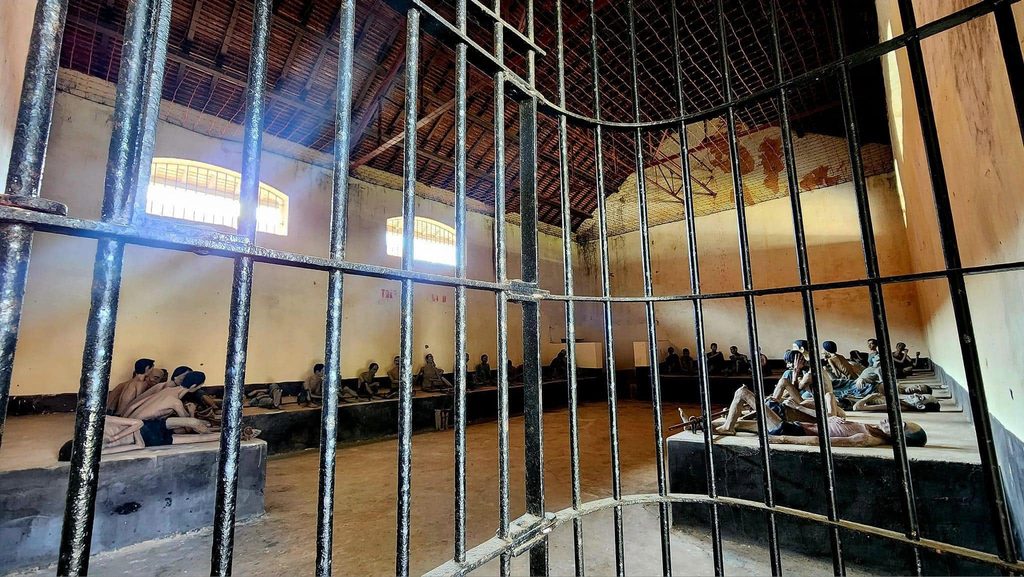
According to the Côn Đảo National Heritage Conservation Centre, the compound had 13 large communal cells and 14 isolated solitary cells.
Additional facilities included an infirmary, kitchen, dining hall, clubhouse, barber’s room, wardens’ offices and gardens.
In the years that followed, Banh II became an important detention facility within the Côn Đảo Prison system, particularly for many political prisoners.
It remained in use during the French colonial period and under the Republic of Vietnam administration, until the prison system ceased operating in 1975.
What names has Phú Sơn Prison had?
During more than half a century of operation, Banh II was renamed several times as the prison administration changed.
Under French colonial rule, it was called Bagne II, commonly rendered in Vietnamese as Banh II.
After 1954, the compound continued under names including Lao II, Nhân Vị Camp and Camp 3.
Historical sources indicate that the compound was renamed Phú Sơn in the period following the 1973 Paris Peace Accords. The book Huyền thoại Côn Đảo (Legends of Côn Đảo) gives the specific date of the change as 17 November 1974.
The name Phú Sơn remained in use when the compound became a historic site after 1975.
Recognizing these names is essential when researching documents about Côn Đảo.
A person might be recorded as having been held at Banh II in a colonial-era file, while the same place appears later as Camp 3 or Phú Sơn Prison.
When reading memoirs, records or photograph captions, therefore, pay attention to the historical period and the corresponding name.
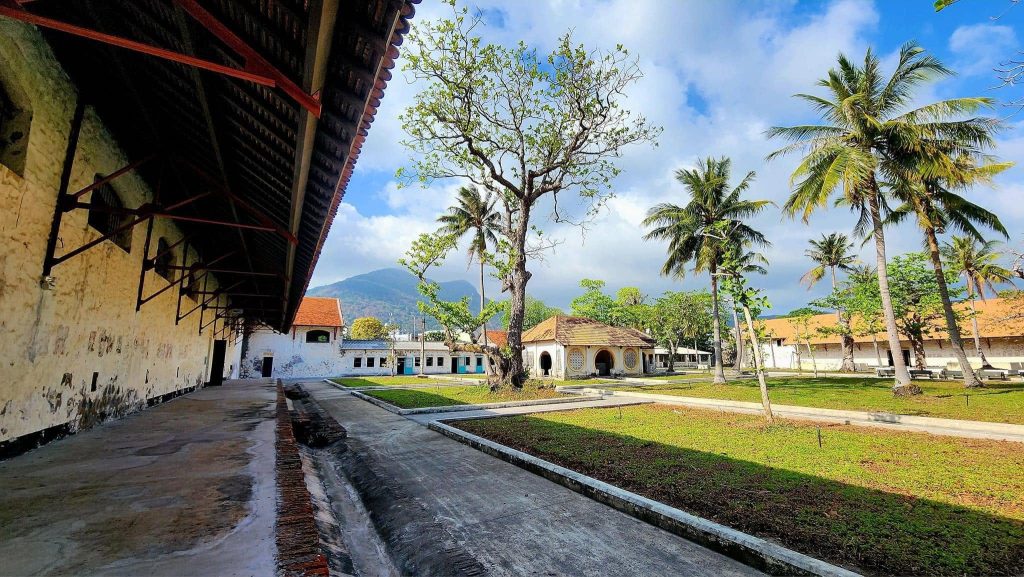
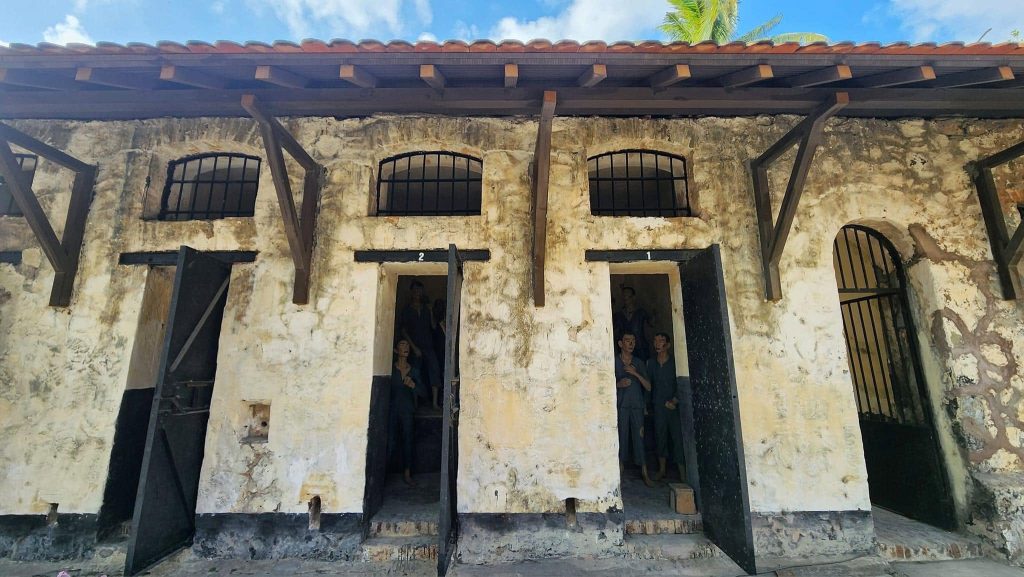
What is distinctive about Phú Sơn’s architecture?
Phú Sơn belongs to the group of solidly built detention facilities within the Côn Đảo Prison system.
Unlike colonial administrative buildings or residences, Banh II’s architecture focused on organizing detention spaces and classifying and controlling prisoners.
Available sources do not agree completely on the compound’s area. The Côn Đảo National Heritage Conservation Centre gives 15,212 m², while the Vietnam National Museum of History and the Côn Đảo Tourism Portal give 13,228 m².
Despite this difference, the sources agree on the important features: large communal cells, an isolated solitary confinement section, a dark cell and support facilities.
Thirteen large communal cells
An important part of Banh II consists of cell blocks with brick walls and substantial construction.
The site’s introductory documents record 13 large communal cells.
These rooms were arranged to hold many people in the same space under the supervision of guards.
When prisoner numbers rose, living conditions became more difficult because of limited space and strict controls.
Prisoners lived with shortages and could neither move freely nor determine their daily routines.
Today, examining the cells’ architecture helps visitors understand how a compound was organized to hold and control large groups of people.
The elevated surveillance corridor
One notable feature of Banh II is the system of elevated walkways used by the prison authorities.
According to the Côn Đảo National Heritage Conservation Centre, the complex was designed with corridors along which guards and security personnel could move to inspect the detention area.
From these positions, they could monitor activity in the rooms and control prisoners.
The arrangement reflects the use of architecture as an instrument of prison administration.
The site’s documentation also recounts an incident in which prisoners fought back and a guard was killed in the corridor area. Afterward, this walkway was no longer used in the same way.
The account is preserved in local records, although the available documentation is insufficient to establish the exact date and the identities of those involved.
The isolation section with 14 solitary cells
One of Phú Sơn’s most important areas is its group of 14 solitary cells.
According to the introductory documentation, this isolation section stood behind a thick wall, separated from the communal living area.
This arrangement was intended to isolate prisoners subjected to a strict detention regime.
Unlike communal cells, the solitary cells restricted contact with other prisoners.
Light, ventilation and living conditions were also harsher in the isolation section.
According to the Côn Đảo National Heritage Conservation Centre, many people confined here became severely weakened by malnutrition, lack of light, illness and punitive measures.
This gives the solitary confinement section a particular importance in the study of Banh II’s history.
The dark cell
In addition to the solitary cells, the Vietnam National Museum of History records a dark cell at Phú Sơn.
A dark cell was a detention space used to restrict light and isolate prisoners.
Prolonged deprivation of natural light can affect both physical and mental health.
For prisoners already ill or weakened, such conditions increased the risk of further harm.
During a visit, use the information panels or a guide’s explanation to understand the dark cell’s location and historical function, rather than confusing it with ordinary cells.
Kitchen, infirmary and other support buildings
Banh II also had support facilities for administration and daily needs.
The kitchen and dining hall were provided for food preparation and meals.
The infirmary served to care for sick people within the camp’s administrative system.
There was also a barber’s room, clubhouse, wardens’ offices and garden areas.
However, the existence of these facilities did not mean that prisoners’ living conditions were always adequate.
Historical records continue to document malnutrition, illness and harsh detention conditions at Banh II across different periods.
Prisoners’ lives at Banh II
Phú Sơn held various groups of prisoners, particularly political and revolutionary activists.
Living conditions changed over time, but detainees generally remained subject to strict control by the prison administration.
Life in communal cells
In the large communal cells, many prisoners shared limited space.
Daily activities such as eating, resting and personal hygiene were organized according to camp regulations.
As detainee numbers increased, ventilation and sanitation could deteriorate.
Prisoners also faced the risk of illness from inadequate diets and insufficient healthcare.
Years of confinement in solitary cells
Life was still harsher for those sent to the isolation section.
Small spaces, lack of light and isolation reduced opportunities for movement, communication and mutual support.
According to historical records on Côn Đảo, scabies and skin sores, severe physical weakness and dysentery seriously affected the health of people held in Banh II’s solitary cells.
In many cases, inadequately treated illness could lead to death.
The surviving solitary cells therefore have significance beyond architecture: they preserve the memory of people subjected to an especially harsh detention regime.
Lê Hồng Phong and his final days at Phú Sơn
One of the most important events associated with Phú Sơn is the death of former General Secretary Lê Hồng Phong.
He was a leading figure in Vietnam’s revolutionary movement before the August Revolution and served as General Secretary of the Indochinese Communist Party.
During his political activities, he was arrested several times and experienced periods of imprisonment.
His final years were closely linked to Côn Đảo Prison.
Imprisonment at Banh II
According to the Côn Đảo National Heritage Conservation Centre, Lê Hồng Phong was held in strict confinement in Banh II’s solitary cell section.
Conditions were extremely harsh, while his health had already declined after years of revolutionary activity and imprisonment.
Illness, malnutrition and torture further weakened him.
Even so, successive generations of Côn Đảo political prisoners remembered Lê Hồng Phong as a steadfast leader.
6 September 1942: Lê Hồng Phong dies in solitary cell No. 5
According to the official records of the Côn Đảo National Heritage Conservation Centre, on 6 September 1942, Lê Hồng Phong died in solitary cell No. 5 at Banh II.
He died under strict confinement, severely weakened by dysentery and harsh prison conditions.
This is one of the most important historical milestones associated with Phú Sơn.
Today, learning about the solitary confinement section associated with Lê Hồng Phong helps visitors understand his final years and the conditions political prisoners endured.
Lê Hồng Phong’s grave at Hàng Dương Cemetery
After his death, Lê Hồng Phong was buried on Côn Đảo.
Today, his grave is in Section A of Hàng Dương Cemetery, the resting place of many revolutionary activists and patriots.
For visitors exploring Lê Hồng Phong’s life, Phú Sơn and Hàng Dương Cemetery are two directly connected historical places.
Phú Sơn is associated with his confinement and final days, while Hàng Dương Cemetery is a place of remembrance and incense offerings.
Nguyễn An Ninh and his years at Banh II
Alongside Lê Hồng Phong, the patriot Nguyễn An Ninh is also recorded as having been held in Banh II’s solitary confinement section.
Nguyễn An Ninh was an influential journalist, thinker and political activist in Cochinchina during the early decades of the twentieth century.
He took part in campaigns for freedom and democratic rights and against colonial rule.
During his activities, Nguyễn An Ninh was repeatedly arrested by the colonial authorities.
In his final years, he was sent to Côn Đảo and imprisoned in harsh conditions.
He died on Côn Đảo on 14 August 1943.
Nguyễn An Ninh is associated with several places of remembrance on the island, including Hàng Dương Cemetery, where his grave is maintained and preserved today.
Learning about Nguyễn An Ninh alongside Lê Hồng Phong helps explain Banh II’s historical significance for Vietnam’s patriotic and revolutionary movements in the first half of the twentieth century.
Other historical figures imprisoned at Phú Sơn
Phú Sơn held many revolutionary activists and political figures who had a major influence on Vietnamese history.
According to the Côn Đảo National Heritage Conservation Centre and the Bà Rịa–Vũng Tàu Museum, those held at Banh II included Nguyễn Văn Cừ, Lê Duẩn, Phạm Văn Đồng, Hoàng Quốc Việt, Lê Thanh Nghị and Hà Huy Giáp.
Nguyễn Văn Cừ
Nguyễn Văn Cừ was a revolutionary activist who served as General Secretary of the Indochinese Communist Party.
During his activities, he was arrested by the French colonial authorities and exiled to Côn Đảo.
His years of imprisonment were linked to the resistance and learning activities of revolutionaries on the island.
Lê Duẩn
Lê Duẩn was a revolutionary activist who later held major responsibilities in the Party leadership.
He spent time imprisoned on Côn Đảo by the French colonial authorities.
His name appears in the histories of several prison compounds, including Banh II.
Phạm Văn Đồng
Phạm Văn Đồng was among the revolutionary activists imprisoned on Côn Đảo and later served for many years as Prime Minister of Vietnam.
He also appears in the account of the play Napoleon organized by political prisoners in the Banh II courtyard in 1935.
Hoàng Quốc Việt, Lê Thanh Nghị and Hà Huy Giáp
Hoàng Quốc Việt, Lê Thanh Nghị and Hà Huy Giáp were revolutionary activists held at Banh II.
While in prison, many activists with organizational experience took part in learning activities, supported their comrades and sustained resistance movements.
These figures later continued to contribute in politics, organizational work and state administration.
Beyond these widely known figures, many other political prisoners were held at Phú Sơn whose names and personal stories have not been fully presented in commonly available publications.
The play Napoleon in the Banh II courtyard in 1935
Not every story about Phú Sơn concerns cells or punishment.
One of Banh II’s most unusual events took place during the Lunar New Year in 1935, when political prisoners staged a play about Napoleon in the camp courtyard.
According to the Côn Đảo National Heritage Conservation Centre, those involved in organizing it included Phạm Văn Đồng, Nguyễn Văn Linh, Nguyễn Kim Cương and several other political prisoners.
Why did prisoners stage a play?
Cultural activities were important to prisoners’ morale and inner lives.
Staging a play required preparing the script, assigning roles, rehearsing and coordinating many people.
Amid shortages and strict supervision, this was far from simple.
Nevertheless, the political prisoners at Banh II managed to stage a play about Napoleon, a prominent figure in French history.
The event shows that prisoners maintained cultural activity, learning and creativity even within a prison environment.
A performance attended by guards
According to the site’s introductory records, many French guards came to watch the performance.
The play made an impression through both its content and the prisoners’ performances.
Local records state that it led some guards to alter their attitudes toward political prisoners to a degree, recognizing them as knowledgeable, cultured people with organizational abilities.
A single performance cannot establish that the entire detention regime at Banh II changed. The account does, however, show how cultural activities could have some influence on how different sides viewed and treated one another.
The significance of Napoleon
The event’s most remarkable aspect goes beyond the staging of a play inside a prison.
It lies in the prisoners’ ability to maintain intellectual life, share knowledge and create art in extremely difficult conditions.
In Phú Sơn’s history, the 1935 play Napoleon stands out as a rare cultural milestone.
The story also helps visitors understand that prisoners’ lives included education, literature and art, alongside imprisonment and direct resistance.
Phú Sơn and political prisoners’ classes
Between 1930 and 1945, Banh II became one of the places where political prisoners organized many learning activities.
According to the Côn Đảo National Heritage Conservation Centre, prisoners organized general education and political theory classes and exchanged experience from their activities.
Learning in detention
These classes could not be organized like those in ordinary schools.
Learning had to fit into whatever time could be used, with limited documents, paper, writing materials and other resources.
Those with knowledge helped others learn to read and write and explore history, politics and social issues.
For young revolutionaries, studying offered a way to continue broadening their understanding while cut off from their activities outside.
For those with experience, it was also a means of passing on knowledge and maintaining connections with comrades.
Solidarity among people with differing political views
One feature mentioned in Banh II’s historical records is the effort to build solidarity between groups of prisoners with different political tendencies.
Political prisoners did not always share the same views or backgrounds.
In detention, these differences could lead to conflict.
Many nevertheless sought to discuss, persuade and cooperate around shared demands such as better living conditions, protecting health and opposing repressive measures.
This is an important aspect of Banh II’s history, alongside the individual activities of each political organization.
1951–1953: Banh II and the escape attempt at Bến Đầm
In the final years of the resistance war against French colonial rule, Banh II continued to hold groups of prisoners of war brought to Côn Đảo from the mainland.
According to the Côn Đảo National Heritage Conservation Centre, many prisoners of war from northern and central Vietnam were transferred here between 1951 and 1953.
Those detained continued to face harsh prison conditions.
Within the prisoner-of-war community, however, ideas and plans emerged for escaping the island.
The development of an escape plan
Côn Đảo’s isolated offshore location made escape extremely difficult.
Anyone seeking to leave had to evade prison controls, gain access to sea transport and face many dangers along the way.
Even so, the prisoners of war at Banh II sought ways to organize, exchange information and prepare a plan.
Historical records indicate that an island escape plan developed during this period and was connected with the 1952 event at Bến Đầm.
12 December 1952: An escape attempt by 198 prisoners of war
On 12 December 1952, an armed attempt to escape the island involving 198 prisoners of war took place in the Bến Đầm area.
The Côn Đảo National Heritage Conservation Centre records the event as an important milestone associated with prisoners of war who had been held at Banh II.
It was one of the notable escape attempts in the history of Côn Đảo Prison.
When studying it, distinguish the Bến Đầm escape attempt from the uprisings that liberated the prison system in 1975.
The two events occurred in different periods and historical circumstances.
Resistance at Phú Sơn, 1954–1975
After 1954, Banh II continued to operate under the Republic of Vietnam administration.
During this period, the camp was renamed and its administration reorganized several times.
Alongside other Côn Đảo prison compounds, Banh II became a setting for numerous political prisoners’ protests and resistance activities.
Opposition to forced labor
One important demand was to end forms of forced labor and harsh punishment.
For prisoners in poor health, strenuous work could cause illness or exhaustion.
Resistance to forced labor therefore became an important part of prison life.
Resistance to compulsory flag salutes
Another aspect of political prisoners’ resistance on Côn Đảo concerned politically coercive demands, including compulsory participation in flag-saluting ceremonies ordered by the prison authorities.
For many political prisoners, these demands directly concerned their political convictions and positions.
As a result, resistance could continue for prolonged periods and take different forms.
The 1970 “Autumn Uprising” movement
According to the Côn Đảo National Heritage Conservation Centre, in August 1970 prisoners at Banh II were among the vanguard initiating the resistance movement known as “Mùa thu đồng khởi” (“Autumn Uprising”).
The movement involved demands against forced labor and compulsory flag salutes. Local historical records state that more than 4,000 political prisoners across the island took part.
It was one of the large-scale resistance movements within the Côn Đảo Prison system during the final phase of the war.
The event shows that prisoners retained their ability to organize and coordinate, even as many prison compounds introduced increasingly strict controls.
Phú Sơn after 1 May 1975
On 1 May 1975, Côn Đảo was liberated, bringing to an end the prison system’s 113 years of existence since 1862.
Like the other prison compounds, Phú Sơn ceased to function as a detention facility and entered a new phase.
Its cell blocks, solitary cells, courtyard and support buildings became subjects of research, conservation and historical interpretation.
The complex gradually changed from a place of confinement into a public space for historical education.
Recognition of the site’s heritage value in 1979
On 29 April 1979, the Ministry of Culture and Information issued Decision No. 54-VHTT.QĐ, recognizing the Côn Đảo Revolutionary Historical Site as a site of special national importance.
Phú Sơn was one of the component structures within the protected system.
This recognition provided a basis for research, management and conservation of the surviving remains.
Special National Heritage designation in 2012
On 10 May 2012, the Prime Minister issued Decision No. 548/QĐ-TTg, designating the Côn Đảo Prison Historical Site as a Special National Heritage Site.
Phú Sơn is a component of the designated complex.
Note that the 2012 decision applies to the entire Côn Đảo Prison Historical Site; it is not a separate designation solely for Phú Sơn.
Features to explore at Phú Sơn
When visiting Phú Sơn, examine the complex by groups of spaces to understand how the camp functioned.
Entrance and perimeter walls
The entrance controlled movement into and out of the compound.
The perimeter walls reflect the need to isolate the detention area from the outside world.
Today, the entrance and old walls help visitors recognize the architecture of a colonial-era prison compound.
Communal cells
These rooms once held many people in the same space.
Pay attention to room size, the arrangement of doors, lighting and surviving features.
These details help convey the conditions of communal life in prison.
The 14 solitary cells
The solitary confinement section has particular significance because of its association with isolation and strict confinement.
It is also linked to the final days of Lê Hồng Phong and other political prisoners.
Consider each cell’s historical function, especially solitary cell No. 5, which is identified in records concerning Lê Hồng Phong’s death.
The dark cell
The dark cell represents a distinct form of detention with restricted light.
Learn about it through the information panels and guided explanation, and do not enter spaces that are not open to visitors.
The courtyard
Banh II’s courtyard served administrative purposes and was also associated with cultural events and resistance activities.
In particular, it is recorded as the setting for the play Napoleon during the Lunar New Year in 1935.
This detail helps visitors understand Phú Sơn through its architecture, intellectual and cultural life, and political prisoners’ activities.
A visitor guide to Phú Sơn Prison, Côn Đảo
Phú Sơn stands near Phú Hải, making it convenient to explore both complexes on the same visit when visitor arrangements permit.
First-time visitors to Côn Đảo should familiarize themselves with the prison system’s history and the names Banh I, Banh II and Banh III beforehand.
This helps avoid confusion between sites with similar architecture or multiple historical names.
Visiting hours
According to the Côn Đảo National Heritage Conservation Centre’s visitor registration information, the general schedule is divided into two periods:
| Session | Time |
|---|---|
| Morning | 07:30–11:30 |
| Afternoon | 14:00–17:00 |
Tours may operate in sessions depending on visitor reception arrangements and group numbers.
Phú Sơn is included among the sites on the Centre’s tour routes.
However, the general opening schedule does not mean that every area inside Phú Sơn is freely accessible.
Access to some cells or features may change according to conservation needs, guided activities and visitor arrangements.
Check with the site management beforehand if you wish to visit a particular area.
Phú Sơn admission fees in 2026
Under Resolution No. 29/2026/NQ-HĐND of 27 August 2026 issued by the Ho Chi Minh City People’s Council, effective from 1 October 2026, the admission fee for the Côn Đảo Prison Special National Historical Site, including Côn Đảo Museum, is VND 60,000 per person per visit for visitors required to pay.
This is the regulated general admission fee for the heritage site, not a separate ticket price for Phú Sơn alone.
Exempt groups include children, school pupils, students, people with particularly severe disabilities, and members of poor or near-poor households.
Some eligible groups receive a 50% reduction, including older people, people with severe disabilities and people recognized for meritorious service to the revolution, subject to the stipulated conditions.
Bring the appropriate documents if you qualify for an exemption or reduction.
How much time should you allow?
Allow approximately 30–45 minutes to explore Phú Sơn’s principal features.
If accompanied by a guide or wishing to examine the history in more depth, allow around an hour or longer.
This is only a suggested planning allowance, not a fixed requirement.
Should you visit with a guide?
At a site with as many historical layers as Banh II, a guide can make the visit easier to follow.
Stories such as solitary cell No. 5, the play Napoleon and political prisoners’ resistance movements are difficult to understand fully simply by looking at the walls and cells.
Guided interpretation connects the physical remains with events and people documented in historical sources.
Visitor contact information
Côn Đảo National Heritage Conservation Centre
Telephone: 0254 3830 517.
Website: https://trungtambaotonditichquocgiacondao.vn/
Contact the Centre in advance to check visitor arrangements and find a suitable tour program.
Advice for visiting Phú Sơn
Phú Sơn is a historic structure that has undergone more than a century of use, alteration and exposure to the weather.
Visitors should therefore follow the site management’s instructions.
Do not enter restricted areas
Access to some communal cells, solitary cells or architectural features may be limited for conservation or safety reasons.
Do not open doors without permission, cross barriers or enter areas marked as restricted.
Do not damage the historic structures
The walls, iron doors, cell floors and surviving structures have historical value.
Do not sit on exhibits, touch features under conservation or carve words into the buildings.
Take photographs respectfully
Photography is allowed in designated areas in accordance with the site’s rules.
However, Phú Sơn is a place where many people were imprisoned and lost their lives.
Avoid poses or actions that show disrespect for this historical setting.
Clothing and footwear
Wear respectful, comfortable clothing suitable for walking.
Shoes or sandals with good grip are more suitable for old brick floors and areas that may be damp.
Visiting with children
Some accounts of detention conditions and illness may be upsetting for young children.
Parents should explain the historical context beforehand and help children understand the site’s meaning in an age-appropriate way.
Distinguishing Phú Sơn from Phú Hải
Because they are close together and both have long histories, Phú Sơn and Phú Hải are often discussed together.
They are, however, separate complexes with different functions and historical milestones.
| Feature | Phú Sơn Prison | Phú Hải Prison |
|---|---|---|
| Historical name | Banh II | Banh I |
| Period of establishment | 1908–1916 | From 1862 |
| Large communal cells | 13 | 10 communal cells |
| Solitary cells | 14 | 20 |
| Notable features | Isolation section, dark cell, surveillance corridor | Rice-grinding chamber, stone-breaking area, stone chamber |
| Historical milestones | Lê Hồng Phong’s death in 1942; the play Napoleon in 1935 | The first Communist Party cell in the prison in 1932 |
| Principal significance | Detention of political prisoners, cultural activities and resistance | The oldest prison compound, associated with forced labor and organizational activities |
Exploring both compounds helps visitors understand how the construction, management and operation of Côn Đảo Prison changed over time.
In particular, the accounts of forced labor at Banh I and learning and cultural activities at Banh II complement one another, offering a fuller view of prisoners’ lives.
The historical significance of Phú Sơn Prison, Côn Đảo
Evidence of detention and solitary confinement
The large communal cells, solitary cells and dark cell reflect the organization of a solidly built colonial-era prison compound.
The surviving remains support research into prison architecture, methods of control and the living conditions detainees faced.
A place associated with many historical figures
Phú Sơn held many revolutionary activists who made important contributions to Vietnamese history.
In particular, Lê Hồng Phong’s death in solitary cell No. 5 is one of the site’s most prominent historical milestones.
The stories of Nguyễn An Ninh and many other activists also help convey the scale of loss under the prison regime.
A setting for learning and cultural activity
The 1935 play Napoleon and prison learning activities reveal another aspect of political prisoners’ lives.
Despite harsh confinement, many people continued to teach, exchange knowledge and create art.
This is a distinctive part of Banh II’s historical and cultural significance.
A site of resistance
From efforts to improve living conditions to the 1970 “Autumn Uprising” movement, Phú Sơn is associated with many political prisoners’ resistance activities.
These events show that prison history concerns not only the machinery of detention but also human organization and choices under conditions of control.
Educational and conservation value
Today, Phú Sơn is a place for visits, research and education about historical traditions.
Its architectural remains, documents and historical accounts help later generations understand a period spanning more than a century of Côn Đảo’s history.
Conserving the complex therefore matters both to local history and to the study of twentieth-century Vietnam.
Frequently asked questions about Phú Sơn
When was Phú Sơn Prison built?
Construction of Phú Sơn, formerly Banh II, began under the French colonial authorities in 1908 and was completed in 1916.
What other names has Phú Sơn had?
The complex was known as Banh II, Bagne II, Lao II, Nhân Vị Camp and Camp 3 before being named Phú Sơn.
Where is Phú Sơn?
The site is in central Côn Sơn Island, near Tôn Đức Thắng and Nguyễn An Ninh streets, beside Phú Hải Prison.
How many cells does Phú Sơn have?
According to the Côn Đảo National Heritage Conservation Centre’s introductory documentation, the compound has 13 large communal cells and an isolation section containing 14 solitary cells.
How large is Phú Sơn?
Sources publish different areas. The Côn Đảo National Heritage Conservation Centre gives 15,212 m², while the Vietnam National Museum of History and the Côn Đảo Tourism Portal give 13,228 m².
Where on Côn Đảo did Lê Hồng Phong die?
According to the Côn Đảo National Heritage Conservation Centre, Lê Hồng Phong died in solitary cell No. 5 at Banh II, now Phú Sơn, on 6 September 1942.
Was Nguyễn An Ninh held at Phú Sơn?
Yes. The heritage management authority’s records state that Nguyễn An Ninh was held in strict confinement at Banh II. He died on Côn Đảo on 14 August 1943.
Why was Napoleon performed at Phú Sơn?
During the Lunar New Year in 1935, political prisoners at Banh II staged a play about Napoleon. The event reflects their cultural activities and ability to organize even while imprisoned.
Is Phú Sơn the same as the French Tiger Cages?
No. Phú Sơn is Banh II, built between 1908 and 1916. The French Tiger Cages are a different isolation compound, built by the French colonial authorities in 1940 and associated with Phú Tường Prison.
Is Phú Sơn a Special National Heritage Site?
Phú Sơn is a component of the Côn Đảo Prison Historical Site, designated a Special National Heritage Site by the Prime Minister under Decision No. 548/QĐ-TTg of 10 May 2012.
What is the Phú Sơn admission fee in 2026?
From 1 October 2026, the admission fee for the Côn Đảo Prison Special National Historical Site is VND 60,000 per person per visit for those required to pay. This is the general fee for the heritage site.
Can Phú Sơn and Phú Hải be visited in the same morning or afternoon?
Both can be included in one program if visitor schedules and opening arrangements permit. Their proximity makes it convenient to explore them consecutively.
Phú Sơn: Old walls and stories that remain in memory
More than a century has passed since Banh II was completed in 1916.
Through repeated changes of name and function, Phú Sơn has remained one of the important historic sites within the Côn Đảo Prison system.
The surviving communal cells, solitary confinement section and support buildings help visitors picture how a detention compound was organized in the colonial period and the years that followed.
Many people here endured harsh living conditions, illness, isolation and punishment.
Phú Sơn is also associated with the lives of revolutionary activists, particularly former General Secretary Lê Hồng Phong, who died in solitary cell No. 5 in 1942.
Alongside these losses, Banh II also preserves memories of classes, cultural activities and political prisoners’ resistance.
The story of the 1935 play Napoleon is a particularly striking example of detainees finding ways to sustain intellectual and cultural life in difficult circumstances.
Today, visitors passing through Phú Sơn’s entrance encounter more than a former prison building.
It is also a place to learn about those once held here, their choices in exceptional historical circumstances, and the values preserved after the prison system ceased to operate.
Phú Sơn is an important part of exploring Côn Đảo’s history, where architectural remains continue to connect stories of the past with the understanding of today’s generations.
Preparing to explore Phú Sơn
Visitors wishing to learn about Phú Sơn can first read introductions to Phú Hải Prison, Côn Đảo Museum and Hàng Dương Cemetery to understand the historical context, figures and related events.
If traveling to Côn Đảo by high-speed ferry, check outbound and return schedules, departure and arrival ports, and weather conditions before deciding the length of your stay.
Con Dao Express provides information about high-speed ferry routes to Côn Đảo, schedules, indicative fares and destinations to help visitors plan their journeys.
Consult the Côn Đảo Express ferry schedule to choose suitable outbound and return sailings.
Reference sources
- Côn Đảo National Heritage Conservation Centre: Phú Sơn Prison Historic Site (Camp 3).
- Côn Đảo Tourism Portal: Phú Sơn Prison Historic Site visitor attraction.
- Vietnam National Museum of History: An overview of the Côn Đảo Prison system.
- Bà Rịa–Vũng Tàu Museum: Conserving and promoting the Côn Đảo Prison historical site.
- Huyền thoại Côn Đảo (Legends of Côn Đảo), Thông Tấn Publishing House, 2013.
- Côn Đảo National Heritage Conservation Centre: Visitor registration.
- Resolution No. 29/2026/NQ-HĐND of 27 August 2026, issued by the Ho Chi Minh City People’s Council.
- Prime Minister’s Decision No. 548/QĐ-TTg of 10 May 2012.
Google Maps: Trại Phú Sơn
The map shows the site’s location. Confirm the entrance and visiting hours with the site management before you go.