
In the history of political prisoners’ struggles on Côn Đảo, People’s Armed Forces Hero Huỳnh Tấn Lợi stands among those who devoted most of their lives to revolutionary activity and continued resisting even under harsh imprisonment.
Born in 1916 in Quảng Ngãi, he joined the Việt Minh movement in 1943 and held several local positions before his arrest in 1956. A year later, he was exiled to Côn Đảo, where he continued participating in political prisoners’ struggles.
On 4 May 1973, Huỳnh Tấn Lợi died during a crackdown in the Côn Đảo prison system while he and other prisoners opposed attempts to forcibly reclassify their records from political prisoners to ordinary criminal prisoners.
Today, his grave lies in Section C of Hàng Dương Cemetery, which preserves the memory of those who died in the struggle for national independence and reunification.
Who was the fallen hero Huỳnh Tấn Lợi?
Huỳnh Tấn Lợi was born in 1916 in Tân Hy village, Bình Đông commune, Bình Sơn district, Quảng Ngãi province. He grew up during a period when patriotic movements and resistance to French colonial rule were developing strongly in central Vietnam.
In August 1943, he began revolutionary activity in the Việt Minh movement.
After the success of the August Revolution in 1945, Huỳnh Tấn Lợi became a key commune official, helping establish and consolidate the local revolutionary administration.
In 1947, he was assigned to district-level work. In 1948, he moved to the Propaganda and Training Department of the Quảng Ngãi Provincial Party Committee, participating in publicity, mobilization and mass organization during the resistance against French colonial rule.
In 1952, under a policy of strengthening personnel at district and grassroots levels, he returned to local work, joining the District Party Committee and serving as district Vice Chairman.
His years of work from commune to provincial level gave Huỳnh Tấn Lợi experience in organizing movements, developing grassroots networks and mobilizing the population to join the resistance.
Continuing revolutionary activity after the 1954 Geneva Accords
After the Geneva Accords were signed in 1954, Vietnam entered a new historical phase marked by major political and military changes.
In these circumstances, Huỳnh Tấn Lợi was assigned to remain in the South and continue revolutionary activity.
At the time, he was a member of the District Party Committee’s Standing Committee, responsible for the northern part of Bình Sơn district, Quảng Ngãi province.
His work focused on maintaining organizations, building grassroots networks, mobilizing residents and strengthening the confidence of people who had participated in the resistance.
This was a difficult period for revolutionary activity. The Republic of Vietnam authorities conducted campaigns to arrest, interrogate and suppress people suspected of involvement in communist organizations or earlier resistance activities.
Despite the constant risk of discovery, Huỳnh Tấn Lợi continued his local activities.
This work made him a target of surveillance and pursuit by the authorities of the time.
Arrest in 1956 and interrogation in Quảng Ngãi
In early 1956, Huỳnh Tấn Lợi was arrested in Bình Nguyên commune, Bình Sơn district, Quảng Ngãi province.
According to historical accounts of his life, he was repeatedly interrogated after his arrest to obtain information about organizations and revolutionary networks still operating locally.
He was taken to the Republic of Vietnam police office in Quảng Ngãi town.
Interrogations there were prolonged. However, Huỳnh Tấn Lợi maintained that remaining in the South after the Geneva Accords and engaging in political activity were consistent with the rights of former resistance participants.
According to “Sống giữa ngục tù” (“Life amid Imprisonment”), published by the Quảng Ngãi Provincial Liaison Committee of Patriotic Political Prisoners, he repeatedly invoked the spirit of the Geneva Accords to protest his detention.
He asserted that he was not military personnel required to regroup, had the right to continue living in the South and could join the population in pursuing national reunification.
When interrogation failed to achieve its purpose, his captors continued using torture and psychological pressure.
Surviving accounts state that his health was seriously damaged during this period.
Even when relatives were brought in to persuade him, Huỳnh Tấn Lợi did not change his position.
His steadfastness during detention in Quảng Ngãi became an important part of his revolutionary life.
17 May 1957: Huỳnh Tấn Lợi was exiled to Côn Đảo
On 17 May 1957, Huỳnh Tấn Lợi was placed aboard a ship bound for Côn Đảo Prison.
For those sentenced and sent to the island, the voyage marked the beginning of imprisonment far from the mainland, in a prison system used to hold many patriots and political prisoners across different periods.
Historical materials state that immediately upon arriving on Côn Đảo, Huỳnh Tấn Lợi and fellow prisoners on the same voyage faced repressive measures intended to force compliance with prison regulations.
He and 58 other prisoners firmly resisted, refusing to renounce the Party or salute the Republic of Vietnam flag.
This was not merely opposition to a formal requirement; it was directly connected to protecting the prisoners’ political status and convictions.
The struggle took place under highly unfavorable conditions, as prisoners faced severe punishments and strict control by the prison apparatus.
Years of struggle in Côn Đảo Prison
During his imprisonment, Huỳnh Tấn Lợi continued participating in political prisoners’ struggles.
According to material recorded in “Sống giữa ngục tù,” repeated crackdowns and torture left him severely debilitated.
At one point, he was beaten so badly that he was almost unable to care for himself.
After one crackdown, he was transferred to the Lao II infirmary for treatment while in very poor health.
At the infirmary, fellow prisoners sought ways to care for him and help him gradually recover.
However, Huỳnh Tấn Lợi was troubled not only by his own health but also by being separated from the prisoners who were continuing their struggle.
Recorded recollections describe his constant concern for fellow detainees and his wish to return to the group.
In prison, solidarity among political prisoners played an important role. They shared food, medicine and information, encouraging one another to endure deprivation.
For Huỳnh Tấn Lợi, maintaining that solidarity was inseparable from his years of imprisonment on Côn Đảo.
Defending political-prisoner status after the Paris Agreement
On 27 January 1973, the Paris Agreement on Ending the War and Restoring Peace in Vietnam was signed.
This brought important changes to the war and to the question of returning people who had been captured or detained.
At Côn Đảo Prison, however, intense struggles over political-prisoner status continued.
According to former Côn Đảo prisoners’ accounts, the prison authorities sought to reclassify some political prisoners as ordinary criminal prisoners.
Prisoners opposed the change because they believed it could affect their rights, political status and release under the relevant agreements.
They were required to be photographed, fingerprinted and to sign prepared declarations.
For Huỳnh Tấn Lợi and many fellow detainees, accepting those procedures meant acknowledging a legal status they firmly rejected.
Consequently, many protests took place in the camps despite the danger of repression.
Early May 1973 at Camps 6 and 7
In early May 1973, the situation in Côn Đảo’s political-prisoner camps became particularly tense.
On 2 May 1973, a severe crackdown occurred in Section B of Camp 6. Many prisoners were beaten and forcibly transferred to Camp 7 for procedures to change their detention records.
Historical records and eyewitness accounts report that many people were seriously injured during this process.
Huỳnh Tấn Lợi was among the prisoners seriously injured in the crackdowns.
After being taken to Camp 7, he continued resisting forced fingerprinting, photography and signatures on records he refused to accept.
Although years of imprisonment and earlier beatings had exhausted him, he remained steadfast.
Early May 1973 became a tragic period in the history of struggle at Côn Đảo Prison, when many prisoners were wounded or killed in crackdowns.
4 May 1973: Huỳnh Tấn Lợi died at Côn Đảo Prison
On the morning of 4 May 1973, Huỳnh Tấn Lợi died following crackdowns at Côn Đảo Prison.
According to “Sống giữa ngục tù,” he protested when further pressure was applied to make him undergo fingerprinting and photography.
The book records his words:
“I will not be fingerprinted or photographed. I protest your actions.”
Immediately afterward, he was beaten again and died at his place of detention.
He was 57 years old.
Huỳnh Tấn Lợi’s death occurred as political prisoners on Côn Đảo continued struggling to protect their status and rights after the Paris Agreement was signed.
His life ended while the country was still at war, just two years before the liberation of the South.
His fellow prisoners remembered his story as an example of steadfastness in the face of pressure and violence in confinement.
Huỳnh Tấn Lợi posthumously awarded the title Hero of the People’s Armed Forces
On 27 April 2012, the President of the Socialist Republic of Vietnam signed a decision posthumously awarding Huỳnh Tấn Lợi the title Hero of the People’s Armed Forces.
The title recognized his revolutionary activity, contributions during the resistance and spirit of struggle throughout his imprisonment.
From joining the Việt Minh movement in 1943 to his death on Côn Đảo in 1973, Huỳnh Tấn Lợi devoted three decades to revolutionary activity.
Nearly the last 16 years of his life were spent in imprisonment and struggle at Côn Đảo Prison.
His life reflects part of the history of many southern revolutionary officials who continued working after 1954, were arrested and spent long years in the prison system.
Where is Huỳnh Tấn Lợi’s grave in Hàng Dương Cemetery?
The grave of fallen hero Huỳnh Tấn Lợi is now in Section C of Hàng Dương Cemetery, Côn Đảo.
Section C is the resting place of many political prisoners and revolutionary fighters who died from approximately 1960 to 1975.
Alongside Huỳnh Tấn Lợi, this section contains the graves of other Heroes of the People’s Armed Forces, including Lê Văn Việt, Trần Thị Thanh (Nguyễn Thị Hoa), Lê Tự Kình and Phan Đình Tụ.
Hàng Dương Cemetery forms part of the Côn Đảo historical site complex and is an important memorial to those imprisoned and killed during the colonial and wartime periods.
Visitors exploring Côn Đảo’s history can combine paying respects at Huỳnh Tấn Lợi’s grave with visits to Hàng Dương Cemetery and sites in the Côn Đảo prison system.
Visitors should preserve the quiet atmosphere, dress appropriately and follow the site management’s instructions.
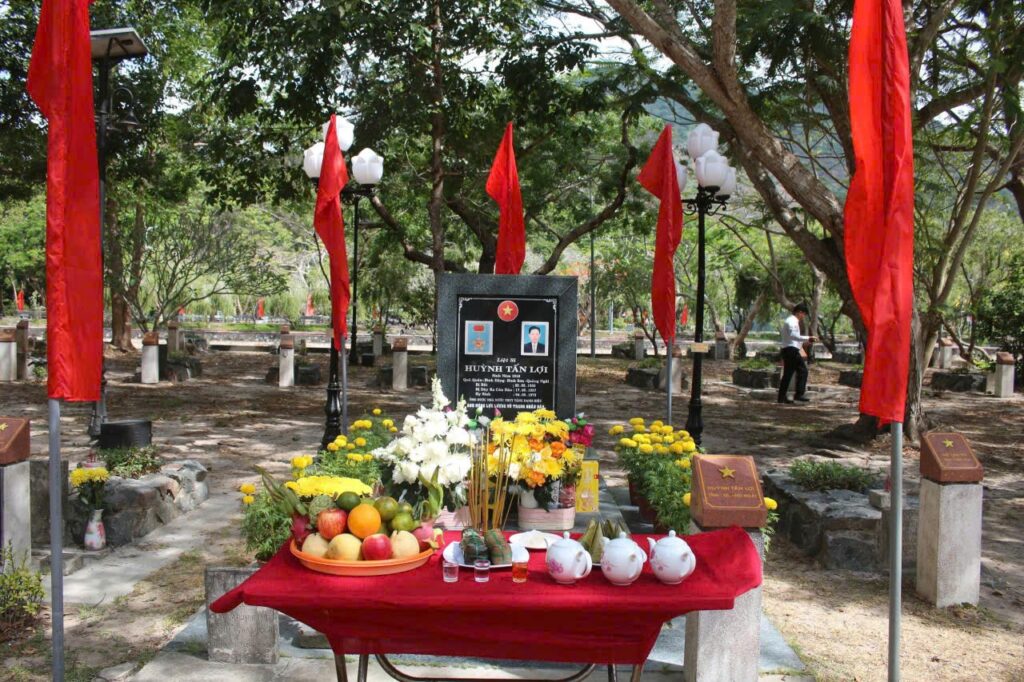
Commemorating Huỳnh Tấn Lợi on Côn Đảo
Every year, 4 May is an occasion to remember the death of People’s Armed Forces Hero Huỳnh Tấn Lợi.
On 4 May 2026, the 53rd anniversary of his death, the Bà Rịa–Vũng Tàu Provincial Museum–Library (Côn Đảo branch) organized a memorial ceremony in Section C of Hàng Dương Cemetery and at Côn Đảo Temple.
The ceremony was attended by representatives of the site management, officials, staff and visitors interested in history.
The commemoration expressed gratitude to Huỳnh Tấn Lợi while helping introduce the stories of generations of political prisoners who struggled on Côn Đảo.
Through these activities, his life and sacrifice continue to be remembered, particularly by young people and visitors to the historical sites.
Huỳnh Tấn Lợi and the memory of an era of struggle on Côn Đảo
Huỳnh Tấn Lợi’s story is not associated with a single feat but spans several historical periods: the Việt Minh movement in Quảng Ngãi, resistance to French colonial rule, revolutionary activity after the Geneva Accords and struggles inside Côn Đảo Prison.
He held various positions, endured interrogations and torture, and spent almost 16 years in one of the harshest prison systems in Vietnamese history.
Even in his final days, Huỳnh Tấn Lợi firmly defended his political status and opposed forced changes to his detention records.
His life ended on Côn Đảo on 4 May 1973, leaving the story of a steadfast fighter in the history of political prisoners’ struggles.
Today, Huỳnh Tấn Lợi’s grave in Section C of Hàng Dương Cemetery is a place for residents and visitors to pause in remembrance and learn more about the island’s history.
Preserving and sharing stories such as Huỳnh Tấn Lợi’s helps later generations better understand those who endured imprisonment, loss and sacrifice in the struggle for national independence and reunification.
Reference sources
- “Sống giữa ngục tù” (“Life amid Imprisonment”), Quảng Ngãi Provincial Liaison Committee of Patriotic Political Prisoners, 2004, pp. 131–143.
- “Lịch sử đấu tranh của các chiến sĩ yêu nước và cách mạng Nhà tù Côn Đảo (1862–1975)” (“History of the Struggle of Patriotic and Revolutionary Fighters in Côn Đảo Prison, 1862–1975”), National Political Publishing House, 2010, pp. 460–469.
- Côn Đảo National Historical Site Conservation Center, “Memorial ceremony marking the 53rd anniversary of the death of People’s Armed Forces Hero Huỳnh Tấn Lợi,” 4 May 2026.
- Côn Đảo National Historical Site Conservation Center, introductory materials on Hàng Dương Cemetery Historical Site and its grave sections.
- Thanh Niên newspaper, eyewitness materials on the crackdown on political prisoners at Côn Đảo in May 1973.