
On the coastal road linking central Côn Đảo with Cỏ Ống Airport, Đất Dốc Beach is one of Côn Sơn Island’s most striking stretches of coast. A long ribbon of sand lies at the foot of Lò Vôi Mountain, with the open blue sea in front and forest-covered hillsides behind. Together, they create a setting that feels spacious yet unusually secluded.
Less busy than beaches near residential areas, Đất Dốc is known for its natural beauty and the luxury Six Senses Côn Đảo resort. It is also a site for sea turtle conservation activities, helping protect one of the rare wildlife species found in Côn Đảo’s waters.
For visitors who enjoy natural scenery, Đất Dốc Beach is worth learning about. However, because the beach area is associated with Six Senses resort operations, access and services are subject to specific rules that visitors should understand before planning a visit.
Where is Đất Dốc Beach?
Đất Dốc Beach lies in the northeast of Côn Sơn Island, within the Côn Đảo Special Zone, Ho Chi Minh City.
The beach runs along Cỏ Ống Road, which connects central Côn Đảo with Côn Đảo Airport. It is around 7–10 km from the centre, depending on the starting point, and approximately 9 km by road from Cỏ Ống Airport.
Behind Đất Dốc Beach rises the Lò Vôi mountain range, part of Côn Sơn Island’s characteristic forested terrain. In front lies the open sea, with a broad horizon and water that changes colour with the weather.
Đất Dốc Beach is more than 1.6 km long, with a sandy shore curving around the foot of the mountains. Its terrain is distinctive: steep hillsides reach close to the coast, creating a clear contrast between forested mountains and ocean.
Compared with beaches near the centre, Đất Dốc has less residential activity directly along the shore. Much of the beach area is currently associated with Six Senses Côn Đảo.
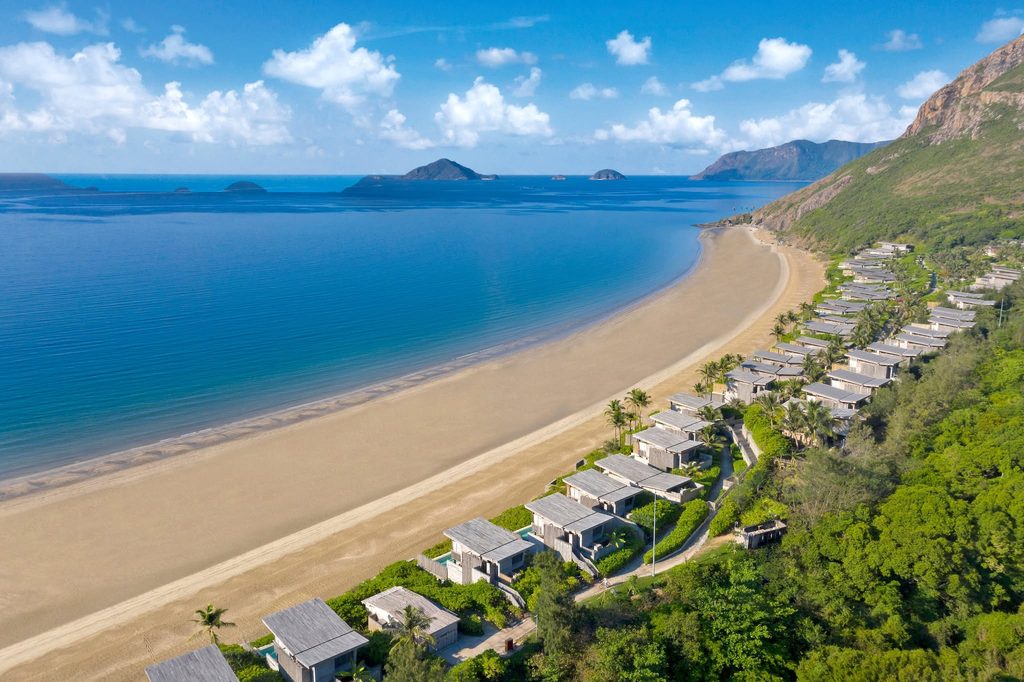
The natural beauty of Đất Dốc Beach
A long sandy beach at the foot of the mountains
Đất Dốc’s most distinctive feature is its long stretch of sand beneath green hillsides.
Viewed from above, the coastline forms a gentle curve between the green forest and blue sea. The mountains behind it are fairly steep, with patches of forest interspersed with natural rock.
On sunny days, the pale sand stands out against turquoise water and densely vegetated slopes.
This landscape feels open without being monotonous. Along the coast, the mountain shapes and the beach’s curve change continually with the viewing angle.
For landscape photographers, Đất Dốc is particularly appealing when seen from elevated viewpoints along the coastal road.
Blue sea and rolling waves
Đất Dốc Beach faces the waters east of Côn Sơn Island. On days with favourable weather, the sea is clear blue, especially beautiful where sunlight reaches the shallow water near shore.
Unlike enclosed bays sheltered on several sides, Đất Dốc Beach can be strongly affected by wind and waves from the open sea.
At certain times of year, waves repeatedly break along the shore, leaving long bands of white foam across the sand.
This is another of the beach’s distinctive qualities. Đất Dốc looks very different on calm days and on days with strong winds.
Do not assume that clear blue water means safe swimming conditions. Check the weather and warning signs, and follow the guidance of the area’s management.
Lò Vôi Mountain and coastal ecosystems
Lò Vôi Mountain is an important part of the landscape around Đất Dốc Beach.
High slopes covered in tropical vegetation extend towards the coast, creating a relatively continuous natural setting between forest and sea.
Beyond their scenic value, Côn Sơn Island’s natural forests help protect the soil, regulate environmental conditions and maintain habitats for many plants and animals.
From Đất Dốc Beach, visitors can clearly see one of Côn Đảo’s notable geographical features: mountains lie very close to the sea, often separated from the water by only a narrow strip of sand or rocks.
This combination gives beaches such as Đất Dốc a character quite different from urban beaches on the mainland.
Six Senses Côn Đảo and Đất Dốc Beach
Any introduction to Đất Dốc Beach would be incomplete without Six Senses Côn Đảo, the luxury resort that runs along the beachfront.
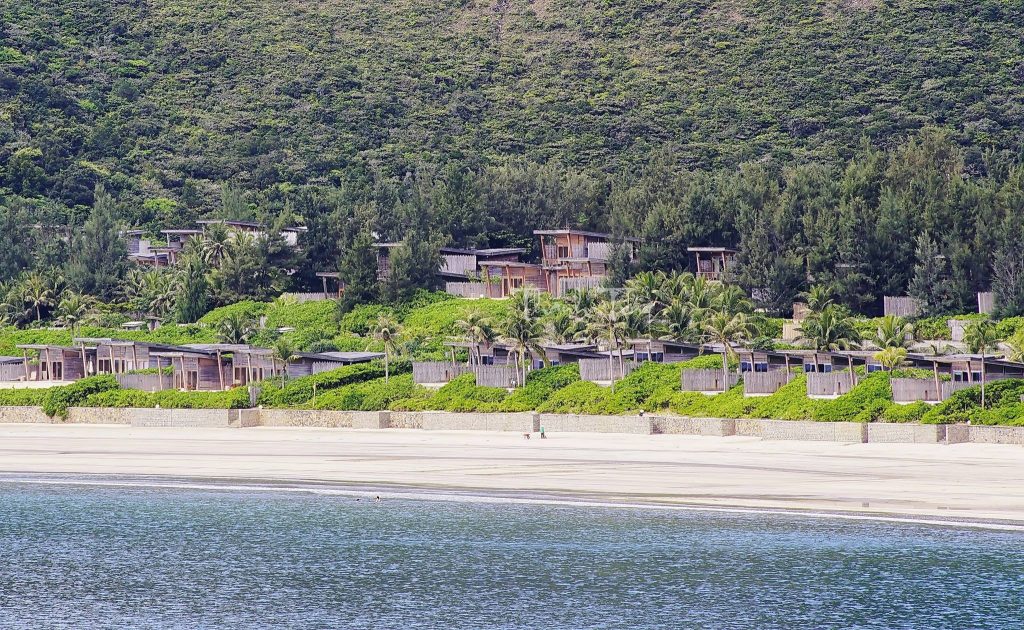
The resort is designed to blend with the natural landscape, drawing inspiration from Vietnamese fishing-village architecture. Villas are positioned along the shore and on the land behind it to make the most of ocean views.
Some of the resort’s notable features include:
- Around 50 villas and villa residences, with many accommodation categories offering private pools.
- Ocean-facing accommodation set between forested mountains and the sandy beach.
- Wellness, dining and nature-based experiences.
- Environmental education and sea turtle conservation programmes in cooperation with Côn Đảo National Park.
In terms of the landscape, the presence of Six Senses associates Đất Dốc Beach with luxury resort tourism and nature conservation.
However, this is not a public swimming beach that visitors can enter freely from any access point.
Can non-residents of Six Senses visit Đất Dốc Beach?
This is an important question for anyone hoping to explore Đất Dốc Beach.
The main access route to the beach is currently managed under Six Senses Côn Đảo’s rules. Non-resident visitors should not assume they can walk freely through the resort to reach the beach.
If you want to use the restaurant or spa, or ask about a possible day visit, contact the resort directly to check its policy for outside guests on your intended date.
Booking an individual service does not automatically grant access to the whole beach area or facilities reserved for staying guests.
Visitors who only want to enjoy the scenery can choose safe public viewpoints along Cỏ Ống Road. From some elevated stretches, Đất Dốc Beach and Lò Vôi Mountain are clearly visible, making them suitable for panoramic photography.
Do not seek shortcuts through the forest, climb down hillsides or cross areas marked with restricted-access signs to reach the beach.
Đất Dốc Beach and sea turtle conservation
One of Đất Dốc Beach’s special qualities is its role in sea turtle conservation.
Côn Đảo is one of Vietnam’s important sea turtle breeding areas, particularly for green turtles. Each year, females come ashore from the ocean onto suitable sandy beaches to dig nests and lay eggs.
Sea turtle nesting has also been recorded at Đất Dốc Beach. This provides an opportunity to combine resort tourism with ecosystem protection and environmental education.
Sea turtles nesting at Đất Dốc Beach
According to Six Senses Côn Đảo, sea turtles come to beaches in the area to nest during the breeding season, mainly in the middle months of the year.
Female turtles usually come ashore when it is relatively dark and quiet. They choose a suitable place on the sand, dig a nest, lay their eggs and return to the sea.
This process can take several hours and is easily disturbed by noise, light or people approaching too closely.
Turtle observation must therefore follow the guidance of trained staff. Do not approach independently or shine lights directly at turtles.
The sea turtle conservation centre at Six Senses Côn Đảo
Six Senses Côn Đảo works with Côn Đảo National Park on a sea turtle conservation programme called Let’s Get Cracking.
An important part of the programme is protecting turtle eggs, managing their incubation and helping hatchlings return to the wild.
Nests at risk from natural conditions or other impacts may be handled according to conservation procedures.
The centre also offers activities introducing the sea turtle life cycle, the threats turtles face and the importance of protecting their habitats.
This is one of the most notable aspects of the conservation-linked resort model at Đất Dốc Beach.
Experiencing the release of turtle hatchlings
For guests staying at Six Senses, a turtle hatchling release can be a special experience if their stay coincides with hatching.
According to the resort’s visitor information, the hatchling release season may run from around May to December, depending on conditions and actual hatching results.
Participants observe the small turtles making their way across the sand towards the sea under the supervision of conservation staff.
However, this is not an activity that can be scheduled at a fixed time or guaranteed to take place every day.
Hatching times depend on nature. Activities must prioritise the hatchlings’ safety and follow Côn Đảo National Park’s guidance.
Visitors must not pick up turtles, change their direction of movement or use flash photography without permission.
Things to experience at Đất Dốc Beach
Walking along the beach
For guests permitted to access the beach, a walk along Đất Dốc is one of the most pleasant experiences.
The long stretch of sand offers plenty of space to enjoy the sea and take in the forested mountain scenery behind it.
In the morning, sunlight creates different shades of blue on the water. As the afternoon progresses, Lò Vôi Mountain becomes more prominent, with areas of light and shade across its slopes.
This suits visitors who want to relax, escape crowded surroundings and spend time observing nature.
Swimming and seaside relaxation
When weather conditions are favourable and management permits it, staying guests can enjoy seaside leisure activities.
However, because it faces the open sea, Đất Dốc can experience strong waves or dangerous currents.
Swimmers must follow safety instructions, stay out of the water in bad weather and avoid swimming far from shore.
Families with young children should maintain constant adult supervision, even when the sea appears calm.
Photographing mountains and sea
Đất Dốc Beach offers many elements for landscape photography: a curved sandy shoreline, blue water, mountain ranges and forest vegetation.
An elevated viewpoint shows the beach’s shape clearly, while a lower angle from the sand emphasises the contrast between Lò Vôi Mountain and the ocean.
Visitors not staying at Six Senses can still look for permitted viewpoints along Cỏ Ống Road.
Avoid stopping vehicles on bends, climbing over barriers or entering dangerous terrain to take photographs.
Learning about sustainable tourism
Beyond leisure activities, the Đất Dốc area is of interest to visitors concerned with environmental protection.
Sea turtle conservation, efforts to reduce impacts on nature and environmental education help visitors understand the relationship between tourism and ecosystems.
Côn Đảo is more than a scenic destination. Its marine environment has exceptional biological value, and tourism development needs to be balanced with conservation.
When should you visit Đất Dốc Beach?
The best time depends on the purpose of your trip.
For relaxation, swimming and enjoying the scenery, prioritise days with a favourable forecast, light winds and calm seas.
Around March to September is often worth considering for sea activities in Côn Đảo. However, rain, wind and wave conditions can change from day to day, particularly during the rainy season.
From around November to March of the following year, the northeast monsoon can bring strong waves to many beaches on the eastern side of Côn Sơn Island.
If you are interested in sea turtles, check the Six Senses conservation programme and its published operating periods in advance. Seeing nesting females or hatchlings on a particular trip is not guaranteed.
For landscape photography from the coastal road, choose clear days with good visibility and make safety a priority when travelling.
How to reach Đất Dốc Beach
From central Côn Đảo
From the central area, follow Cỏ Ống Road towards Côn Đảo Airport.
The route passes forested mountains, blue sea and natural rocky headlands. Đất Dốc Beach lies along this road, in the Six Senses resort area.
You can take a taxi, private car service or motorbike to the area near the beach.
To enter the resort, visitors need an accommodation booking or confirmation of a service booking in accordance with Six Senses’ admission policy.
From Cỏ Ống Airport
Đất Dốc Beach is around 9 km by road from Côn Đảo Airport, depending on the access point.
If staying at Six Senses, contact the resort in advance to arrange an airport transfer.
If you only want to see the roadside scenery, follow Cỏ Ống Road towards the centre and stop where parking is permitted.
From Côn Đảo’s high-speed ferry port
Visitors arriving in Côn Đảo by high-speed ferry should check the exact arrival port on their ticket.
Depending on the route and operator, passengers may arrive at Bến Đầm Port or the passenger port specified in the operating schedule.
From the port, continue by road to the Đất Dốc Beach area.
Book a transfer in advance if travelling in a group or with substantial luggage, especially when the ferry arrives at a busy time.
Places to combine with a visit to the Đất Dốc area
Cape Chim Chim
Cape Chim Chim lies along the Cỏ Ống coastal road and is known for its rocks projecting into the sea.
It is a well-known location for wide ocean views and natural rocky mountain scenery.
Visitors can include views of Cape Chim Chim while travelling between central Côn Đảo and the airport.
Do not climb onto precarious rocks or get too close to cliff edges, particularly in strong winds.
Đầm Trầu Beach
Đầm Trầu Beach lies near Côn Đảo Airport and is one of the island’s best-known beaches.
Unlike Đất Dốc, Đầm Trầu has areas serving ordinary visitors and beachgoers.
Its broad sandy shore, natural rocky headlands, coastal trees and, especially, views of aircraft landing close to the beach make it memorable.
This is a more suitable option for visitors not staying at Six Senses who want to spend time at an accessible recreational beach.
An Hải Beach
An Hải Beach is near central Côn Đảo, making it convenient to reach and visit.
Its scenery differs from Đất Dốc, with residential areas and accommodation close to the shore.
For visitors staying in the centre, An Hải is an option for walking and swimming when weather conditions are suitable.
Important tips for visiting Đất Dốc Beach
Confirm beach access: Đất Dốc Beach is associated with Six Senses resort. Non-residents should ask about the rules in advance rather than arriving and searching for a way down to the sand.
Do not enter the resort without permission: Respect areas reserved for staying guests, restricted-access signs and staff instructions.
Protect the marine environment: Do not litter, discard cigarette filters or leave plastic items on the sand.
Protect sea turtles: Do not approach nesting females, nests or hatchlings without a trained guide. Limit bright lights and noise in conservation areas.
Take care when swimming: Waves and currents can change quickly. Do not swim when warning signs are displayed or weather conditions are unfavourable.
Road safety: Cỏ Ống Road has winding and steep sections, with many sea views. Stop only where permitted and do not obstruct traffic.
Take photographs responsibly: Do not enter private areas, use drones contrary to regulations or disturb wildlife.
Travel to Côn Đảo by high-speed ferry to discover its beaches
Đất Dốc is part of Côn Đảo’s distinctive coastal landscape. Beyond this beach, Côn Sơn Island has many beaches, bays and rocky headlands, each with its own character.
Visitors from the mainland can travel to Côn Đảo by plane or high-speed ferry, depending on their departure point and the transport services available at the time.
Sea routes linking Côn Đảo with the mainland should be checked against each operator’s actual schedule and ticket availability.
After arriving, visitors can plan a route along Cỏ Ống Road, Đất Dốc Beach, Cape Chim Chim and Đầm Trầu Beach, together with visits to the well-known historic sites in the central area.
To plan ahead, check the weather, sailing times, arrival port, transport arrangements and each attraction’s rules before departure.
Fleet information, routes, sailing schedules and reference fares are available from Con Dao Express – https://condaoexpress.com.
Frequently asked questions about Đất Dốc Beach, Côn Đảo
Where is Đất Dốc Beach?
Đất Dốc Beach is in the northeast of Côn Sơn Island, along Cỏ Ống Road, within the Côn Đảo Special Zone, Ho Chi Minh City. It lies in front of the Lò Vôi mountain area and is associated with Six Senses Côn Đảo resort.
Is Đất Dốc Beach freely accessible to visitors?
Access to the beach area is managed by Six Senses under the resort’s rules. Non-residents should contact the resort directly to confirm access and services available to outside guests.
Can you swim at Đất Dốc Beach?
Visitors permitted to use the beach can swim when weather and safety conditions are suitable. Stay out of the water when waves are strong or danger warnings are in place.
Do sea turtles nest at Đất Dốc Beach?
Yes. Sea turtle nesting has been recorded in the Đất Dốc area, which hosts the conservation programme run by Six Senses in cooperation with Côn Đảo National Park.
However, observing nesting females or hatchlings must comply with conservation rules and is not guaranteed on every visit.
Can non-residents of Six Senses join turtle hatchling releases?
The resort manages this activity as part of its conservation programme. Non-residents should ask Six Senses directly about any participation options and requirements for their intended date.
How far is Đất Dốc Beach from Côn Đảo Airport?
Around 9 km by road. Travel time depends on traffic conditions and the pickup and drop-off points.
Is Đất Dốc Beach suitable for children?
Families staying at the resort can choose activities appropriate to children’s ages and the conditions in which they are offered. Adults should supervise children when playing near the sea or joining nature experiences.
Đất Dốc Beach: natural beauty alongside a responsibility to conserve
Đất Dốc Beach clearly illustrates Côn Đảo’s distinctive terrain: forested mountains meet the sea, a long sandy shore runs beneath high slopes and the natural setting retains much of its unspoilt character.
Six Senses creates a particular model of tourism here, linking resort stays with environmental and sea turtle protection programmes.
Whether you only see Đất Dốc from Cỏ Ống Road or stay here for a holiday, you can experience another side of Côn Đảo, where nature is the most striking part of the journey.
Con Dao Express introduces Côn Đảo’s beaches, bays, islands and historic sites, while providing information to help visitors plan their journey to the islands by sea.
Website: https://condaoexpress.com
Google Maps: Đất Dốc Beach
The map marks Đất Dốc Beach, not a confirmed public entrance. Non-resident visitors should contact Six Senses Côn Đảo in advance to confirm access.