
Off the eastern coast of Côn Đảo, Hòn Bảy Cạnh is one of the Côn Sơn archipelago’s most ecologically valuable islands. It is known for Bãi Cát Lớn, the beach where more sea turtles come ashore to nest than anywhere else in Côn Đảo, as well as its pristine mangrove forests, rich coral ecosystems and historic lighthouse built in the late nineteenth century.
While Hòn Cau draws visitors with its unspoilt beaches and the legend of the Betel and Areca, and Hòn Tre Lớn is known as an important sea turtle conservation site, Hòn Bảy Cạnh brings together many remarkable natural features in one place.
Visitors to Hòn Bảy Cạnh can enjoy blue seas and explore tropical forests while also learning about the sea turtles’ nesting journey, the lives of forest rangers and the history of a maritime structure that has stood for more than a century.
It is a destination for nature lovers, those interested in wildlife conservation and anyone hoping to discover a green, peaceful side of Côn Đảo largely untouched by urban development.
Where is Hòn Bảy Cạnh?
Hòn Bảy Cạnh lies east of Côn Sơn Island in the Côn Đảo archipelago, Ho Chi Minh City. With a natural area of approximately 683 hectares, it is the archipelago’s second-largest island after Côn Sơn.
The entire area falls under the management and protection of Côn Đảo National Park.
One distinctive feature of Hòn Bảy Cạnh’s terrain is that its two landmasses are joined by a natural strip of sand known as Bãi Cát Lớn.
Seen from above, the island stands out for its green mountain ridges, small bays, winding shoreline and pale sandy isthmus between two forested areas.
This combination of mountains, forest and sea creates a distinctive landscape and provides habitat for many rare plant and animal species.
Unlike central Côn Đảo, Hòn Bảy Cạnh has not developed as an urban tourism destination. Most of its landscape remains natural forest, beaches and conservation areas with their own access regulations.
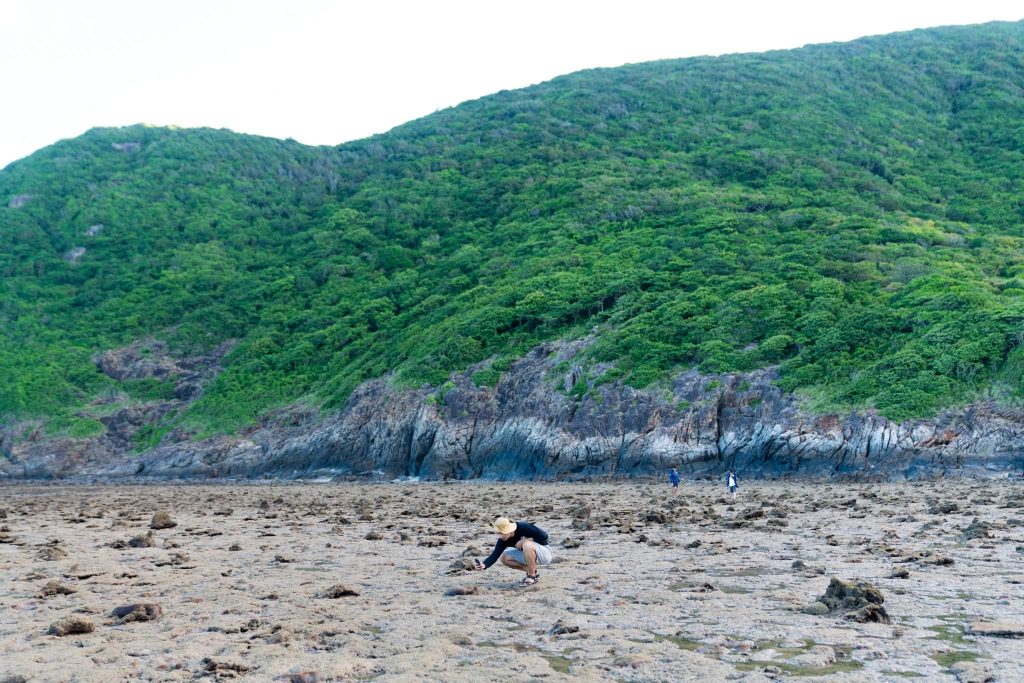
Bãi Cát Lớn: Where sea turtles return to nest
One of Hòn Bảy Cạnh’s most remarkable features is Bãi Cát Lớn, a major sea turtle nesting beach.
According to Côn Đảo National Park, more female turtles come ashore to nest and lay eggs here than on any other beach in the archipelago.
The beach lies between the two parts of Hòn Bảy Cạnh, with terrain that is relatively favourable for turtles coming ashore, digging nests and laying eggs.
During the nesting season, adult female turtles return from the ocean to the beach to continue their species’ natural life cycle.
A female turtle’s journey ashore to lay her eggs
Sea turtles spend most of their lives in the ocean. During the breeding season, however, adult females must return to land to lay their eggs.
On Hòn Bảy Cạnh, this usually happens at night, when the light, tide and environmental conditions are suitable.
After reaching the shore, a female uses her front flippers to move across the sand and find a suitable spot, then digs an egg chamber with her hind flippers.
A female may lay from dozens to more than a hundred eggs in a single clutch, depending on the individual and the species.
She then covers the nest, camouflages the surface of the sand and returns to the sea. The entire process can take several hours and requires considerable effort.
The eggs continue to develop beneath the sand for many weeks. When conditions are right, the hatchlings break out of their shells, emerge onto the sand and begin their journey towards the ocean.
Only a small proportion of hatchlings survive to adulthood, however, as they face many threats from both the natural environment and human activities.
Protecting nesting beaches, egg clutches and sea turtle habitats is therefore especially important.
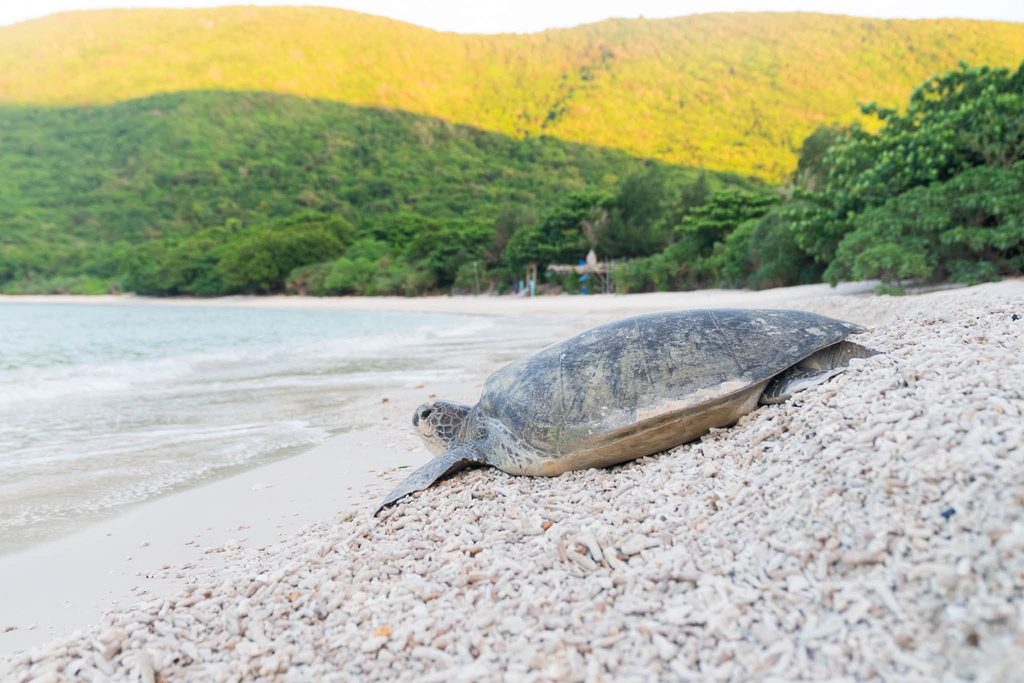
Sea turtle nesting season on Hòn Bảy Cạnh
The sea turtle breeding season in Côn Đảo usually begins around April, continues through the summer months and may last until around October or later, depending on the year.
At peak times, several female turtles may come ashore at Bãi Cát Lớn in the same night.
Even so, the number of turtles appearing varies with natural conditions, tides, weather and the characteristics of each nesting season.
Visitors should not expect turtle nesting observation to be a scheduled show in which animal appearances can be guaranteed.
Instead, it is an opportunity to learn about nature, requiring patience and respect for the conservation team’s instructions.
Sea turtle conservation on Hòn Bảy Cạnh
Hòn Bảy Cạnh is an important site in the sea turtle conservation programme run by Côn Đảo National Park.
Forest rangers and conservation staff patrol the area, monitor nesting females, record nests, protect breeding grounds and help hatchlings return to the sea.
Night patrols on the beach
During the nesting season, sea turtle protection work often continues day and night.
When a female comes ashore, the conservation team monitors the nesting process, records the necessary information and assesses the safety of the nesting site.
Nests at risk of flooding, erosion or other adverse conditions may be relocated to a protected incubation area in accordance with specialist procedures.
This work requires great care to minimise disturbance to the developing turtle embryos.
As well as protecting nests, rangers monitor hatching times, assess conservation outcomes and maintain a safe environment for hatchlings.
Behind the sight of tiny turtles crawling towards the sea lies a great deal of quiet work, from forest protection and beach patrols to waste management and monitoring human activities.
Watching hatchlings return to the sea
Releasing turtle hatchlings into the sea is one of Côn Đảo’s distinctive environmental education activities.
When hatchlings are available and the conditions for organising the activity are met, visitors on an authorised programme can learn about conservation and watch the young turtles begin their journey back to the ocean.
The moment the hatchlings use their front flippers to move towards the water is a memorable sight.
However, the activity must follow the instructions of National Park staff.
Visitors must not pick up hatchlings, place them in the water or interfere with their natural movements without permission.
The aim is not only to offer a visitor experience, but also to raise awareness of wildlife conservation and protection of the marine environment.
Hòn Bảy Cạnh’s mangrove forest: A distinctive ecosystem offshore
In addition to its sea turtles, Hòn Bảy Cạnh is home to a mangrove ecosystem of high conservation value.
At Bờ Đập Beach, a pristine mangrove forest grows on a bed of sand mixed with dead coral, creating a distinctive ecological environment.
According to Côn Đảo National Park’s documentation, the mangrove forest here covers approximately 5.1 hectares.
Although small, the forest plays an important role in connecting tropical forest, mangrove, seagrass and coral reef ecosystems.
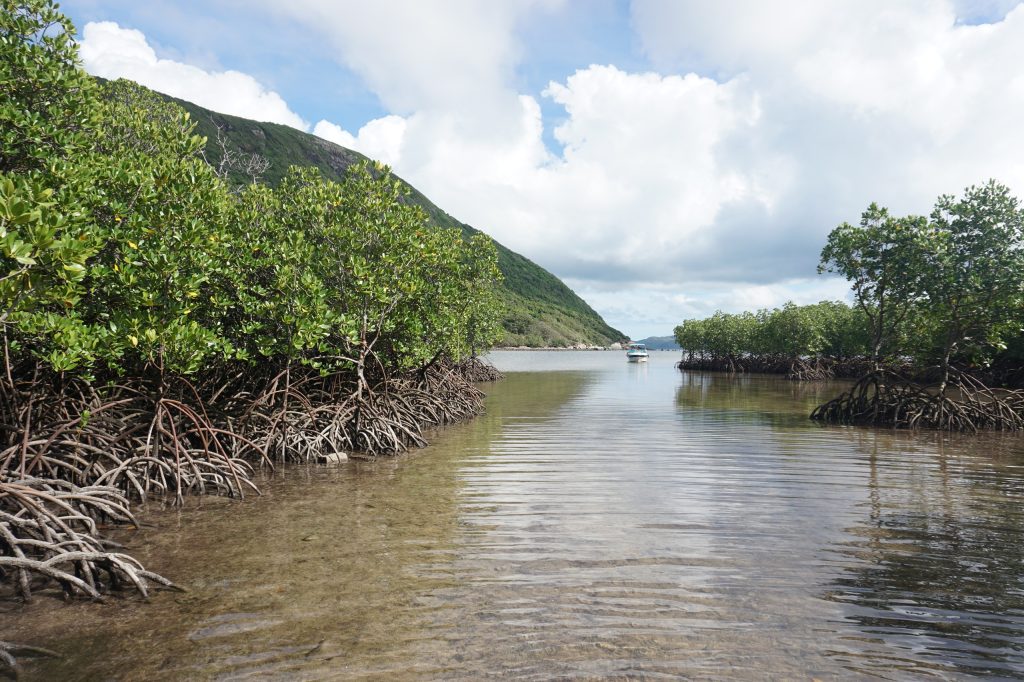
Trees adapted to saltwater conditions
Hòn Bảy Cạnh’s mangrove forest contains characteristic plants known locally as đước đôi, vẹt trụ, vẹt dù, dà vôi and su ổi, along with other salt-tolerant trees.
Their root systems help hold the soil in place, reduce erosion and provide shelter for many organisms.
In particular, the presence of mangroves on a sandy, coral-rich substrate shows how plants adapt to the harsh natural conditions of offshore islands.
Beneath the canopy and in the muddy and sandy areas at the forest’s edge live crabs, shrimp, small fish, molluscs and many other organisms.
Discovering the “tank crab”
One animal that intrigues visitors learning about Hòn Bảy Cạnh is the “tank crab”, a local name for a large land crab.
This crab is distinguished by its hard shell, sturdy body and habit of foraging on land.
It may be seen in forested areas, particularly when environmental conditions are suitable.
However, encountering tank crabs in the wild depends on the time of day and their activity patterns.
Visitors should not dig into burrows, capture crabs or use food to lure them out of their shelters.
Protecting these animals helps maintain balance in the mangrove ecosystem.
Tropical forest and wildlife on Hòn Bảy Cạnh
Most of Hòn Bảy Cạnh is covered in island tropical forest, across terrain ranging from low coastal areas to mountain slopes.
The forest vegetation protects the soil, sustains water sources and provides habitat for many animals.
According to Côn Đảo National Park’s introduction to the island, wildlife includes squirrels known locally as sóc mun and sóc đen Côn Đảo, as well as monitor lizards, pythons, snakes and several species of seabird.
These animals form part of the area’s biodiversity.
While exploring, visitors may hear forest birds, spot animal tracks or encounter small creatures beneath the canopy.
Wildlife must, however, be observed from an appropriate distance.
Do not venture deep into the forest on your own, feed animals or try to approach bird nests or animal dens.
A responsible ecotourism visit helps people learn about nature without changing the behaviour of the animals that live there.
Exploring the coral ecosystems around Hòn Bảy Cạnh
The waters around Hòn Bảy Cạnh are rich in biodiversity, with coral reef and seagrass ecosystems supporting many groups of marine life.
Coral reefs provide shelter, feeding grounds and breeding sites for many fish, bivalves, sea snails, sea cucumbers and other organisms.
In suitable shallow-water areas, visitors can observe coral formations in a variety of shapes and colours.
Snorkelling around Hòn Bảy Cạnh
Among authorised ecotourism programmes, exploring the coral reefs is an activity that interests many visitors.
When the sea is calm and underwater visibility is good, snorkelling with a mask and snorkel offers a chance to see schools of small fish, coral reefs and the habitats beneath the surface.
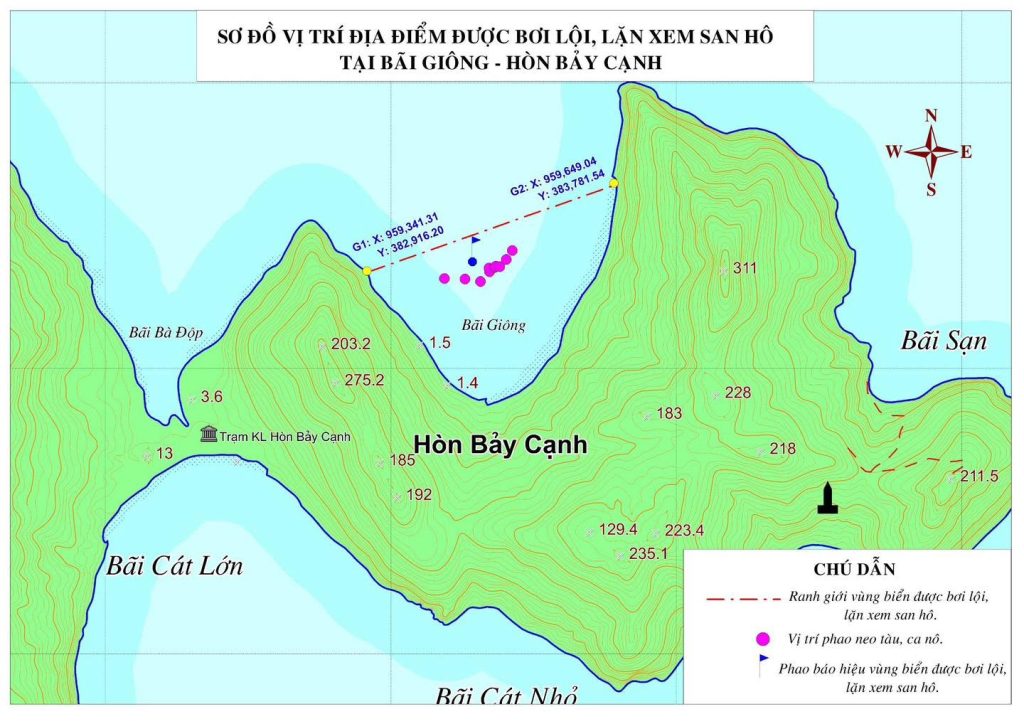
However, tourism activities are not permitted throughout all the waters surrounding Hòn Bảy Cạnh.
Some areas lie within strictly protected or ecological restoration zones, so access and tourism activities must comply with the relevant management regulations.
Visitors must wear life jackets, use suitable equipment and follow the organiser’s instructions.
Above all, never stand on or break coral, catch marine animals or collect specimens to take home.
Bảy Cạnh Lighthouse: A maritime landmark more than 140 years old
Alongside its natural treasures, Hòn Bảy Cạnh is known for its historic lighthouse high in the island’s mountains.
Built by the French in 1884 and brought into service in 1885, Bảy Cạnh Lighthouse is one of the oldest navigational aids in the waters of southern Vietnam.
After more than a century, it continues to play an important role in the maritime navigation system, helping vessels establish their position and find their way through the waters of Côn Đảo.
The architecture of Bảy Cạnh Lighthouse
The lighthouse tower is approximately 16 metres tall, its light-coloured exterior standing out against the sky and forest.
It stands high in the mountains, allowing its light to reach far across the sea.
According to information about the lighthouse, the light’s focal plane is approximately 212 metres above sea level.
Its light characteristic is a group of three white flashes every 20 seconds, helping vessels identify the lighthouse and navigate.
The structure is both an engineering work and a reminder of the history of transport and maritime safety in the waters of Côn Đảo.
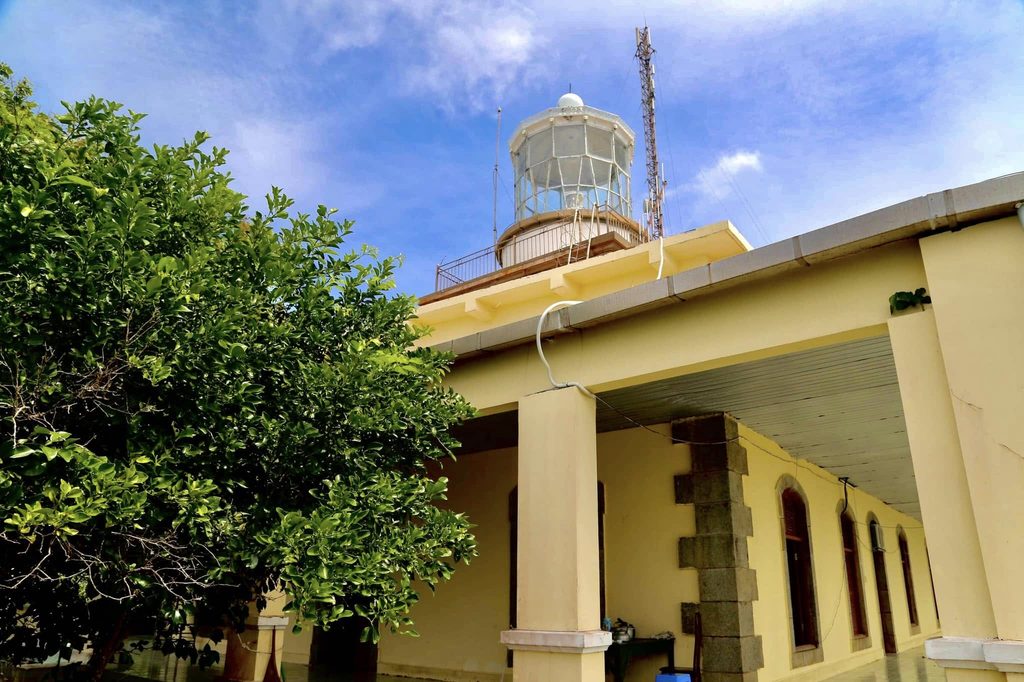
The walk up to the lighthouse
For visitors who enjoy exploring, the route to Bảy Cạnh Lighthouse is a rewarding experience.
From the island’s access area, visitors can follow a trail through the forest and along the mountainside to the lighthouse when the route is open to visitors.
Travel guides describe the walking route as approximately 1.3 kilometres long, with some fairly steep sections and numerous bends.
The walk may take around 30–45 minutes or longer, depending on fitness and actual conditions.
Along the way, the forest canopy provides shade, with occasional openings offering views of the surrounding sea.
At the lighthouse, views open up over forested mountains, small islands and the vast sea.
This is one of Hòn Bảy Cạnh’s outstanding viewpoints.
However, access to the structure, entry into the tower or ascent to the light must follow the instructions of the lighthouse operator and Côn Đảo National Park.
Memorable experiences on Hòn Bảy Cạnh
Hòn Bảy Cạnh offers a range of ecotourism experiences for people who love islands, the sea and nature.
Learning about sea turtle conservation
Visitors can join environmental education programmes to learn about the sea turtle life cycle, nest protection and the work of forest rangers.
This is the destination’s most distinctive activity, with strong conservation and educational value.
Visiting Bãi Cát Lớn
Bãi Cát Lớn has a distinctive landscape and is closely associated with sea turtle nesting.
Visits are controlled to avoid disturbing nesting areas, especially during the breeding season.
Exploring the Bờ Đập mangrove forest
Visitors can learn about a mangrove ecosystem growing on sand mixed with coral, observing salt-tolerant trees and the creatures that live in the forest.
This activity helps explain the relationship between mangroves and the surrounding marine environment.
Snorkelling over coral reefs
In permitted areas and safe conditions, visitors can explore underwater habitats with coral reefs and many species of marine fish.
Trekking to the lighthouse
The route to the lighthouse suits visitors in good health who enjoy walking in nature.
Its appeal lies in the combination of tropical forest, historic lighthouse architecture and elevated views over the islands and sea.
Watching wildlife
With luck, visitors may encounter squirrels, forest birds or other characteristic animals within the visitor area.
Observe them from an appropriate distance without disturbing their habitat.
How to get to Hòn Bảy Cạnh, Côn Đảo
To reach Hòn Bảy Cạnh, visitors must first arrive on Côn Sơn Island.
From there, the journey continues by boat or speedboat on organised, licensed marine ecotourism routes.
The vessel, departure point and travel time depend on the programme, sea conditions and actual operating arrangements.
Because Hòn Bảy Cạnh lies within Côn Đảo National Park, visitors must register with the organiser in advance and complete the required visitor procedures.
Do not independently charter a vessel to land on the island or enter strictly protected areas without approval.
How long does a visit to Hòn Bảy Cạnh take?
According to Côn Đảo National Park’s information about its ecotourism route, a visit may take approximately 4–6 hours.
A day programme can combine sightseeing, beach visits, learning about turtle conservation and exploring marine ecosystems.
Visitors wishing to observe female turtles coming ashore to lay eggs at night must register for a separate programme approved by the managing authority.
Overnight stays are permitted only in the places, at the times and under the conditions specified by the National Park.
Visitors may not independently camp, organise group activities or sleep on the beach.
Can Hòn Bảy Cạnh be combined with other islands?
Depending on the authorised programme and weather conditions, visitors may combine Hòn Bảy Cạnh with other islands such as Hòn Tài or Hòn Cau.
Each island has its own distinctive features:
- Hòn Bảy Cạnh stands out for its turtle nesting beach, mangrove forest and historic lighthouse.
- Hòn Tài offers coastal scenery, coral reefs and ecological features worth exploring.
- Hòn Cau draws visitors with its beach, natural freshwater source, folk legends and historical remains.
Combining destinations requires allowing enough time and following the conservation regulations at each site.
When is the best time to visit Hòn Bảy Cạnh?
The right time to visit Hòn Bảy Cạnh depends on the purpose of the trip.
For coastal scenery, mangrove forests, snorkelling or a trek to the lighthouse, choose days with settled weather and calm seas.
For those interested in sea turtle conservation, the breeding season from around April to October is a particularly relevant period.
However, nesting females and hatchlings are not present every day of the breeding season.
Wind and wave conditions may also require visitor programmes to be changed or temporarily suspended.
It is therefore important to confirm arrangements with Côn Đảo National Park or the organiser before setting out.
Important guidelines for visiting Hòn Bảy Cạnh
Hòn Bảy Cạnh is an area of high nature conservation value. All tourism activities must follow the principle of minimising environmental impact.
Visitors must follow all instructions from forest rangers, especially when approaching areas where sea turtles come ashore to nest.
Do not use flash photography, make loud noises, touch nesting females or dig into nests without permission.
When visiting mangrove and tropical forests, do not break branches, pick plants, catch animals or collect natural specimens.
When snorkelling or diving, keep clear of coral and avoid disturbing marine habitats.
Visitors should also limit single-use plastics, take their rubbish back to the main island and follow safety requirements when travelling by boat or speedboat.
Above all, Hòn Bảy Cạnh should not be treated as an unrestricted tourist beach. It is first and foremost a nature conservation area, where visits take place under specific conditions.
What makes Hòn Bảy Cạnh a special destination in Côn Đảo?
Within the Côn Đảo archipelago, Hòn Bảy Cạnh is important not only for its size, but also for its concentration of ecosystems with conservation value.
On a single island, visitors can learn about island tropical forest, pristine mangroves, seagrass beds, coral reefs and sea turtle nesting beaches.
Each ecosystem helps sustain life, protect the environment and contribute to the biodiversity of Côn Đảo’s waters.
Alongside these natural features, the lighthouse built in 1884 reflects part of maritime history and the human endeavour to navigate the sea routes.
In particular, sea turtle conservation efforts at Bãi Cát Lớn have made Hòn Bảy Cạnh a destination with profound value for environmental education.
Hòn Bảy Cạnh is more than a place to admire blue seas or take beautiful photographs. It is also a place to understand that every protected turtle nest, every preserved coral reef and every conserved forest helps sustain life in the ocean.
For nature lovers wishing to explore Côn Đảo responsibly, Hòn Bảy Cạnh is a particularly worthwhile destination on a journey to the islands and sea.
Sources: Côn Đảo National Park Management Board; Côn Đảo Tourism Information Portal; information on Bảy Cạnh Lighthouse and notices governing sea turtle tourism experiences.