
Hidden among the green forests of Côn Sơn Island, Sở Rẫy is a distinctive destination in Côn Đảo National Park, where visitors can explore a tropical forest ecosystem, discover traces of forced labor under French colonial rule, and admire sweeping views of the islands and sea from above.
Without the long white-sand beaches or turquoise waters found at many other Côn Đảo attractions, Sở Rẫy offers a very different experience. It is a walk beneath the forest canopy, up slopes, accompanied by birdsong, revealing the transformation of a place that has lived through many historical upheavals.
Sở Rẫy is also closely associated with forest restoration after Typhoon Linda in 1997, making it an important site for biodiversity conservation and ecotourism development on Côn Đảo.
Where is Sở Rẫy?
Sở Rẫy is on Côn Sơn Island, within the area managed by Côn Đảo National Park, at an elevation of approximately 260 m above sea level.
It is a relatively flat area amid hilly terrain, covering approximately 20 hectares. Tropical forest surrounds it, creating a cool, green habitat in the heart of the island.
From the vicinity of the Côn Đảo National Park Visitor Center, visitors can follow the indicated route into the forest and continue uphill to Sở Rẫy.
The journey follows stone-paved paths, trails, and slopes beneath the forest canopy. As you climb higher, the surroundings grow quieter, the air becomes cooler, and the natural landscape gradually opens up.
Although it is not far from central Côn Đảo, Sở Rẫy still feels removed from urban life, making it appealing to those who enjoy hiking, exploring nature, and learning about history.
The history of Sở Rẫy: From a forced-labor site to a green heritage
Sở Rẫy under French colonial rule
The history of Sở Rẫy is closely linked to the establishment and operation of the Côn Đảo prison system.
In the early twentieth century, the French colonial authorities organized the clearance of this area, using prisoners to clear forest, prepare the land, and grow crops to meet the island’s needs.
With hilly terrain, harsh weather, and inadequate living conditions, land clearance and cultivation became grueling forms of forced labor.
Prisoners had to work in the forest, transport materials, clear land, and construct buildings for agricultural production.
Over time, Sở Rẫy developed into a relatively level farming area amid the forested mountains.
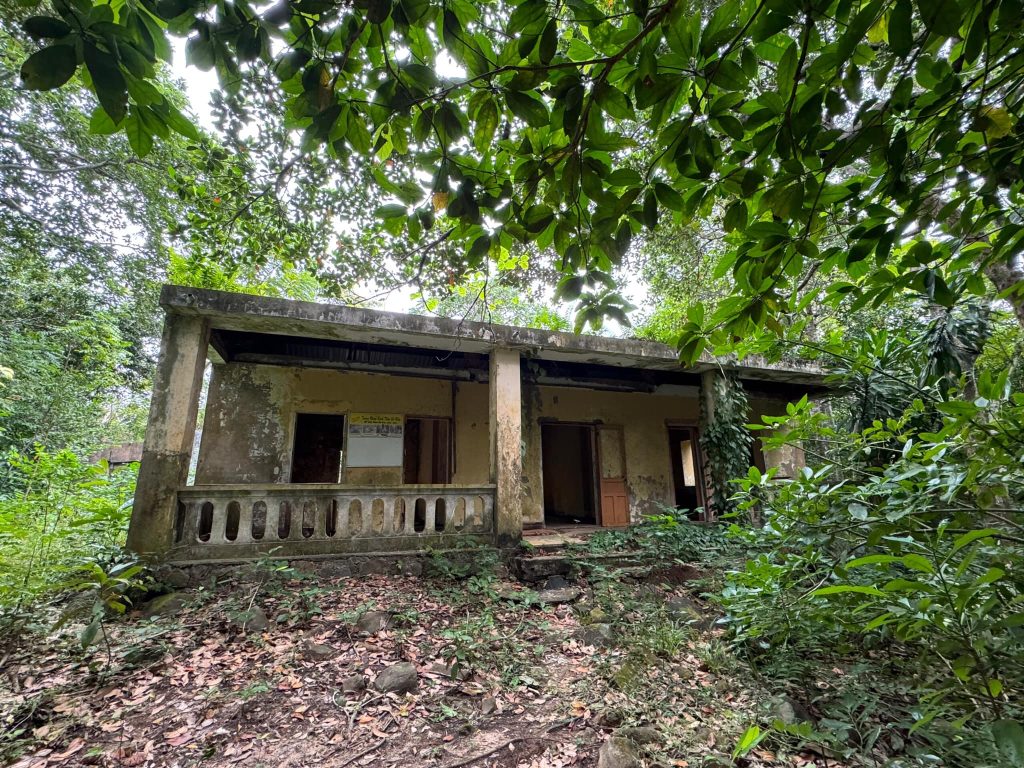
Today, the remains of old stone houses built by prisoners during the French colonial period still bear witness to the area’s past.
Surrounded by flourishing forest, the weathered stone walls create a striking contrast between recovering nature and enduring historical memories.
Old stone houses in the forest
Among the notable sights at Sở Rẫy are the remains of stone structures built during the French colonial period.
The timeworn walls, interspersed with trees and vegetation, recall a period when Sở Rẫy was used for forced labor, land clearance, and cultivation.
Although smaller than the well-known prison camps on Côn Sơn Island, these structures offer another perspective on the history of Côn Đảo Prison.
While camps such as Phú Hải and Phú Sơn, along with the Tiger Cages, reveal the conditions in which prisoners were confined, Sở Rẫy helps visitors understand forced labor outside the prison grounds.
Preserving and interpreting these remains is important for historical education and safeguarding Côn Đảo’s heritage.
Sở Rẫy and forest restoration after Typhoon Linda in 1997
Côn Đảo’s natural environment after the historic storm
In November 1997, Typhoon Linda caused severe damage across southern Vietnam, including Côn Đảo.
The storm affected extensive areas of forest, toppling and breaking trees, damaging vegetation, and disrupting wildlife habitats.
At Sở Rẫy, the storm’s impact created a need to restore the ecosystem, protect rare and valuable plants, and gradually replenish natural food sources for forest wildlife.
In response, the Côn Đảo National Park Management Board launched an ecological reforestation program at Sở Rẫy in 2002.
Planting 8,000 trees to restore the ecosystem
The Sở Rẫy Ecological Reforestation Project ran from 2002 to April 2007, with funding from BP in Vietnam.
According to Côn Đảo National Park’s final project report, 8,000 trees were planted and tended across approximately 20 hectares, comprising:
- 3,750 trees in the rare and valuable plant group.
- 4,250 fruit-bearing trees.
The choice of trees was intended not only to restore damaged forest but also to conserve native plant genetic resources, improve ecological conditions, and provide food for wildlife.
Fruit-bearing trees are particularly important to birds, squirrels, monkeys, and many other forest animals.
Replenishing natural food sources also helps sustain and restore animal populations.
At the same time, Sở Rẫy became a site for scientific research, ecosystem observation, environmental education, and ecotourism development.
From damaged forest to an ecotourism destination
Sở Rẫy’s special value lies in its story of nature’s recovery.
After years of tree planting and care, areas once affected by natural disaster have gradually become green again.
Today, visitors to Sở Rẫy can observe growing forest trees, learn about native plants, and see the role ecological restoration programs play in nature conservation.
Sở Rẫy is therefore more than a forest walking destination. It also demonstrates the long-term efforts to restore habitats for Côn Đảo’s living organisms.
Exploring the tropical forest ecosystem at Sở Rẫy
The rich vegetation of Côn Đảo’s forests
Sở Rẫy is part of an island tropical forest ecosystem, with many species of trees, shrubs, and understory plants.
Visitors can learn about trees characteristic of Côn Đảo’s forests, such as dầu Côn Sơn, lát hoa, and other native species.
Some trees are valuable for conserving genetic resources, while fruit-bearing species provide natural food for animals.
Along the trekking route, layers of greenery create a cool setting, sunlight filters through the canopy, and trails wind with the contours of the land.
At suitable times, visitors may also observe butterflies, insects, and many forms of vegetation characteristic of tropical forests.
Watching Côn Đảo’s black giant squirrels
One of the distinctive animals in the Sở Rẫy area is the Côn Đảo black giant squirrel.
This dark-furred squirrel lives in trees and often moves swiftly among the branches.
For wildlife enthusiasts, catching sight of a squirrel leaping from branch to branch in the canopy is a memorable experience.
Wildlife, however, does not appear on a fixed schedule. Sightings depend on the time of day, weather conditions, and how quiet the forest is.
Visitors should move quietly, keep their distance, and never feed the animals.
Côn Đảo’s long-tailed macaques
Long-tailed macaques are another animal visitors may encounter while exploring Sở Rẫy.
They usually live in troops, feeding and moving through the forest’s layers.
These intelligent animals can adapt to a range of living conditions.
When observing macaques, visitors should keep a safe distance and avoid approaching, teasing, or offering them food.
Feeding wildlife can alter natural foraging behavior and lead to unsafe interactions between animals and people.
Forest birds and smaller creatures
Alongside squirrels and macaques, Sở Rẫy provides habitat for many birds, reptiles, and small animals.
These include the Côn Đảo gecko and many other creatures that contribute to the ecosystem’s diversity.
Birdsong in the canopy, the sounds of insects, and rustling forest leaves create a distinctive experience of nature.
For those interested in photography, birdwatching, or biology, Sở Rẫy is a worthwhile place to consider when visiting Côn Đảo.
Sở Rẫy lookout: Panoramic views of Côn Đảo from above
After the walk through the forest, one of the most appealing rewards is the expansive view from the Sở Rẫy lookout area.
Here, the canopy gradually gives way to views toward central Côn Đảo and the surrounding sea.
From above, visitors can see settlements nestled amid the forested hills, the island’s important freshwater lakes, Côn Sơn Bay, and offshore islands.
On clear days, the scenery is especially striking, combining green mountains and forests, blue seas, and small settlements in the distance.
This is also a popular spot for capturing panoramic photographs of Côn Đảo.
A different perspective on Côn Sơn Island
While exploring Côn Đảo by motorbike or car offers views from the coastal road, Sở Rẫy lets visitors see the island’s terrain from above.
Successive mountain ridges, broad stretches of forest, and low-lying areas near the sea clearly reveal Côn Đảo’s distinctive topography.
From this perspective, visitors can appreciate how closely the forest, sea, and local community’s living spaces are connected.
This is one reason Sở Rẫy is a rewarding trekking destination for those seeking a fuller understanding of Côn Đảo’s natural environment.
How difficult is the Sở Rẫy trek on Côn Đảo?
Sở Rẫy is a forest ecotourism route explored mainly on foot and by hiking uphill.
Although it is not among Côn Đảo’s highest peaks, the route still includes fairly steep slopes, rocky surfaces, steps, and forest trails.
During the rainy season or after heavy rain, the path can be wet and slippery, making progress more difficult.
Visitors therefore need suitable physical preparation and equipment.
This trek is better suited to people in good health who are used to walking and can manage steep terrain.
People with cardiovascular conditions, joint problems, limited mobility, or little hiking experience should consider the route carefully and discuss it with the organizer beforehand.
Families with young children or older adults should choose a program suited to each member’s physical condition.
Combining a Sở Rẫy trek with a visit to Ông Đụng Beach
One notable ecotourism itinerary on Côn Đảo combines Sở Rẫy and Ông Đụng Beach.
After exploring the forest ecosystem and visiting Sở Rẫy, visitors can continue along an authorized route down to Ông Đụng Beach on the western side of Côn Sơn Island.
This journey offers an interesting transition between two characteristic ecosystems: tropical forest and the marine environment.
What makes Ông Đụng Beach worth visiting?
Ông Đụng Beach lies within Côn Đảo National Park and is known for its natural scenery, rocky shoreline, and clear blue water in favorable weather.
Visitors can rest, take in the views, and learn more about the marine environment.
Depending on conditions and the managing authority’s rules, the visit may include swimming or snorkeling to see coral in permitted areas.
Combining a forest trek with time by the sea creates a varied itinerary for those who want to spend more time in nature.
However, the Sở Rẫy–Ông Đụng route should be confirmed with the organizer in advance to check access conditions, timing, and safety.
A guide to visiting Sở Rẫy, Côn Đảo
How do you get to Sở Rẫy?
Visitors can begin near the Côn Đảo National Park Visitor Center, close to the Ma Thiên Lãnh road.
Contact the ecotourism team there for guidance on registering for a suitable route.
Reaching Sở Rẫy mainly involves walking and hiking uphill through the forest. Visitors should go with a national park guide or a guide authorized to lead the route.
Do not leave the trail on your own, enter restricted areas, or trek alone in unfavorable weather.
How long does a visit to Sở Rẫy take?
According to Côn Đảo National Park’s route information, the journey may take approximately 4–5 hours.
The actual duration depends on walking pace, weather conditions, rest stops, and the specific itinerary.
If combining Sở Rẫy with Ông Đụng Beach, allow suitable additional time rather than assuming every activity can be completed within 4–5 hours.
Starting in the morning helps avoid the strongest heat and leaves enough time to return before dark.
What should you prepare?
For a safe and comfortable trip, visitors should bring:
- Trekking shoes or sports shoes with good grip.
- Lightweight, sweat-wicking clothing.
- Personal drinking water and some energy-boosting snacks.
- A hat, a light jacket, and rainwear as appropriate for the weather.
- Insect repellent and personal medical supplies.
- A fully charged phone.
- Swimwear and a towel if the itinerary includes Ông Đụng Beach.
Avoid bringing unnecessary items so that your load stays manageable on the climb.
All waste generated during the trip must be carried out of the forest and disposed of in designated places.
Things to keep in mind when exploring Sở Rẫy
Sở Rẫy is managed by Côn Đảo National Park, so visits must comply with forest protection and nature conservation regulations.
Visitors must not cut trees, collect plants, hunt animals, or remove natural specimens from the forest without authorization.
When encountering monkeys, squirrels, or other animals, keep a safe distance, do not feed them, and avoid loud noises.
Do not climb on deteriorating walls, carve or draw on old stone structures and historical remains, or alter their existing condition.
During heavy rain, strong winds, or unsafe trail conditions, follow the managing authorities’ instructions.
Group arrangements and visitor numbers must comply with the rules in force at the time of registration.
When is a good time to trek to Sở Rẫy?
Sở Rẫy offers different experiences depending on the weather and season.
Dry days with little rain are generally more favorable for forest walking, especially on steep or rocky sections.
Morning is a good time to start, as temperatures are usually more comfortable and there is more time to explore.
After rain, the forest may look lush and fresh, but the trails can also be slippery.
Those interested in birds and wildlife should move slowly, keep noise to a minimum, and take time to observe their surroundings.
Avoid setting your heart on seeing a particular animal, as its appearance depends entirely on its natural behavior.
What makes Sở Rẫy a special destination on Côn Đảo?
Among Côn Đảo’s many well-known attractions, Sở Rẫy has a distinctive appeal through its combination of nature, history, and ecological conservation.
It was once a forced-labor site where prisoners were compelled to clear land and cultivate crops under French colonial rule.
After historical upheavals and natural disasters, the area became a site for forest restoration, the protection of rare plant genetic resources, and the creation of wildlife habitats.
Today, Sở Rẫy gives visitors the chance to experience a journey unlike a typical seaside holiday.
It is a journey along forest paths, past the remains of old stone houses, accompanied by birdsong in the canopy, and culminating in moments spent admiring Côn Đảo from above.
Sở Rẫy is more than a trekking route: it tells a story of the past, the resilience of nature, and the efforts to keep Côn Đảo green.
For those who enjoy exploration, history, and responsible tourism, a walk through the Sở Rẫy forest can be a memorable part of a visit to Côn Đảo.
References: Côn Đảo National Park’s information on the Sở Rẫy ecotourism route; the final report on the Sở Rẫy Ecological Reforestation Project dated 13 July 2007; and Côn Đảo National Park’s publications on forest ecosystems and conservation activities.