
Lê Tự Kình, also known as Lê Kinh Đức, was a revolutionary from Quảng Nam who died at Côn Đảo Prison on 19 June 1964. His life was marked by years of clandestine activity, struggles in prison and close bonds with his comrades. Today, his grave at Hàng Dương Cemetery is a place where visitors to Côn Đảo can pause to remember him and learn about a life devoted to his ideals.
Who was Lê Tự Kình?
Lê Tự Kình was born in Quảng Nam in 1916. He joined the revolutionary movement in 1936 and became a Party member in 1937. From his youth, he was involved in the struggle in his home region, gradually taking on duties entrusted to him by the organization.
Before the August Revolution of 1945, he helped prepare forces for the uprising to seize power. During the subsequent years of resistance, he continued working in Quảng Nam in various positions. Accounts of his life acknowledge his contributions to propaganda and education, and to mobilizing manpower and material resources for the struggle.
Years of clandestine activity in Saigon
After the Geneva Accords of 1954, Lê Tự Kình remained in the South to continue his work. When former resistance cadres were being hunted down locally, the organization transferred him to Saigon.
There, he built a support network among people from central Vietnam living and working in the city. According to accounts of his life, he used a cyclo to travel, enabling him to maintain a lawful public presence while continuing his clandestine work.
The source material also recounts a brief meeting with his youngest child before his arrest. That day, he took the child for a bowl of phở, and then father and child parted. Later, just after his vehicle had passed a six-way intersection, he was arrested by the police.
This small detail reveals a familiar side of the revolutionary’s life: amid dangerous clandestine work, he was still a father who made time for his child. The meeting is recorded in only a few lines, but helps readers understand more deeply the separations that war brought to individual families.
Remaining steadfast through years of imprisonment
Following his arrest, Lê Tự Kình was held at several detention facilities in central Vietnam and Saigon before being exiled to Côn Đảo. Torture and harsh living conditions did not make him abandon his convictions.
At Côn Đảo, he continued taking part in political prisoners’ struggles, resisting coercion alongside his comrades and defending solidarity within the prison. The People’s Army newspaper identifies him as a central figure in the resistance movement during his imprisonment.
His story shows how prisoners’ endurance was also tied to a sense of responsibility for others in the same circumstances. In isolation, maintaining morale and caring for one another gave them support to continue their struggle.
The 1964 hunger strike and his message to his comrades
In 1964, Lê Tự Kình joined a hunger strike by political prisoners at Côn Đảo. The protest took place under brutal prison conditions, when many prisoners’ health had already deteriorated after years of mistreatment.
Day after day, the lack of food, drinking water and care left many exhausted. Even then, fellow prisoners tried to help one another, carefully saving every small amount of water to sustain life.
According to the account of his final days, as his strength ebbed, Lê Tự Kình still thought of the comrades who would remain behind. He told them:
“I am too weak now. Those of you who remain, please look after our comrades and continue the struggle.”
These words express his bond with the group, even as he stood between life and death. His wish was that his comrades would continue caring for one another and remain steadfast in their struggle.
On 19 June 1964, Lê Tự Kình died at Côn Đảo. His date of death is recorded in an article about the ceremony presenting the title of Hero of the People’s Armed Forces to the fallen revolutionary’s family in his home region. (Quảng Nam newspaper, now archived by Đà Nẵng newspaper)
His death marked a painful moment in the history of political prisoners’ struggle at Côn Đảo. The account of his final days also preserves the image of a man who continued to think of his comrades in the harshest circumstances.
Posthumously awarded the title of Hero of the People’s Armed Forces
In 2018, the State posthumously awarded Lê Tự Kình the title of Hero of the People’s Armed Forces, recognizing his contributions and sacrifice.
On 21 July 2018, the ceremony presenting the title to his family was held in his home village of Thanh Quýt, Điện Bàn, Quảng Nam. On this occasion, the local authorities also inaugurated the family memorial house, which commemorates him and his son Lê Tự Nhất Thống.
Lê Tự Nhất Thống was also posthumously awarded the title of Hero of the People’s Armed Forces, in 1994. Father and son belonged to two generations who took part in the revolution, leaving a family story intertwined with the history of struggle in their home region.
Where is Lê Tự Kình’s grave on Côn Đảo?
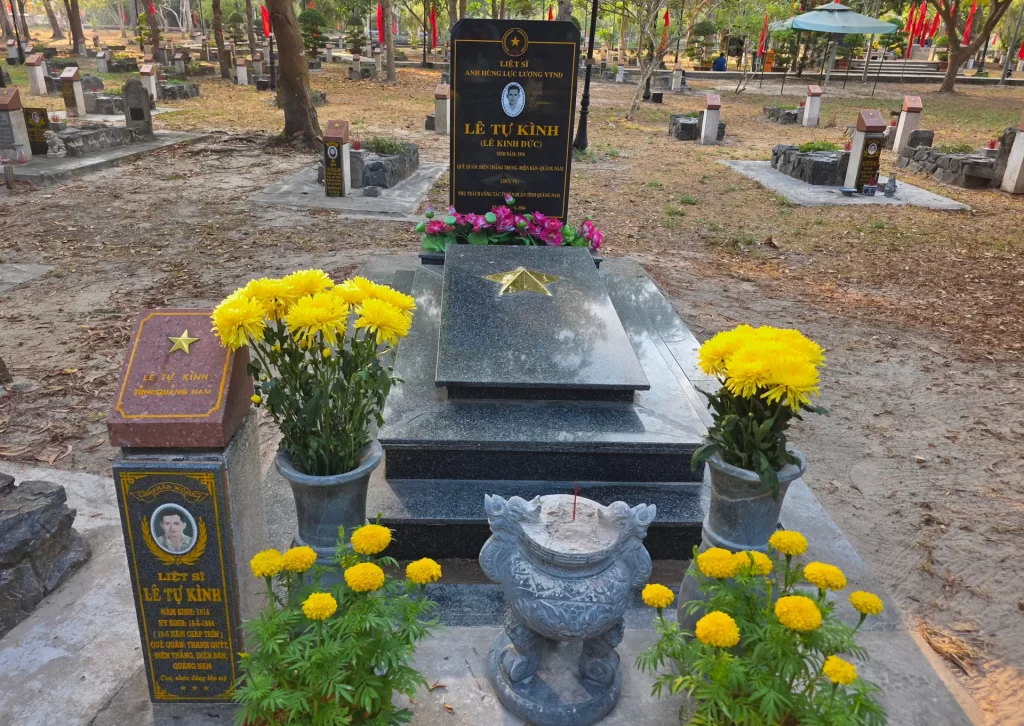
The grave of Hero Lê Tự Kình is in Section C of Hàng Dương Cemetery, Côn Đảo. This location is recorded on the Côn Đảo tourism portal. Section C also contains the graves of many revolutionaries and patriots who died during their years of imprisonment on the island.
Visitors can ask cemetery staff or a guide to help them locate the correct grave. Dress respectfully, speak quietly, and follow the site’s instructions when laying flowers or offering incense.
Taking time to learn about Lê Tự Kình before visiting Hàng Dương adds depth to the visit. The name on the headstone then becomes connected to a hometown, a family, years of activity and a final message to his comrades.
Remembering him is also an opportunity to value the lives woven into Côn Đảo’s history, preserve the memory of sacrifice and better appreciate the peaceful life we have today.
Sources
The original material supplied cites two sources:
- History of the Struggle of Patriots and Revolutionaries at Côn Đảo Prison (1862–1975), National Political Publishing House, 2010, pp. 398–400.
- The dossier for the posthumous award of the title of Hero of the People’s Armed Forces to Lê Tự Kình.
Additional sources used for cross-checking:
- People’s Army newspaper, Father and Son Are Both Heroes, 2018.
- Quảng Nam newspaper, Điện Bàn Presents the Title of Hero of the People’s Armed Forces to Martyrs Lê Tự Kình and Nguyễn Thị Tranh, 24 July 2018, now archived by Đà Nẵng newspaper.
- Côn Đảo tourism portal, Hàng Dương Cemetery: A Sacred Symbol of Revolutionary Tradition, 15 December 2025.