
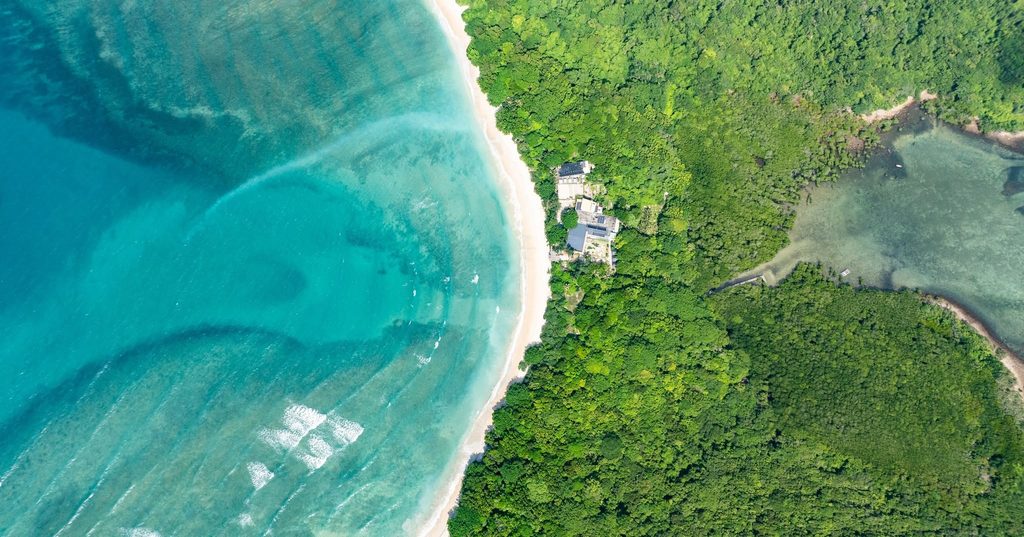
Amid the blue waters of Côn Đảo, Bãi Cát Lớn on Hòn Bảy Cạnh is one of Vietnam’s beaches of exceptional ecological value. Set between two parts of the island covered in tropical forest, its white sand curves along the water’s edge, with clear blue sea in front and hillsides behind that retain their almost untouched natural beauty.
Rather than resorts or recreational facilities, Bãi Cát Lớn is best known for a remarkable natural phenomenon: every year, female sea turtles make hundreds of visits to the sandy beaches of Hòn Bảy Cạnh to nest and lay their eggs.
This area records the highest number of nesting sea turtles in Côn Đảo and is also an important site in the sea turtle conservation program run by Côn Đảo National Park.
A visit to Bãi Cát Lớn offers more than views of an unspoiled beach. Visitors also have opportunities to learn about the sea turtle life cycle, observe conservation work, and explore the mangroves and other ecosystems characteristic of Côn Đảo’s coastal waters.
Where is Bãi Cát Lớn on Hòn Bảy Cạnh?
Bãi Cát Lớn is on Hòn Bảy Cạnh, an island in the Côn Đảo archipelago, Côn Đảo Special Zone, Ho Chi Minh City.
Hòn Bảy Cạnh lies east of Côn Sơn Island. With a natural area of approximately 683 hectares, it is one of the archipelago’s larger islands and is rich in biodiversity.
Hòn Bảy Cạnh consists of two parts connected by a natural sandspit. This connecting area is Bãi Cát Lớn, with its stretch of white sand, coastal vegetation, and environmental conditions suitable for nesting sea turtles.
Most of Hòn Bảy Cạnh is covered in tropical island forest. The area also contains mangroves, coral reefs, seagrass beds, and shallow waters rich in wildlife.
As Bãi Cát Lớn lies within Côn Đảo National Park, visits must comply with conservation regulations. Visitors may not land on the island independently, arrange overnight stays, or enter turtle breeding areas without registering as required.
The natural beauty of Bãi Cát Lớn
A ribbon of white sand between two parts of the island
Bãi Cát Lớn’s most distinctive feature is its geographical setting.
Instead of running along a mountainside or a conventional stretch of coastline, the beach connects two areas of high ground on Hòn Bảy Cạnh.
From above, the sand stands out against the green forest and blue sea. The shoreline curves naturally, while pale blue shallows near the shore gradually deepen in color farther out to sea.
Lush forest grows behind the beach. Viewed from the sea, the forested mountains form an almost continuous backdrop, with few buildings interrupting the landscape.
The scenery is typical of tropical islands, where forested mountains, sandy beaches, and ocean lie close together.
A beach that retains its unspoiled character
Bãi Cát Lớn has not been developed as a mass-tourism beach.
Visitors will not find rows of restaurants, cafés, or crowded recreational activities like those at many other tourist beaches.
Instead, the setting consists of sea, forest, managed trails, and facilities supporting forest rangers and nature conservation.
In favorable weather, the water near the shore is quite clear. Its shades change with the sunlight, depth, and wave conditions.
Along the beach, visitors may see marks left by the waves, natural debris washed ashore, and sometimes sea turtle tracks during the nesting season.
Together, these features create a landscape relatively untouched by conventional tourism.
Tropical forest and coastal ecosystems
Bãi Cát Lớn is surrounded by the natural forests of Hòn Bảy Cạnh.
According to Côn Đảo National Park, the island is home to many animal species, including ebony squirrels, Côn Đảo black squirrels, monitor lizards, pythons, snakes, and birds.
In addition to its hillside forests, the Bờ Đập area of Hòn Bảy Cạnh has natural mangroves growing on sand and dead coral.
Although they cover only about 5.1 hectares, these mangroves play an important role in connecting forest, marine, and intertidal ecosystems.
The combination of tropical forest, mangroves, coral reefs, and seagrass beds makes Hòn Bảy Cạnh an area of exceptional conservation value.
Bãi Cát Lớn: Côn Đảo’s busiest sea turtle nesting beach
No account of Bãi Cát Lớn would be complete without its sea turtles.
Côn Đảo is one of Vietnam’s most important sea turtle breeding areas. Among the archipelago’s nesting beaches, Bãi Cát Lớn on Hòn Bảy Cạnh is consistently recorded as the site with the greatest concentration of nesting females.
The species most often associated with conservation work here is the green sea turtle, known locally as vích, whose scientific name is Chelonia mydas.
These long-lived marine reptiles travel across vast stretches of ocean and characteristically return to suitable sandy coastal areas to reproduce.
Why do sea turtles choose Bãi Cát Lớn to lay their eggs?
Sea turtles need beaches with suitable conditions for digging nests and incubating eggs.
The beach must have suitable sand, be high enough to reduce the risk of seawater flooding the nests, and offer a relatively undisturbed environment.
Bãi Cát Lớn provides many of the natural conditions important for sea turtle reproduction.
In particular, because it lies within a protected area of Côn Đảo National Park, activities that could affect turtles coming ashore are controlled.
During the nesting season, forest rangers patrol regularly, record nesting females, check nests, and carry out the necessary protective measures.
Restricting artificial light, noise, vehicles, and uncontrolled human access is vital to protecting the turtles’ breeding environment.
How do sea turtles come ashore to lay their eggs?
Sea turtles usually come ashore at night, when their surroundings are quiet and conditions are suitable.
On reaching the beach, a female uses her flippers to move to a nesting site. She then digs a pit in the sand, creates an egg chamber, and begins laying.
Depending on the individual, a female may lay anything from dozens to more than a hundred eggs in a single nest.
After laying, she covers the nest with sand and makes her way back to the sea.
In natural conditions, turtle eggs develop beneath the sand, affected by temperature, moisture, and other environmental factors.
When the eggs hatch, the hatchlings make their way from the nest to the surface and then move toward the sea.
However, the period between egg-laying and the hatchlings’ return to the ocean carries many risks. Nests may be affected by weather, seawater, animals, or human activity.
For this reason, conservation work at Bãi Cát Lớn plays an important role in improving the next generation of turtles’ chances of survival.
Hòn Bảy Cạnh Sea Turtle Conservation Station
One meaningful stop at Bãi Cát Lớn is the ranger station and sea turtle conservation facility.
Here, forest rangers conduct patrols, protect nesting beaches, monitor nesting females, record egg numbers, and support incubation and hatching.
Systematic sea turtle conservation in Côn Đảo began in the 1990s and has become an important part of the national park’s work.
Protecting nests and monitoring nesting females
During the breeding season, forest rangers often work at night.
When a female is spotted coming onto the beach, trained staff observe the nesting process, record information, and assess the nest’s location.
After the female has finished laying and returned to the sea, the nest is checked. Nests in locations at risk may be moved to a safe incubation area in accordance with specialist procedures.
Not every nest needs to be moved. Whether a nest is protected in place or relocated to a hatchery depends on the specific conditions.
For visitors, learning about the conservation process provides a better understanding of the challenges involved in protecting wildlife.
The sea turtle hatchery
At conservation stations, nests requiring support may be placed in a managed incubation area.
Conservation staff monitor environmental conditions, incubation periods, and the condition of the eggs to determine appropriate measures.
When the hatchlings emerge, they are checked and their return to the marine environment is organized according to national park procedures.
Visitors may learn about this work through an approved visitor program.
However, visitors may not wander freely around the hatchery, touch eggs, or take hatchlings out to look at them.
Watching sea turtles lay eggs at Bãi Cát Lớn
For many visitors, watching sea turtles come ashore to nest is the most anticipated experience on Hòn Bảy Cạnh.
This activity is usually organized during the breeding season as part of Côn Đảo National Park’s programs.
Because females mainly come ashore at night, visitors wishing to observe them need to register for a program with suitable timing, usually including an overnight stay on the island.
A nighttime turtle-watching visit
After arriving on Hòn Bảy Cạnh, visitors receive a briefing on sea turtle protection rules.
While waiting, the group rests in the area designated by the program.
When forest rangers spot a nesting female on the beach and determine that conditions are suitable for observation, visitors may be guided to the viewing area.
Everyone must remain quiet, move as instructed, and stand in the designated positions.
Visitors must not shine lights on turtles without permission, use flash photography, touch turtles, or obstruct the nesting process.
Observation is permitted only when it does not compromise the female’s safety or breeding behavior.
Are turtle nesting sightings guaranteed?
No.
Although Hòn Bảy Cạnh has the highest number of nesting females in Côn Đảo, their appearance still depends on natural conditions.
Even during the breeding season, the number of turtles coming ashore varies from night to night.
Weather, sea conditions, or conservation requirements may also lead to changes in the observation program.
Visitors should therefore approach this as an opportunity to learn about nature, rather than a service that guarantees a sighting of turtles laying eggs.
Watching hatchlings return to the sea
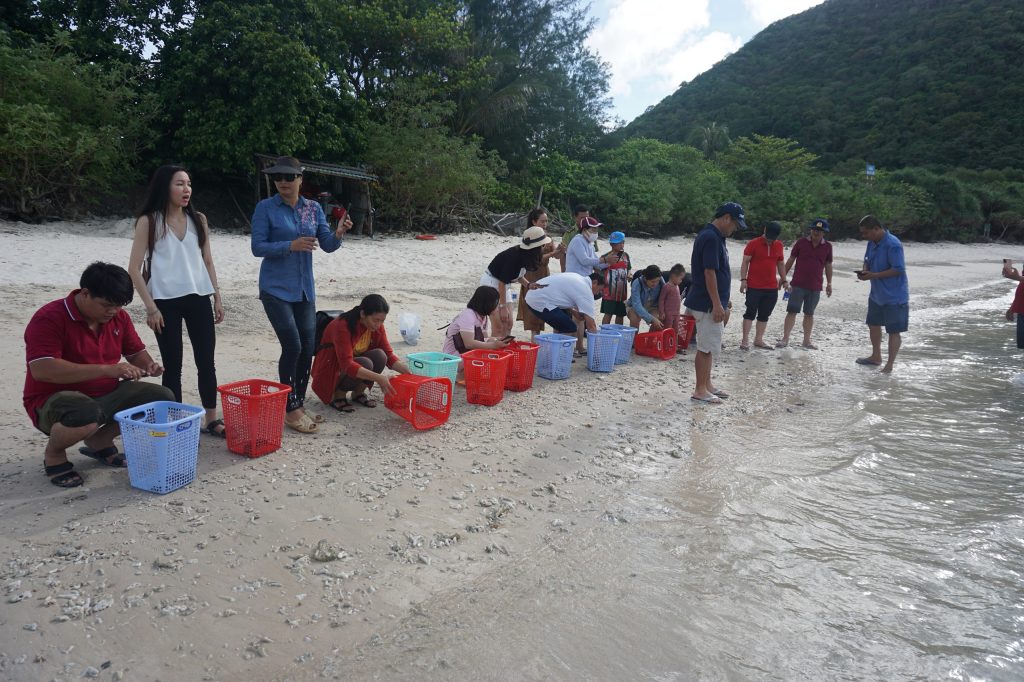
Alongside observing nesting females, the release of hatchlings into the sea is a notable experience on Hòn Bảy Cạnh.
Following incubation, once the eggs have hatched and the necessary conditions are met, conservation staff organize the hatchlings’ return to the marine environment.
This usually takes place in the early morning, when temperatures and environmental conditions are more favorable for the hatchlings.
From the designated area, visitors can watch the tiny turtles move across the sand toward the waves.
This marks the first stage of their struggle for survival in the ocean.
Can visitors hold the hatchlings themselves?
As a rule, visitors may not pick up, catch, or carry hatchlings into the sea without authorization.
Turtle releases must follow specialist procedures and the instructions of conservation staff.
Visitors must not step on turtles, block their path, use lights that interfere with their ability to navigate, or hold them back for photographs.
The purpose of this activity is not to provide photo opportunities. Its first priority is to ensure that hatchlings return safely to the sea.
Can visitors take part in hatchling releases all year round?
No. Hatchling releases depend on the breeding season and when the eggs hatch.
There are not necessarily hatchlings ready for release every day.
Visitors should contact Côn Đảo National Park or an authorized operator in advance to confirm the actual schedule.
Sea turtle nesting season on Hòn Bảy Cạnh
Sea turtles in Côn Đảo usually begin coming ashore to breed around April and may continue until October or November, depending on natural conditions in each year.
June through September is generally recorded as the peak breeding season.
This period is worth considering for visitors wishing to register for a turtle nesting observation program.
However, these months also fall within a period when Côn Đảo may experience rain, thunderstorms, and spells of rough seas.
Weather conditions directly affect boats, speedboats, and visitor programs on the smaller islands.
Visitors should book ahead, monitor the weather, and allow extra time in their itinerary.
If your main aim is to experience sea turtle conservation, prioritize a program confirmed by the national park rather than choosing solely on the basis of advertising or promotional photographs.
Other nature experiences on Hòn Bảy Cạnh
Beyond its sea turtles, Hòn Bảy Cạnh has many natural and scenic attractions.
Visiting the Bờ Đập mangrove forest
The mangroves in the Bờ Đập area are one of Hòn Bảy Cạnh’s distinctive ecosystems.
Unlike the mangrove forests commonly found on muddy estuary soils, those here grow on sand mixed with coral material.
This ecosystem supports many plants adapted to saltwater, along with animals living in the intertidal environment.
On a suitable program, visitors can learn how mangroves protect coastlines, maintain habitats, and support biodiversity.
Snorkeling over coral reefs
The waters around Hòn Bảy Cạnh contain coral reefs supporting many species of marine life.
Depending on the weather and which areas are open to authorized activities, visitors may be able to snorkel to observe the coral and schools of small fish.
Participants must follow the operator’s instructions, use safety equipment, and avoid damaging the reefs.
Do not break or step on coral, or take marine organisms home as souvenirs.
Exploring Hòn Bảy Cạnh Lighthouse
A prominent structure on the island is Hòn Bảy Cạnh Lighthouse, built in 1884 during the French colonial period.
The lighthouse stands in the high hills in the island’s northeast and helps guide vessels through the waters of Côn Đảo.
Reaching the lighthouse may involve walking along a mountainside trail as part of an authorized program.
From elevated viewpoints, visitors can look out across broad stretches of sea and the surrounding small islands.
This activity suits people in good physical condition who enjoy trekking and taking in the scenery.
Before registering, visitors should confirm whether the lighthouse is accessible, how difficult the walking route is, and what safety conditions apply.
How to reach Bãi Cát Lớn on Hòn Bảy Cạnh
Bãi Cát Lớn is on a separate island from Côn Sơn, so it cannot be reached by motorbike or car.
Visitors need to travel by boat or speedboat as part of an authorized excursion.
From central Côn Đảo to the tourist pier
Visitors travel from central Côn Đảo to the meeting point and pier specified by the operator.
There, they receive a briefing on the rules, have their names checked against the passenger list, are provided with life jackets, and board the vessel for the trip to the island.
Do not head to a pier without confirming the pickup location, as Côn Đảo has several piers serving different purposes.
Traveling to Hòn Bảy Cạnh by boat or speedboat
According to a visitor program presented by the national park, the boat journey from the tourist pier to Hòn Bảy Cạnh can take around 45 minutes.
The actual travel time varies with the vessel, weather conditions, wind direction, and operating route.
Along the way, visitors can enjoy views of the sea, islands, and mountainous terrain of the Côn Đảo archipelago.
Upon arrival on Hòn Bảy Cạnh, the group continues its visit under the guidance of the person in charge.
Note: The boats or speedboats used for Hòn Bảy Cạnh excursions are not the high-speed passenger ferries connecting the mainland with Côn Đảo. These are ecotourism services subject to their own operating regulations.
Can you hire a private speedboat to Bãi Cát Lớn?
Visitors can book transport through an operator authorized to run excursions, but this does not mean they can land independently or visit every part of the island.
Bãi Cát Lớn is managed and protected by Côn Đảo National Park.
Access to turtle nesting beaches, conservation station visits, overnight stays, and wildlife observation must be registered with the managing authority in accordance with the rules.
Even when traveling by privately hired speedboat, visitors must complete the required procedures and follow instructions at their destination.
The best approach is to contact Côn Đảo National Park’s Ecotourism and Environmental Education Department in advance to learn about the programs currently available.
Hòn Bảy Cạnh visit costs and registration
The cost of visiting Bãi Cát Lớn depends on the type of program, transport, and accompanying services.
A day trip may include boat or speedboat transport, a guide, admission fees, and permitted nature activities.
An overnight turtle nesting program may involve additional charges for accommodation, nighttime guiding, and other necessary services.
As prices and operating rules can change, visitors should not assume that old price lists found online reflect current charges.
Côn Đảo National Park contact details:
Ecotourism and Environmental Education Department.
Telephone: 0254 3830 669.
Hotline/Zalo/WhatsApp: 0983 830 669.
Email: phongdulichsinhthaivqgcd@gmail.com.
Website: https://condaopark.com.vn
When making an inquiry, ask about your proposed visit date, turtle-watching or hatchling-release programs, fees, transport, visitor capacity, and the policy for weather-related schedule changes.
Suggested itineraries for Bãi Cát Lớn on Hòn Bảy Cạnh
Day-trip option
Morning: Depart from Côn Sơn Island
Meet at the designated point, attend the safety briefing, and travel by boat or speedboat to Hòn Bảy Cạnh.
During the journey, visitors can enjoy views of the sea and nearby small islands.
Arrive on Hòn Bảy Cạnh: Learn about sea turtle conservation
Visit permitted areas and learn about the sea turtle life cycle and the work carried out to protect nests.
If conditions and the program allow, visitors may observe the local ecosystems or a hatchling release on days when one is scheduled.
Continue exploring nature
Visit the mangroves, discover the scenery of Bãi Cát Lớn, and take part in marine activities included in the program.
Then return to Côn Sơn Island according to the boat schedule.
Overnight turtle nesting observation option
Visitors who want to observe sea turtles breeding can register for a stay on Hòn Bảy Cạnh according to the authorized schedule.
Visitors travel to the island, take part in activities introducing its ecosystems, and rest in an area arranged by the managing authority.
In the evening, the group waits for word from the forest rangers. If a female comes ashore and conditions are suitable for observation, visitors are guided to an approved viewing position.
The following morning, the program may include learning about egg incubation and watching hatchlings being released if a release is scheduled, before returning to Côn Sơn Island.
This is only a suggested itinerary. All actual activities must follow the plan confirmed by the operator, and there is no guarantee that turtles will appear or eggs will hatch during your stay.
Rules to follow when visiting Bãi Cát Lớn
Bãi Cát Lớn is a nature conservation area, so environmental protection must take priority during any visit.
Do not approach sea turtles without permission: Keep your distance and do not touch nesting females, hatchlings, or nests.
Limit light and noise: Do not use flash photography or shine lights on turtles without permission during nighttime observation.
Do not camp independently: Stay only in locations and for periods approved by the managing authority.
Do not litter: Take all your rubbish to designated disposal points and limit single-use plastics.
Do not collect marine life: Do not take coral, turtle eggs, or shells containing live animals, or capture wildlife.
Follow instructions: When watching turtles lay eggs or taking part in hatchling releases, visitors must follow national park staff’s directions.
Stay safe at sea: Wear a life jacket as required, follow boarding and disembarking rules, and do not swim far from shore or dive in areas without permission.
These rules are intended not to limit visitors’ experiences, but to protect sea turtle breeding habitats and Côn Đảo’s exceptionally valuable ecosystems.
Which places can you combine with a visit to Hòn Bảy Cạnh?
Hòn Cau
Hòn Cau is one of the beautiful islands of the Côn Đảo archipelago, known for its beaches, natural forest, and coastal ecosystems.
Some ecotourism programs combine Hòn Bảy Cạnh with Hòn Cau, giving visitors more opportunities to explore the island and marine landscapes.
Hòn Cau also has sea turtle conservation activities.
Hòn Tài
Hòn Tài lies in the waters near Côn Sơn Island and is known for its coral reef ecosystems and ecotourism programs.
Excursions may combine Hòn Tài with Hòn Bảy Cạnh, depending on the programs authorized to operate.
Đầm Tre Bay
Đầm Tre Bay lies in the northeast of Côn Sơn Island and is known for its bay scenery, mangroves, and seasonal beds of sargassum seaweed.
It is a suitable choice for visitors who enjoy trekking and exploring natural ecosystems.
Unlike Bãi Cát Lớn on Hòn Bảy Cạnh, Đầm Tre Bay is on Côn Sơn Island and has its own access arrangements.
Đầm Trầu Beach
Đầm Trầu Beach lies near Côn Đảo Airport and is one of the area’s well-known beaches, easy to include in a travel itinerary.
It is better suited to visitors looking to swim, take photographs, and relax as part of a conventional sightseeing trip.
Traveling to Côn Đảo by high-speed ferry to explore Hòn Bảy Cạnh
To visit Bãi Cát Lớn, travelers first need to reach Côn Sơn Island before continuing to Hòn Bảy Cạnh.
From the mainland, visitors can choose air travel or the high-speed ferry routes currently operating to Côn Đảo.
When traveling by sea, check the ferry operator, timetable, departure port, arrival port, and ticket availability at the time of booking.
After arriving in Côn Đảo, visitors can arrange a trip to Hòn Bảy Cạnh through the national park or an authorized tour operator.
If you want to watch turtles nesting overnight, set aside time specifically for this activity rather than scheduling it too close to your departure from Côn Đảo.
Allowing extra time is necessary because speedboat schedules, ecotourism programs, and even the ferry back to the mainland can be affected by the weather.
Visitors can find information on high-speed ferry routes to Côn Đảo, schedules, fares, and notable destinations on the Con Dao Express – https://condaoexpress.com website.
Frequently asked questions about Bãi Cát Lớn on Hòn Bảy Cạnh
Where is Bãi Cát Lớn?
Bãi Cát Lớn is on Hòn Bảy Cạnh, east of Côn Sơn Island, in the Côn Đảo archipelago, Ho Chi Minh City. It occupies the sandspit connecting the two parts of Hòn Bảy Cạnh.
Why is Bãi Cát Lớn famous?
Bãi Cát Lớn has the highest number of sea turtles coming ashore to nest and lay eggs in Côn Đảo. It also offers beautiful natural scenery and protected ecosystems.
When is turtle nesting season at Bãi Cát Lớn?
The breeding season usually begins around April and may last until October or November. June through September generally sees peak nesting activity.
Can you take a speedboat to Bãi Cát Lớn independently?
Visits must be registered and comply with Côn Đảo National Park’s regulations. Visitors may not land independently or enter conservation areas without permission.
Do you need to stay overnight to watch turtles laying eggs?
Females mainly come onto the beach at night, so observation programs usually involve an overnight stay. Accommodation must be registered and arranged in accordance with national park rules.
Can you watch hatchlings return to the sea during the day?
You may be able to join an early-morning hatchling release on days when eggs have hatched and the national park organizes the activity. Programs do not take place every day.
Can children visit Hòn Bảy Cạnh?
Children can join programs appropriate to their age and health, subject to the operator’s conditions. Families should ask in advance about boat journey times, overnight accommodation, and safety requirements.
Is there a lighthouse on Hòn Bảy Cạnh?
Yes. Hòn Bảy Cạnh Lighthouse was built in 1884 and stands in the hills in the island’s northeast. Visits depend on authorized routes and access conditions.
Is Bãi Cát Lớn a public swimming beach?
No. It is part of Côn Đảo National Park and plays an important role in sea turtle conservation. Swimming and other activities are permitted only in authorized areas and at approved times.
Bãi Cát Lớn: Where sea turtles’ journeys continue
For many people, Côn Đảo’s beauty is associated with white sandy beaches, green forested mountains, and clear seas. But at Bãi Cát Lớn on Hòn Bảy Cạnh, nature carries an even deeper meaning.
Each breeding season, female turtles return from the ocean to the beach, find nesting sites, and leave their eggs beneath the sand. After incubation, the hatchlings begin their first journey out to sea.
Behind this seemingly natural process lies the sustained work of forest rangers, conservation staff, and others helping preserve sea turtle breeding habitats.
A visit to Bãi Cát Lớn therefore offers more than photographs of islands and the sea. It is also an opportunity to better understand Côn Đảo’s natural environment and everyone’s role in protecting rare wildlife.
If you enjoy ecotourism, learning about wildlife, and discovering a side of Côn Đảo beyond its familiar destinations, Bãi Cát Lớn on Hòn Bảy Cạnh is worth considering for your itinerary.
Con Dao Express – Connecting the mainland and Côn Đảo
Website: https://condaoexpress.com
Google Maps: Bãi Cát Lớn, Hòn Bảy Cạnh
The map marks the Bãi Cát Lớn beach area on Hòn Bảy Cạnh, not a boat departure point. Visits must be arranged with Côn Đảo National Park or an authorized operator. Confirm the meeting point, transport, and itinerary in advance.