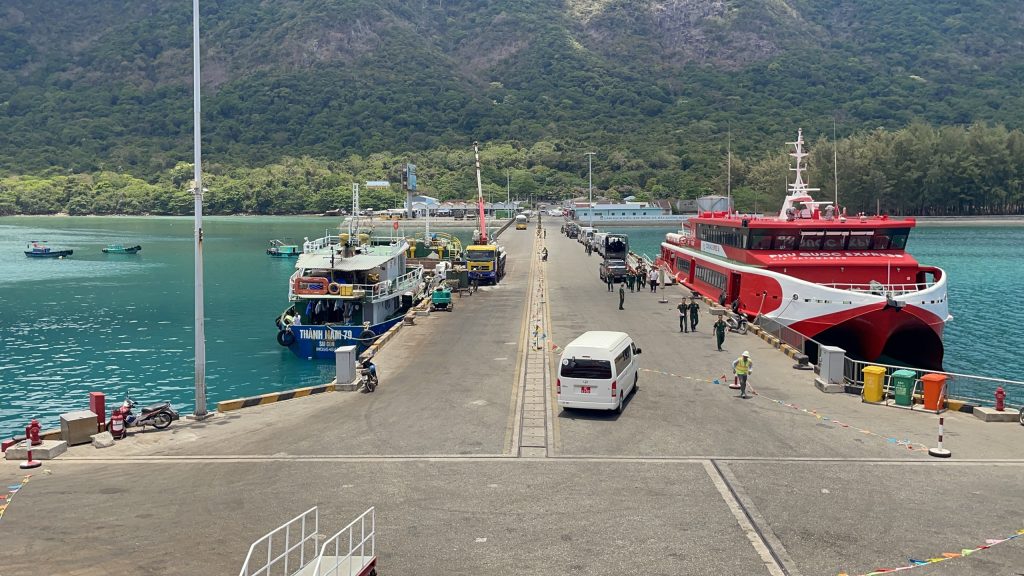
Located in the southwest of Côn Sơn Island, Bến Đầm Bay is one of Côn Đảo’s distinctive bays and plays an important role in the islands’ economy and maritime transport. Surrounded by forested mountains and small islands, its relatively sheltered waters are home to fleets of moored fishing boats and Bến Đầm Port, one of the main gateways bringing passengers and goods from the mainland to Côn Đảo.
Unlike the secluded Đầm Tre Bay or the beach scenery of Đầm Trầu, Bến Đầm Bay has its own appeal. Nature sits alongside the everyday activity of a working harbour, from high-speed ferries carrying visitors to the island and cargo vessels transporting goods to fishing boats returning from offshore trips.
For many visitors arriving by high-speed ferry, Bến Đầm is their first glimpse of Côn Đảo. But if you hurry straight into a vehicle bound for the centre, you may miss one of the island’s scenic and interesting bays.
Where is Bến Đầm Bay?
Bến Đầm Bay lies in the southwest of Côn Sơn Island, within the Côn Đảo Special Zone, Ho Chi Minh City. The bay and Bến Đầm Port are around 12–15 km by road from central Côn Đảo, depending on your starting point, with a typical journey time of about 20–30 minutes.
The bay lies between the forested mountains of Côn Sơn Island and Hòn Bà, sheltered by mountain ranges and small offshore islands.
Its relatively enclosed natural setting has provided favourable conditions for boat anchorage and the development of maritime transport.
The bay has long been part of everyday life for the people of Côn Đảo. Before it began receiving high-speed passenger ferries, Bến Đầm already played an important role in fishing, seafood transport and supplying goods to the island.
Today, the bay is both a scenic natural site and a multipurpose port area, serving passenger vessels, cargo ships, fishing boats and fisheries support services.
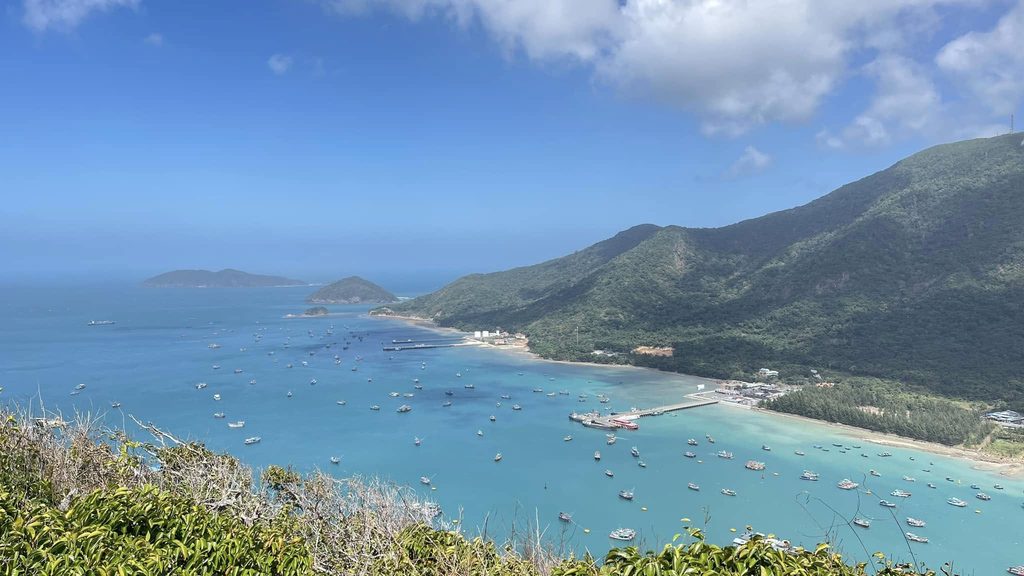
The difference between Bến Đầm Bay and Bến Đầm Port
These two names are often used together, but they do not mean exactly the same thing.
Bến Đầm Bay refers to the entire natural bay, including its waters, surrounding mountains, shoreline, small islands and coastal ecosystems.
Bến Đầm Port is the harbour infrastructure built within the bay to serve passenger and cargo transport, fishing and related services.
A visit to Bến Đầm Bay can therefore involve more than looking around the pier area. Visitors can also explore the coastal road, learn about fishing communities or register for ecotourism programmes to Hòn Bà.
The natural beauty of Bến Đầm Bay
A bay framed by green mountains
What makes Bến Đầm Bay stand out is the way mountains and sea meet across a broad landscape.
From elevated viewpoints, visitors can see the bay stretching between green hillsides. Small islands lie towards the open sea, while piers, the coastline and scattered boats occupy the inner bay.
On clear days, the sea takes on attractive blue tones. The colour varies with depth, light and weather, creating different shades when viewed from the shore or higher stretches of road.
Fishing boats, mooring buoys and port structures add to the landscape’s distinctive character.
Bến Đầm is not a bay completely removed from human activity. The boats and rhythms of maritime life are what make its scenery so lively.
Hòn Bà and the small islands around the bay
One of Bến Đầm Bay’s highlights is Hòn Bà, also known as Hòn Phú Sơn.
It is one of the larger islands in the Côn Đảo archipelago, with forested mountains and diverse natural ecosystems.
Hòn Bà and the nearby coastal mountains help shelter Bến Đầm Bay. Viewed from the port, the island’s ridges form a striking outline against the blue sea.
Beyond Hòn Bà, nearby Hòn Vung and other small islands contribute to the distinctive seascape of southwestern Côn Đảo.
From suitable viewpoints, visitors can take panoramic photographs with boats in the foreground and island mountains in the distance.
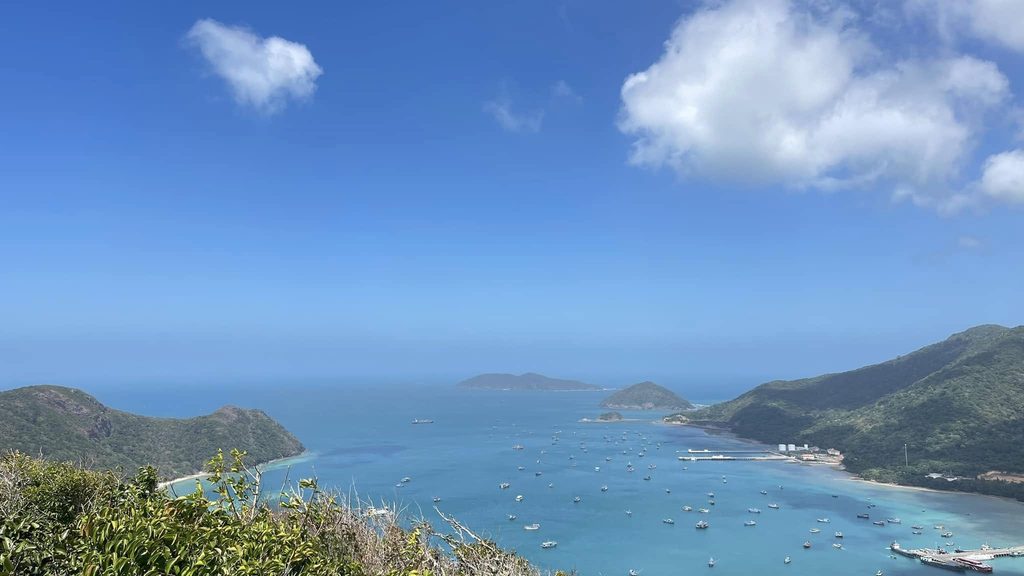
Sunset over Bến Đầm Bay
If you want time to enjoy the scenery rather than simply visiting the port to board a boat, the afternoon is worth considering.
Bến Đầm lies in the southwest of the island, with many suitable places to see the evening light over the sea.
As the sunlight softens, the hillsides gradually darken. Across the water, long reflections stretch between the moored boats.
On days with attractive cloud formations, the sky may turn shades of yellow, orange and pink before nightfall.
Visitors can choose viewpoints along the coastal road, around Bãi Nhát or at permitted sightseeing locations near Bến Đầm.
Do not enter piers where cargo is being loaded or unloaded, or stand on technical infrastructure merely to find a camera angle.
Bến Đầm Port: Côn Đảo’s maritime gateway
For many years, Bến Đầm Port has played an important role in the maritime transport network serving Côn Đảo.
The port receives passenger vessels as well as cargo ships and fishing boats, and supports the supply of equipment, fuel and essential goods to vessels operating in the surrounding waters.
For a place as far from the mainland as Côn Đảo, maritime transport is central to daily life.
Many goods needed for everyday living, construction, production and tourism must be shipped to the islands. In the other direction, seafood caught in Côn Đảo’s fishing grounds is collected, stored and transported through the fisheries support network.
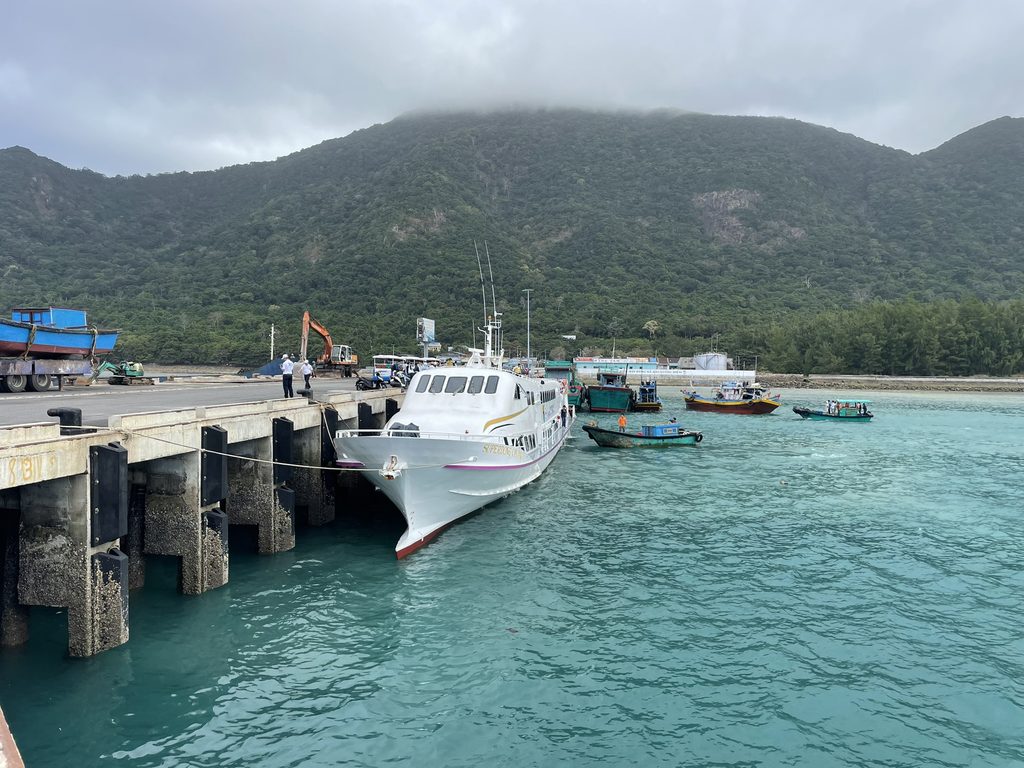
Bến Đầm Port and high-speed ferry routes
Bến Đầm Port is a familiar arrival point for many high-speed ferry routes connecting the mainland with Côn Đảo.
Sea routes associated with this port include Vũng Tàu–Côn Đảo and Trần Đề–Côn Đảo. Actual services depend on the ferry operator, operating schedule, weather conditions and ticket availability.
During the development of passenger sea transport to Côn Đảo, vessels such as Côn Đảo Express 36, Trưng Nhị and Thăng Long have become familiar names to many travellers.
However, visitors should remember that sailing schedules, arrival ports and operating status may change over time.
Côn Đảo also has the Côn Đảo Passenger Port in the central area. This is a different port from Bến Đầm. When booking tickets or arranging a transfer, passengers should check the exact port name shown on their ticket.
Fishing life at Bến Đầm
Alongside passenger transport, Bến Đầm is closely connected with the fishing industry.
From permitted viewing areas near the port, visitors may see moored fishing boats and workers preparing fishing gear, moving goods or carrying out support tasks for the next trip to sea.
These activities offer a glimpse into the everyday lives of Côn Đảo residents.
The sea provides more than beautiful scenery and opportunities for tourism. For many families, it is a source of livelihood built around fishing trips and year-round work.
Visitors interested in local culture can take time to learn about fishing, different types of vessels and the seafood supply trade at Bến Đầm.
Respect the fishermen’s workspace. Do not board boats, enter loading areas or take close-up photographs of workers without permission.
Things to experience at Bến Đầm Bay
Enjoying the scenery and photographing the bay
This is the simplest activity to enjoy when visiting Bến Đầm.
Visitors can stop at safe viewpoints along the coastal road to take in the bay, the mountain ranges and the boats below.
On clear days, good visibility makes it easier to see the shape of the bay and its small islands.
If you enjoy photography, take time to observe the direction of the light and the sun’s position, and choose compositions that include both nature and the working life of the port.
Learning how an island port operates
Not every visitor to Côn Đảo has the chance to observe a multipurpose port in a bay surrounded by mountains.
At Bến Đầm, you can see the differences between high-speed passenger ferries, cargo vessels and fishing boats.
Each type of vessel has its own role and operating characteristics.
Watching port activity from suitable public areas is another way to understand why maritime transport is so important to life in Côn Đảo.
Trying local seafood
Because Bến Đầm is associated with fishing and seafood supply, visitors can explore dining and seafood options at businesses currently operating in the area.
Seafood often associated with trips to Côn Đảo includes marine fish, squid, shrimp, crabs and sea snails.
However, availability, prices and menus change with fishing seasons and catches.
If you plan to buy or eat seafood, choose an establishment that provides clear information, and ask about the price per unit and cooking method before ordering.
Do not buy or sell protected marine species or products obtained through illegal harvesting.
Exploring Hòn Bà on an ecotourism programme
From the Bến Đầm Port area, visitors can join excursions to Hòn Bà organised or authorised by Côn Đảo National Park.
Hòn Bà has significant scenic and biodiversity value.
It contains natural forest ecosystems, the Đầm Quốc mangroves and marine areas with coral reefs.
Depending on the approved programme, visitors may trek through the forest, learn about plants, observe marine life or go snorkelling in permitted areas.
One of Hòn Bà’s highlights is Đỉnh Tình Yêu, or Love Peak, which offers panoramic views over Bến Đầm Bay.
Hòn Bà is managed by Côn Đảo National Park. Visitors must register for a programme and follow the managing authority’s instructions, rather than independently hiring transport to enter protected areas.
Places to combine with a visit to Bến Đầm Bay
Bãi Nhát: a scenic beach on the way to Bến Đầm
Bãi Nhát lies on the road from central Côn Đảo to Bến Đầm and is known for its natural beach scenery and expansive sea views.
It is a favourite stop for many visitors exploring the island’s southwestern coastal route.
Bãi Nhát changes with the tide. At low tide, stretches of sand and shoreline rocks become more visible, creating a scene quite different from high tide.
The area is also associated with historical traces of a prison escape by Côn Đảo’s political prisoners in December 1952.
Visitors passing Bãi Nhát can combine sightseeing and photography with learning about local history.
Mũi Cá Mập: a distinctive viewpoint on the coastal road
Mũi Cá Mập, or Shark Cape, lies on the coastal road linking the central area with Bến Đầm.
The area is distinguished by rocky mountains close to the sea, roads winding around the hillsides and wide views over the water.
This is one of Côn Đảo’s scenic stretches of road, well suited to taking in the mountain and sea landscape.
However, the road has bends and steep sections and may be affected by strong winds. Motorcyclists should watch their speed and avoid stopping on blind bends.
Love Peak: a highlight of Hòn Bà
Love Peak stands on Hòn Bà at approximately 338 metres above sea level.
According to local folklore, the shape of the peaks resembles a young couple together, giving rise to the name Love Peak.
For visitors who enjoy exploring nature, it is a place of notable scenic interest.
From above, you can see Bến Đầm Bay, the port and the surrounding mountain ranges.
Climbing activities must follow a programme approved by the Côn Đảo National Park Management Board.
The Đầm Quốc mangrove forest
Đầm Quốc is on Hòn Bà and is one of Côn Đảo’s mangrove areas of high conservation value.
Its ecosystem provides habitat for many plants adapted to saltwater and for coastal animals.
Đầm Quốc is particularly notable for rare trees, including Bruguiera hainesii, a mangrove species receiving conservation attention.
Visitors can learn about this ecosystem through an appropriate National Park ecotourism programme.
Bến Đầm Bay and the history along the coastal road
Besides its natural and transport importance, the Bến Đầm area is connected with events in the history of Côn Đảo Prison.
During the period when the French colonial authorities ran the prison, the road to Bến Đầm was associated with prisoners’ forced labour.
In particular, an escape attempt was organised in the Bãi Nhát–Bến Đầm area in 1952. Political prisoners secretly prepared the means to attempt an escape by sea.
Although the escape did not achieve its intended aim and lives were lost, it remains a significant event in the history of the Côn Đảo prisoners’ struggle.
Today, a memorial site associated with the 1952 escape stands along this route.
For visitors interested in history, the journey from the centre to Bến Đầm Bay is more than a scenic drive. It is an opportunity to learn about stories connected with the road, the beach and the historical traces still present on the island.
How to reach Bến Đầm Bay
From central Côn Đảo
From the central area, travel towards the southwest of Côn Sơn Island along the road leading to Bến Đầm Port.
This scenic coastal route includes many stretches running close to the foot of the mountains and overlooking the sea.
Along the way, visitors can see Mũi Cá Mập, Bãi Nhát and the outline of Love Peak on Hòn Bà.
The distance is around 12–15 km, usually taking 20–30 minutes by car or motorbike, excluding sightseeing stops.
Transport options
Motorbike: Suitable for visitors who want the flexibility to stop at viewpoints. Make sure the motorbike is in good condition and take care on bends and slopes.
Taxi: Convenient for families, groups travelling with older people or passengers carrying substantial luggage.
Private cars and port transfers: Suitable for those arriving in or leaving Côn Đảo by high-speed ferry. Book ahead and provide the correct port name and sailing time.
Do not enter forest trails or restricted areas around the port without permission.
When should you visit Bến Đầm Bay?
Bến Đầm Bay can be visited for sightseeing at many times of the year, although the experience depends on the weather.
Morning: A good time to observe life around the port, the boats and the mountain and sea scenery while the light is still soft.
Afternoon: Suitable for landscape photography, particularly sunset viewing along the Bến Đầm–Bãi Nhát route.
On days with heavy rain, strong winds or poor visibility, consider changing your plans.
If you plan to take a boat excursion to Hòn Bà or nearby waters, confirm the schedule with the organiser. Sea conditions inside the bay can differ from those offshore.
A suggested afternoon itinerary for Bến Đầm Bay
Visitors can allow around 2–3 hours to explore the scenery around Bến Đầm and the stops along the road.
14:30 – Depart from central Côn Đảo
Travel towards Bến Đầm, enjoy the coastal scenery and choose safe places to stop.
15:00 – Explore the Bến Đầm Bay area
Take in panoramic views of the bay, learn about boat activity and take photographs from public areas where access is permitted.
For a more detailed visit focusing on port operations or fishing, contact a suitable guide or organiser in advance.
16:00 – Explore the coastal road
Head towards Bãi Nhát, learn about the historical sites and enjoy the mountain and sea views along the way.
17:00 – Watch the sunset
Choose a suitable viewpoint at Bãi Nhát or along the Bến Đầm waterfront and wait for sunset.
18:00 – Return to the centre
Finish the trip, have dinner or continue with other activities in Côn Đảo.
The times in this itinerary are suggestions only. Sunset times and lighting conditions vary with the season.
If you book the National Park’s Hòn Bà programme, set aside a separate half-day or full day according to the tour schedule rather than fitting it into a short sightseeing trip.
Important tips for visiting Bến Đầm Bay
Do not swim in the working port area. Passenger vessels, cargo ships and fishing boats enter and leave Bến Đầm Port, so it is not an ordinary swimming beach.
Do not enter piers or board boats without permission. Some locations are subject to security, maritime safety and cargo-handling controls.
Protect the marine environment. Do not litter or throw plastic bottles or food waste into the water.
Respect fishing activities. Do not obstruct port workers or fishermen, or take photographs without permission in areas where restrictions apply.
Pay attention to weather and sea conditions. The water inside the bay may be relatively calm, but that does not mean every sea activity is safe in all conditions.
Check the port name when travelling by high-speed ferry. Bến Đầm Port is different from the Côn Đảo Passenger Port in the island’s centre. Confirm the correct location before booking a transfer.
Reaching Côn Đảo by high-speed ferry and discovering Bến Đầm Bay
For many passengers travelling by sea, their experience of Bến Đầm Bay begins as the ferry approaches the port.
From the vessel, visitors can see the green mountains surrounding the bay, small offshore islands and boats moving across the water.
After the ferry docks, passengers continue to central Côn Đảo or their pre-booked accommodation.
If you have time, set aside part of another day to return to Bến Đầm rather than simply passing through when arriving on or leaving the island.
Passengers travelling to Côn Đảo by high-speed ferry should remember to:
- Check the departure and arrival ports on the ticket.
- Follow the actual sailing schedule, as services may change because of the weather.
- Arrange transfers to match the ferry’s arrival time.
- Arrive at the port before departure as required by the ferry operator.
- Allow extra time on days when sea conditions are unfavourable.
Visitors can find fleet information, sailing schedules, fares and Côn Đảo travel guides at https://condaoexpress.com.
Frequently asked questions about Bến Đầm Bay, Côn Đảo
How far is Bến Đầm Bay from central Côn Đảo?
Around 12–15 km by road, depending on the starting point. The journey usually takes about 20–30 minutes by car or motorbike.
Is Bến Đầm Bay where high-speed ferries dock?
Bến Đầm Port lies within the bay and receives many high-speed ferries, cargo ships and other vessels. However, not every sailing to Côn Đảo necessarily arrives at this port. Passengers should check the arrival port shown on their ticket.
Can you swim in Bến Đầm Bay?
Do not swim in the port area or shipping channels. If you want to swim or snorkel over coral, choose a suitable beach or join an organised activity in a permitted area.
Can you visit Hòn Bà independently?
Hòn Bà is managed by Côn Đảo National Park. Visitors must register and obtain permission to take part in a programme under the park’s regulations, rather than entering protected areas independently.
Is there an entrance ticket for visiting Bến Đầm Bay?
Enjoying the scenery from ordinary public roads does not mean you need to buy an entrance ticket for the whole bay. However, entering the port, using boat transport or joining a Hòn Bà tour may involve fees and separate regulations.
How do Bến Đầm Bay and Đầm Tre Bay differ?
Bến Đầm Bay is in the southwest of Côn Sơn Island and is known for its mountain and sea scenery, port and fishing activities.
Đầm Tre Bay, by contrast, lies in the northeast of the island within Côn Đảo National Park’s nature conservation area. It is known for its mangrove ecosystem, Sargassum seaweed and nature exploration programmes.
The two bays offer very different experiences, and both are worth learning about when visiting Côn Đảo.
Bến Đầm Bay: where nature meets island life
Bến Đầm Bay is more than a high-speed ferry arrival point or a cargo hub for Côn Đảo. It is also a bay with distinctive mountain and sea scenery, closely tied to fishermen’s livelihoods and the development of transport on the island.
Moored boats, green mountains, Hòn Bà, Bãi Nhát and afternoons by the southwestern sea create an intimate picture of Côn Đảo, different from familiar seaside resort areas.
If you arrive in Côn Đảo by sea, take a little extra time to discover Bến Đầm. Beyond its role as a visitor gateway, the bay retains many distinctive features of nature and life on these offshore islands.
Con Dao Express – Connecting the mainland and Côn Đảo
Website: https://condaoexpress.com