
On Nguyễn Văn Cừ Street, among the trees of Côn Đảo, the Sở Lò Vôi historic site is marked by old stone walls, peeling mortar and the remains of a building that has witnessed many historical changes. It has neither the long cell blocks of Phú Hải Prison nor the distinctive iron bars of the French Tiger Cages, yet Sở Lò Vôi remains an important place for understanding prisoners’ lives of forced labour on Côn Đảo.
Built by the French colonial authorities from 1864, Sở Lò Vôi was a lime works where prisoners were forced to extract coral at sea, bring it ashore and burn it into lime for building prisons, houses, roads and other structures on the island.
Behind these old walls are the stories of people made to work in fierce sunlight, spend hours immersed in seawater, handle sharp coral rock and face beatings when they failed to complete their assigned work.
Lime production has now ceased. The surviving structures of Sở Lò Vôi are preserved within the Côn Đảo Prison Special National Heritage Site. They bear witness to a period when prisoners’ labour was exploited to build and maintain the very prison system that held them.
Where is the Sở Lò Vôi historic site on Côn Đảo?
Sở Lò Vôi is on Nguyễn Văn Cừ Street on Côn Sơn Island, in the Côn Đảo Special Zone of Ho Chi Minh City.
Visitors can reach the site from central Côn Sơn by motorbike, taxi or car.
Sở Lò Vôi is part of the network of historic sites associated with Côn Đảo Prison. Unlike many prison compounds concentrated in the central area, however, this site is directly associated with building-material production and outdoor labour.
According to the Côn Đảo Tourism Portal, the site covers approximately 4,966 m². Construction began in 1864, and the facility was renovated and expanded in 1920–1921.
It is one of the surviving traces of the forced-labour establishments that once operated on the island under French colonial rule.
What was Sở Lò Vôi?
To understand the significance of Sở Lò Vôi, it is first necessary to distinguish between prison compounds and forced-labour establishments within the Côn Đảo Prison system.
Compounds such as Banh I, Banh II and Banh III were built primarily to hold and control prisoners.
Labour establishments, by contrast, were places where prisoners were taken to carry out work supporting the prison administration and the island’s construction and production needs.
During the French colonial period, Côn Đảo had around 18 forced-labour establishments, each organised around different tasks.
Sở Muối was associated with salt production. Sở Rẫy served agricultural purposes. Sở Bàn Chế used prisoners’ labour and skills for handicraft and mechanical work. Other establishments were organised to quarry stone, gather firewood, haul timber or perform tasks supporting the everyday needs of the prison authorities.
Sở Lò Vôi specialised in extracting coral and burning it into lime for use as a building material.
The work involved two main stages: collecting coral at sea and loading it into kilns.
The prisoners involved faced arduous working conditions, schedules dictated by the tides and supervision by prison guards.
This role makes Sở Lò Vôi a representative example of the use of forced labour within the Côn Đảo Prison system.
The origins of Sở Lò Vôi from 1864
The context of Côn Đảo Prison’s construction
On 1 February 1862, the French colonial authorities issued a decision establishing a prison on Côn Đảo.
In the early years, the island’s infrastructure was very limited. The colonial authorities needed large quantities of building materials to construct detention areas, barracks, offices, piers and roads supporting their administration.
Côn Đảo lies far from the mainland, making the transport of materials by sea difficult and dependent on weather conditions.
Meanwhile, the waters around Côn Sơn contained coral beds and sources of limestone-bearing material that could be extracted to produce lime.
The colonial authorities exploited these resources, using prisoners’ labour to extract, transport and process them.
The construction of Sở Lò Vôi formed part of the development of facilities supporting Côn Đảo Prison in the early French colonial period.
1864: Establishment of the lime works
According to documentation from the Côn Đảo National Tourism Area Management Board, Sở Lò Vôi was built from 1864.
At that time, the prison system was still taking shape and expanding.
Sở Lò Vôi was used to burn coral into lime, supplying materials for houses, prison compounds and transport infrastructure on the island.
Lime production was inseparable from imprisonment. Prisoners were brought from the detention compounds to the worksite and carried out assigned tasks under guards’ supervision.
Once their work was finished, they remained under the control of the prison system.
Sở Lò Vôi was therefore both a building-material production facility and a place where the forced-labour regime was imposed.
1920–1921: Renovation and expansion
After decades of use, Sở Lò Vôi continued to be adapted to meet the island’s construction needs.
The facility was renovated and expanded in 1920–1921.
These changes reflected its continued use as part of the network of forced-labour establishments.
A notable detail at the site is the date 1920–1921, still recorded on the old structure as a reminder of its expansion.
In subsequent years, coral extraction and lime production continued to serve the demand for building materials on Côn Đảo.
Why were prisoners made to extract coral for lime?
Building with brick and stone requires a binding material, and lime is an important component of traditional construction techniques.
Coral consists primarily of calcium carbonate. When heated to a sufficiently high temperature, this can decompose to form quicklime. The lime is then processed for use in construction.
On Côn Đảo under French colonial rule, extracting coral for lime production was one way to supply materials locally.
This was not voluntary work, however.
Prisoners were compelled to extract coral at the prison authorities’ orders, often in poor weather and without adequate protective equipment.
Once removed from the sea, the coral blocks had to be loaded for transport, brought ashore and carried onward to the kiln area.
This demanded considerable physical effort, especially when handling heavy, sharp-edged coral blocks or pieces firmly attached to the rocky seabed.
Work at Sở Lò Vôi therefore involved much more than operating kilns. It encompassed an entire sequence of strenuous tasks extending from the sea to the production area.
Forced labour at Sở Lò Vôi
According to historical records, labour at Sở Lò Vôi was organised into teams responsible for different stages of the process.
One team specialised in extracting coral at sea. Another transported, processed and burned the coral into lime.
The teams worked under the supervision of prison guards and had to meet assigned quotas.
Prisoner teams extracting coral at sea
Coral extraction was among the most arduous tasks.
According to interpretive material on Côn Đảo, a coral-collecting team usually comprised around 80 people. Other accounts mention teams of 80 to 100 prisoners, depending on the period and how work was organised.
These prisoners had to use rudimentary tools to lever, chisel and detach coral blocks.
The work generally took place on coral beds around 2–3 km offshore.
As the tide receded, prisoners had to find ways to reach coral blocks below the water or within rocky crevices.
They used levers, chiselling tools and physical force to prise the blocks from the rock, then break them into smaller pieces and load them onto barges.
Large coral blocks required several people to coordinate their efforts to lift, lever or move them.
This was extremely dangerous because coral has many sharp edges, while the work often took place on slippery rock and underwater.
Records concerning Sở Lò Vôi describe accidents including falls, crushing injuries from rocks, broken limbs and injuries caused by tools.
Working according to the tides
A defining feature of coral extraction was its dependence on the tides.
Rather than following regular daytime working hours, prisoners had to go out to sea when conditions allowed access to the coral beds.
Some work periods began at night or around dawn.
According to interpretive material from the Côn Đảo Tourism Management Board, some prisoner teams had to start at around 1–2 a.m., or between 11 p.m. and midnight, depending on the tide.
When working at night, they had to carry bundles of torches for light.
A few torches were insufficient to illuminate the entire work area at sea at night, particularly in moving water, rain or strong winds.
Prisoners had to immerse themselves in the water to find and detach coral, often standing in water up to their necks.
These conditions increased the risk of exhaustion, injury and accidents in the water.
Rudimentary tools for extracting coral
Coral extraction relied mainly on physical strength and simple tools.
Historical accounts mention the use of crowbars and chiselling tools to open gaps and separate coral from the rocky bed.
Large coral masses were often joined together and could not easily be lifted by hand.
Prisoners had to find cracks, widen them with tools and insert long levers underneath.
Several people would then combine their strength to lift the coral block.
If a lever slipped or a coral block sprang back, those handling it could suffer serious injuries.
Repeating these movements for hours, underwater and in a state of exhaustion, made the work particularly dangerous.
Coral extraction quotas
Labour was controlled not only through working hours but also through production quotas.
According to the Côn Đảo Tourism Portal, coral-extraction teams were at one time required to supply around four barge-loads of coral each month.
This placed constant pressure on the prisoners.
They had to keep working until the requirement was met, regardless of their health or the weather.
Changes in the tide made extraction and transport more difficult as well.
Prisoners who failed to meet their quotas risked beatings or other disciplinary measures from the guards.
The combination of arduous labour, compulsory quotas and punishment made Sở Lò Vôi an especially harsh place.
From coral blocks to construction lime
After extraction, coral had to be transported and fired before becoming a product that could be used in construction.
Other prisoner teams at Sở Lò Vôi handled these stages.
Bringing coral ashore
After being detached from the rocky bed, coral blocks were loaded onto barges.
Transport depended on the water level and the vessels’ ability to move.
Prisoners had to wait for a suitable tide, load the coral and transport it towards the shore.
On arrival, it was unloaded and taken to the production area.
Every stage required manual effort, especially without the mechanical equipment available today.
The prisoner team working the kilns
According to material introducing the site, a team of around 12 people loaded coral into the kilns and produced lime.
Lime burning requires a high temperature to be maintained for a certain period.
In addition to loading material into the kilns, workers had to handle fuel, monitor the firing process and remove the finished product from the production area.
The high-temperature environment made the work strenuous and posed numerous health risks.
Prisoners worked without adequate protective equipment, under a labour regime determined by the prison authorities.
What was the lime used for?
Lime produced at Sở Lò Vôi was used in many structures on Côn Đảo.
It supplied the construction and repair of prison compounds, homes, administrative buildings, bridges, roads and other works.
From a historical perspective, this reveals a striking paradox of the Côn Đảo Prison system.
People held in captivity were forced to produce the materials used to build and maintain the very structures serving the prison administration.
The old walls at Sở Lò Vôi are therefore more than the remains of a production facility.
They also recall the connection between forced labour, resource extraction and the expansion of the island’s prison system.
Life for prisoners doing hard labour at Sở Lò Vôi
Alongside coral extraction and lime burning, the prisoners’ everyday lives are an important part of the site’s history.
Records of Côn Đảo Prison show that prisoners faced long working hours, inadequate food and accommodation, and punishment by guards.
Long days of labour
Coral extraction could last for many hours, not including the journey from the prison compound to the worksite and back.
For teams working according to the tides, daily routines were frequently disrupted.
Some had to go to sea at midnight; others worked for hours in intense heat, rain or wind.
Travelling, carrying tools, extracting coral and loading and unloading materials greatly depleted the prisoners’ strength.
After their work, they still had to return to the detention compounds and remain under strict control.
Inadequate food and healthcare
According to historical records of Côn Đảo, prisoners doing hard labour often worked without enough food.
The heavy workload was out of proportion to their living conditions and opportunities to recover their health.
Many became severely weakened after prolonged periods of labour.
Injuries caused by coral rock, tools and accidents at sea became more serious because medical care was limited.
In such conditions, illness and inadequately treated injuries could have lasting consequences.
Accidents during coral extraction
Extracting coral involved numerous hazards.
Prisoners worked on uneven, sharp-edged rock while seawater levels could change unexpectedly.
Large coral blocks were extremely heavy and difficult to control when lifted or moved with levers.
Rain and strong winds greatly increased these dangers.
According to interpretive material about the site, many prisoners suffered severe injuries, permanent disabilities or death as a result of their labour and the harsh detention regime.
These losses are an important part of Sở Lò Vôi’s history, although complete and consistent statistics for the number of deaths specifically at this facility are not currently available.
Sở Lò Vôi and solidarity among prisoners
The history of Côn Đảo’s forced-labour establishments records more than coercion and suffering.
Studies of Côn Đảo Prison also show how prisoners tried to maintain collective activities, share knowledge and protect one another in difficult circumstances.
At some labour establishments, including Sở Lò Vôi, prisoners used their breaks to learn to read and write and to share knowledge.
Learning activities had to be organised around working conditions and prison controls.
For those who could not read or had little opportunity for education before their arrest, this offered access to knowledge and a way to sustain their inner lives.
Such small activities reflected prisoners’ efforts to maintain connections, support one another and find ways to endure captivity.
This aspect also deserves attention when learning about Sở Lò Vôi, alongside accounts of strenuous labour and punishment.
Sở Lò Vôi after French colonial rule
After the French colonial authorities ceased administering the prison, some facilities previously used for forced labour were repurposed.
According to the Côn Đảo Tourism Management Board, Sở Lò Vôi was used to station troops during the period when the Republic of Vietnam authorities administered the island.
An additional ancillary building was also constructed in the area.
This change of function reflected the reuse of existing facilities within the prison system.
A place once used to extract and process building materials became a site serving military activities.
Changes in successive periods also meant that the site’s architecture no longer retained its original appearance in full.
When studying Sở Lò Vôi as it stands today, it is therefore necessary to distinguish French colonial remains from features added in later periods.
The old walls of Sở Lò Vôi today
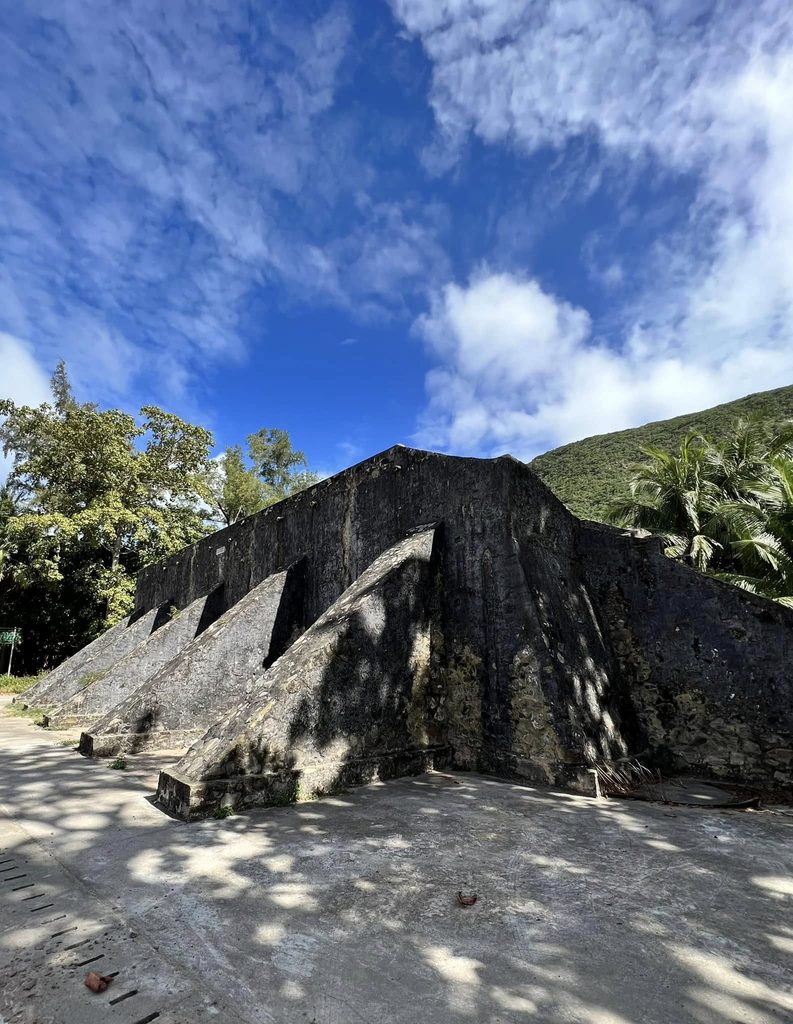
What stands out in present-day photographs of Sở Lò Vôi is not an intact architectural structure but its surviving remains.
Old wall sections, openings, peeling mortar and roofless structures reveal how the building has changed over time.
Unlike fully reconstructed monuments, Sở Lò Vôi has the appearance of a historical ruin.
Stone walls marked by time
Deteriorating layers of building material can be observed on the surviving walls.
Some areas expose the brick and stone beneath, while patches of old mortar have peeled away or changed colour.
Under the effects of sunlight, rain, humidity and the marine environment, moss, stains and signs of weathering have gradually appeared on the surfaces.
These walls give some sense of the scale and architectural form of the facility that once operated here.
However, observing the remains alone cannot establish the exact original function of every opening, section of wall or foundation.
Identifying particular features requires survey records, historical documents and research by the heritage management authorities.
Surviving structural features
Photographs of Sở Lò Vôi show wall sections with rectangular openings, roofs that are no longer intact and surviving load-bearing structures.
These architectural details provide valuable evidence for studying the former building.
Notably, some exterior wall sections are reinforced with sloping masonry supports, creating a form different from ordinary residential buildings.
The surviving structures help visitors recognise a building once used for production, while highlighting the need for conservation in the island’s marine climate.
The value of incomplete remains
A historic building does not have to survive intact to be valuable.
At Sở Lò Vôi, the missing architectural elements also reflect its history of use, changes in function and the effects of time.
What matters is that the remains are documented, surveyed and conserved with respect for their original historical value.
Reconstruction without sufficient evidence could strip the building of features that reveal its true history.
Preserving Sở Lò Vôi therefore requires more than repairing deteriorating walls. It also means conserving physical traces and the documents associated with them.
Why does Sở Lò Vôi have particular value within the Côn Đảo Prison system?
When people think of Côn Đảo Prison, prison compounds, solitary cells and the Tiger Cages often come to mind first.
To understand the prison’s history fully, however, it is also necessary to explore the facilities used for forced labour.
Sở Lò Vôi has its own historical significance, which a visit to the main detention compounds cannot replace.
Evidence of the exploitation of prisoners’ labour
Sở Lò Vôi illustrates the use of forced labour to support construction and the operation of the prison administration.
Prisoners here were not only confined but also compelled to undertake strenuous, dangerous tasks under harsh working and living conditions.
The history of Sở Lò Vôi helps visitors understand more about the work prisoners had to perform outside the prison compounds.
Traces of construction on Côn Đảo under French colonial rule
The lime produced at this facility was used to construct buildings and other works on the island.
This demonstrates the connection between resource extraction, the organisation of labour and infrastructure development on Côn Đảo during the colonial period.
The surviving prison structures therefore reflect not just building activity, but also the effort, hardship and losses of generations of prisoners.
Value for the study of architecture and production methods
Sở Lò Vôi is part of the history of building-material production on the island.
Its remains are valuable for studying building layouts, construction techniques and the organisation of production before modern mechanical equipment was available.
Preserving the site also helps retain physical evidence of a type of labour establishment once common within the Côn Đảo Prison system.
Value for historical education
The story of Sở Lò Vôi can help later generations understand the distinction between voluntary and forced labour.
Its history also recalls the importance of safe working conditions, the right to protection of health and human dignity.
These lessons remain relevant to modern society, extending beyond a historic site associated with the past.
Sở Lò Vôi after 1975 and its conservation
After the liberation of Côn Đảo in 1975, the prison system’s detention and forced-labour operations ended.
The island’s historic structures gradually became subjects of research, protection and heritage interpretation.
Sở Lò Vôi is among the sites preserved within the network of monuments associated with Côn Đảo Prison.
Recognition of its historical value
On 29 April 1979, the Ministry of Culture and Information issued Decision No. 54-VHTT/QĐ, recognising the Côn Đảo Historical and Revolutionary Site as one of the country’s particularly important heritage sites.
On 10 May 2012, the Prime Minister signed Decision No. 548/QĐ-TTg, designating the Côn Đảo Prison Historical Site as a Special National Heritage Site.
Sở Lò Vôi is one of the component sites within the designated complex.
It should be noted that the 2012 decision applies to the entire Côn Đảo Prison Historical Site. It is not a separate designation for Sở Lò Vôi alone.
Conservation challenges
Unlike structures that remain relatively complete, Sở Lò Vôi contains many deteriorating architectural remains.
Conserving such buildings requires attention to the effects of the tropical climate and marine environment.
High humidity, rain, sunlight and salt-laden air can accelerate the weathering of building materials.
Vegetation growing close to the building may also affect old structures if it is not managed appropriately.
Conservation must therefore balance safety, the prevention of further deterioration and the preservation of historically valuable remains.
Learning about and visiting Sở Lò Vôi on Côn Đảo
Sở Lò Vôi is suited to visitors interested in history, architecture and the development of the Côn Đảo Prison system.
Unlike attractions with numerous exhibition rooms, artefacts or reconstructed buildings, Sở Lò Vôi’s value lies mainly in its architectural remains and the history associated with the location.
What should you learn about when visiting Sở Lò Vôi?
Before visiting, it is useful to learn about the roles of forced-labour establishments within the prison system.
This helps explain why Sở Lò Vôi differs from ordinary prison compounds.
When examining the building, look at the old stone walls, openings, load-bearing structures and other surviving architectural features.
It is also worth learning about the process of extracting coral, bringing it ashore and burning it into lime.
Connecting these tasks with the construction of the prison compounds helps clarify the site’s historical significance.
How much time to allow
Visitors who only want to view the exterior remains and learn the basic history can allow around 15–30 minutes.
Those wishing to listen to a guide or explore the subject in greater depth may need longer.
This is only a suggested duration for planning an itinerary, not a fixed requirement set by the management authority.
Can visitors enter Sở Lò Vôi?
Because some parts of the structure have deteriorated, visitors must follow the rules governing which areas are open to them.
Do not enter areas with unstable structures on your own, climb old walls or go inside buildings without safety guidance.
Contact the heritage management authority before your trip to confirm the current opening arrangements and permitted visiting areas.
Photography etiquette
The old walls at Sở Lò Vôi can create distinctive photographs, especially when natural light reveals the textures of stone, brick and weathered mortar.
However, this is a historic site associated with forced labour and the losses suffered by generations of prisoners.
Visitors should photograph the site respectfully, avoiding climbing, disturbing the structures or posing in ways that disrespect its historical setting.
In particular, do not move bricks or stones, remove materials from the site or interfere with structural elements under conservation.
Distinguishing Sở Lò Vôi from Lò Vôi Beach
The name Lò Vôi appears in several place names on Côn Đảo.
Sở Lò Vôi is the historic site associated with coral extraction and lime burning during French colonial rule.
By contrast, Lò Vôi Beach is a coastal location on Côn Sơn Island, known for its seascape and forming part of Côn Đảo’s natural environment.
The two places are connected through their names and the area’s history, but they should not be treated as interchangeable in travel information.
When searching for directions, enter “Di tích Sở Lò Vôi Côn Đảo” specifically to avoid confusion with the beach or other places called Lò Vôi.
Frequently asked questions about Sở Lò Vôi, Côn Đảo
When was Sở Lò Vôi built?
According to the Côn Đảo Tourism Portal, Sở Lò Vôi was built from 1864 and later renovated and expanded in 1920–1921.
Where is Sở Lò Vôi?
The site is on Nguyễn Văn Cừ Street, Côn Sơn Island, in the Côn Đảo Special Zone of Ho Chi Minh City.
How large is Sở Lò Vôi?
According to interpretive material about the site, the grounds of Sở Lò Vôi cover approximately 4,966 m².
What work were prisoners forced to do at Sở Lò Vôi?
Prisoners were forced to extract coral at sea, bring it ashore and burn it into lime for use as a building material.
What was the lime produced here used for?
It was used to build and repair prisons, houses, roads and other structures on Côn Đảo.
Why was coral extraction dangerous?
Prisoners had to work underwater, using rudimentary tools to detach heavy, sharp-edged coral blocks. The work depended on the tides and could take place at night or in poor weather, increasing the risk of accidents and exhaustion.
Was Sở Lò Vôi a prison compound?
Sở Lò Vôi was primarily a forced-labour facility producing building materials within the Côn Đảo Prison system. It was linked to the detention and control of prisoners, but differed from main prison compounds such as Phú Hải or Phú Thọ.
Is Sở Lò Vôi part of a Special National Heritage Site?
Yes. Sở Lò Vôi is a component of the Côn Đảo Prison Historical Site, designated a Special National Heritage Site by the Prime Minister under Decision No. 548/QĐ-TTg dated 10 May 2012.
Does Sở Lò Vôi still operate today?
No. The extraction of coral and production of lime for the prison system have ended. The surviving remains are now preserved as part of Côn Đảo’s historic heritage complex.
Sở Lò Vôi: Surviving walls that tell a historical story
On present-day Côn Đảo, where roads have changed and local life is connected with tourism, services and nature conservation, the old walls of Sở Lò Vôi remain notable traces of an earlier period.
The sound of chiselling tools, barge-loads of coral and kilns serving the prison administration are gone, but the site’s history survives in documents and its remaining architecture.
Sở Lò Vôi gives visitors a fuller understanding of Côn Đảo Prison. Beyond its cells and isolation compounds lay an entire system of forced labour, in which prisoners’ strength was used to produce materials, build and maintain structures on the island.
The site’s value lies not in grand scale or perfectly preserved architecture, but in the stories of the people, work and living conditions once associated with this place.
Learning about Sở Lò Vôi also reveals that Côn Đảo’s history is not told through prison compounds alone. Sometimes an old stone wall, a building foundation or the remains of a kiln can help people today gain a deeper understanding of the past.
Con Dao Express introduces Côn Đảo’s historic sites, cultural buildings and natural destinations, while also providing information on high-speed ferry routes, schedules and indicative fares to help visitors prepare for their journey around the island.
Reference sources
Côn Đảo Tourism Portal: Sở Lò Vôi Historic Site.
Côn Đảo Tourism Management Board: Lò Vôi Historic Site Visitor Attraction.
Côn Đảo National Heritage Conservation Centre: List of component sites within the Côn Đảo Prison Special National Heritage Site.
Prime Minister’s Decision No. 548/QĐ-TTg of 10 May 2012 on the designation of Special National Heritage Sites.
Google Maps: Sở Lò Vôi
The map shows the site’s location. Confirm the entrance and visiting hours with the site management before you go.